CM Siddaramaiah gives clarion call to make Kannada state's 'business language'
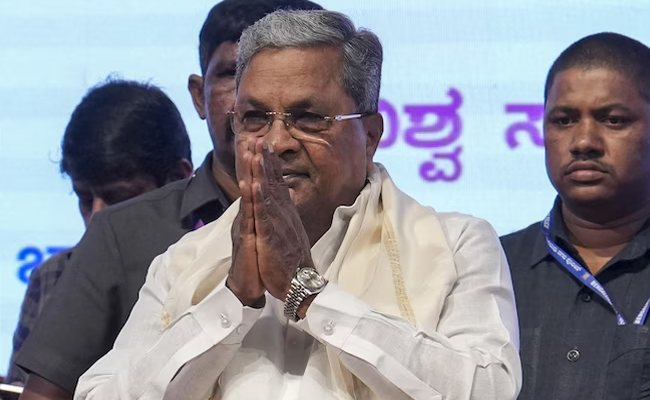
Raichur (Karnataka) (PTI): Chief Minister Siddaramaiah on Saturday gave a clarion call to the people of Karnataka to make Kannada their 'business language'.
Speaking at an event to celebrate 50 years of naming the erstwhile Mysore state as Karnataka, the CM appealed to people to make Karnataka a Kannada state.
"All the people living here are Kannadigas. No matter what your home language is, the ‘business language’ should be Kannada. Kannada should be the main and first language in the state," he said.
"Learn every language, but Kannada should be the official language in the state," he added.
Dwelling on the Gokak agitation, which was related to granting Kannada the first language status in the state, the chief minister said the 'Kannada Kavalu Samiti' was formed to create an atmosphere for Kannada to prosper in Karnataka. Later, the committee became the Kannada Development Authority, he explained.
Siddaramaiah asked people to respect all languages, learn as many languages as possible but never be generous to give up Kannada, the language of this land.
On the occasion, the chief minister felicitated senior Kannada activists and leaders of the Gokak agitation.
Let the Truth be known. If you read VB and like VB, please be a VB Supporter and Help us deliver the Truth to one and all.
Vice president releases latest edition of Constitution in Sindhi
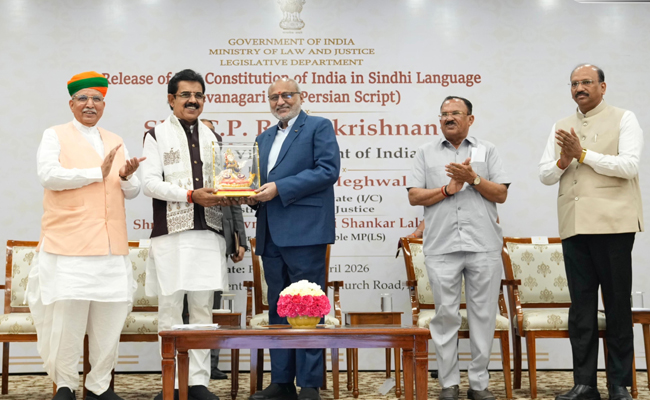
New Delhi (PTI): Vice President C P Radhakrishnan on Friday released the latest edition of the Constitution in Sindhi language, in both Devanagari and Persian scripts here.
Addressing a gathering, the vice president extended greetings to the Sindhi-speaking community on the occasion of Sindhi Bhasha Diwas.
He described Sindhi as one of the oldest and most melodious languages, noting that its literary tradition reflects a unique confluence of Vedantic philosophy and Sufi thought, promoting universal values of oneness, love, and brotherhood.
Highlighting the significance of the occasion, he said that the release of the Constitution in Sindhi, particularly in the Devanagari script for the first time since Independence, marks an important milestone in promoting linguistic inclusivity.
He emphasised that the Constitution is not merely a legal document but the living spirit of the nation, embodying its aspirations, safeguarding rights, and guiding democratic governance.
He observed that India stands unique in making its Constitution available in a wide range of languages and recalled similar initiatives undertaken in recent years, including translations in Bodo, Dogri, Santhali, Tamil, Gujarati, and Nepali. These efforts, he said, celebrate India’s linguistic diversity and reinforce democratic values.