Commercial LPG price hike 'direct blow' to common man: CM Siddaramaiah
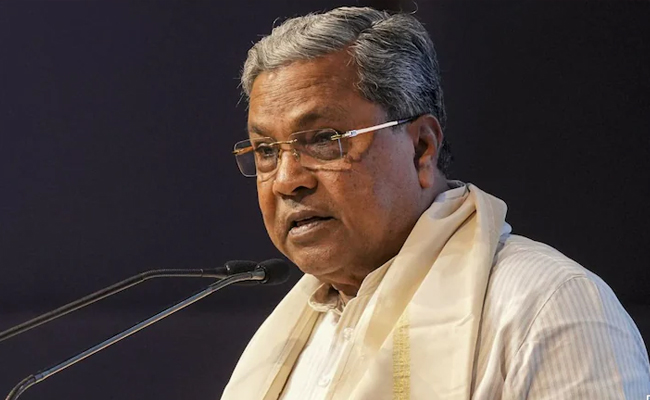
Bengaluru (PTI): Karnataka Chief Minister Siddaramaiah on Thursday launched a sharp attack on the union government over the recent hike in commercial LPG cylinder prices, calling it a "direct blow" to the common man and warning that rising fuel and tax burdens were quietly fuelling inflation and hurting livelihoods.
In a post on social media platform X, the Chief Minister said the increase would severely impact tea shops, darshinis (Quick service restaurants), small hotels, bakeries and street vendors, who depend heavily on commercial LPG, and accused the Centre of pursuing selective economic logic while burdening citizens.
"The recent hike in commercial LPG cylinder prices by about Rs 111 is a direct blow to the common man. Tea shops, small hotels, bakeries and street vendors depend on commercial LPG. When its price rises, food becomes costlier, livelihoods suffer and inflation quietly enters every household," Siddaramaiah said.
Responding to the Union government's explanation that the LPG price rise was due to an increase in Saudi Contract Prices (CP), the Chief Minister questioned the inconsistency in fuel pricing.
ALSO READ: Congress and NCP (SP) to contest separately in Nagpur civic polls
"The Union Government now argues that LPG prices have increased due to the rise in Saudi Contract Prices (CP). If that is the logic, an important question must be answered honestly by Narendra Modi on why have petrol and diesel prices not been reduced when global crude oil prices have been consistently falling?" he asked.
Siddaramaiah pointed out that while Saudi CP may fluctuate, global crude oil prices, the primary input for petrol and diesel, have softened. "Yet petrol and diesel prices remain unchanged, burdening citizens while generating record revenues. This selective application of 'international price logic' raises serious concerns," he said.
The CM also flagged what he described as fiscal injustice towards states, alleging that Karnataka contributes far more to the national exchequer than it receives in return.
"Karnataka contributes 4.5 to 5 lakh crore every year to the national exchequer, but receives barely Rs 60,000 crore in return, often delayed. This is not cooperative federalism, it is fiscal imbalance," he claimed.
He further criticised the Centre over rising railway fares, additional cesses and surcharges outside the GST framework, and what he termed as the shifting of welfare responsibilities to states.
Referring to the VB-G RAM G Act, Siddaramaiah said states were now being forced to bear nearly 40 per cent of the cost, increasing their financial burden.
"India cannot be built by squeezing its workers, taxing its poor, and weakening its States. Economic governance must be rooted in fairness, transparency and compassion, not selective justifications," he said, adding "a strong nation respects its people, empowers its States, and ensures growth is shared fairly."
Let the Truth be known. If you read VB and like VB, please be a VB Supporter and Help us deliver the Truth to one and all.
UP: Petrol pump manager booked for denying fuel to ambulance; causing man's death
Ballia (UP) (PTI): Police on Saturday registered a case against a petrol pump manager in connection with the death of a 50-year-old man who allegedly could not be taken to hospital in time after a private ambulance was denied fuel.
The case has been filed against Ashok Kumar Bharti, manager of M/s Bhushan Service Station in Tengrahi village, under sections of the Essential Commodities Act, officials said.
According to police, the FIR was lodged following a complaint by Supply Inspector Indresh Kumar Tiwari. During the inquiry, the manager admitted that an ambulance had arrived at the petrol pump around 9.20 pm on April 22 seeking fuel, stating that it had run out of petrol. However, fuel was not provided, citing non-availability, officials said.
The ambulance allegedly remained stationed at the pump for about 15 minutes. However, records showed that the petrol pump had sufficient stock on that day, including 4,595 litres of motor spirit, 4,784 litres of high-speed diesel and 3,475 litres of premium petrol, indicating that fuel was available but not supplied, the FIR said.
District Magistrate Mangla Prasad Singh said an inquiry was conducted under the supervision of the Additional District Magistrate by a team comprising the Sub-Divisional Magistrate of Bairia and the District Supply Officer. Based on the findings, directions were issued to register a case.
Circle Officer (Bairia) Mohammad Fahim Qureshi said police have launched a probe and are searching for the accused manager.
Earlier, District Supply Officer Devmani Mishra had said that Chhatthu Sharma (50), a resident of Pandeypur village in Bairia tehsil, fell critically ill on the night of April 22. His family was taking him to the district hospital in a private ambulance when it ran out of fuel on the way.
The family approached a petrol pump near Tengrahi village for fuel, but the operator allegedly refused, citing a shortage. The family claimed that Sharma died on the way as he could not be taken to the hospital in time due to a lack of petrol.
The district magistrate said that CCTV footage confirmed that the ambulance had reached the petrol pump and sought fuel, which was not provided. He added that the pump operator cited low stock, but inspection revealed sufficient stock of petrol and diesel at the outlet.
Officials said that representatives of Indian Oil have also visited the site, and further action against the petrol pump will be recommended based on the findings.