Cong, BJP MLAs spar in K'taka Assembly over PM's promise of Rs 15 lakh into every bank account
Bengaluru(PTI): The Karnataka Legislative Assembly on Thursday witnessed a heated verbal exchange between treasury and opposition sides, with BJP demanding the ruling Congress to provide proof for their allegation that Prime Minister Narendra Modi had promised to credit Rs 15 lakh to every person's bank account.
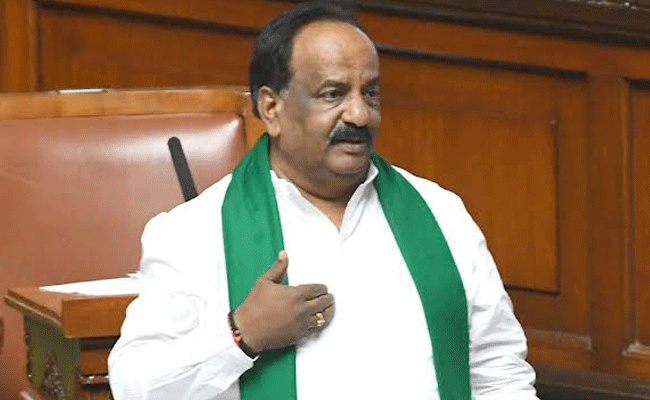
The issue came up during Navalgund Congress MLA Konareddy's intervention during the motion of thanks to the Governor's address in the Assembly.
"They (BJP) have criticised our (Congress) guarantees schemes. We stand by our guarantees, as our government is taking measures to fulfill it, but you had given a guarantee of crediting Rs 15 lakh to every bank account, but you did not credit that money to even a single bank account. You had also promised 2 lakh jobs to youth, but could not do it. You had also promised to double the farmers income," Konareddy said.
Senior BJP leader Basangouda Patil Yatnal objected to this, and asked Konareddy to give at least one evidence or a video clip to prove that the Prime Minister had promised to credit Rs 15 lakh to every bank account.
"Why is he (Konareddy) speaking bogus and false things? What the PM had spoken then was regarding the black money deposited by certain rich people and politicians in foreign bank accounts, by looting this country, and getting them back. Let him (MLA) show at least one video clipping of the Modi's speech where he has promised to deposit Rs 15 lakh in every bank account. I will quit from politics. No one should make such irresponsible statements," he said.
"The Prime Minister has never spoken about crediting Rs 15 lakh to every bank account and Congress was purposely spreading lies against the BJP government and PM," he added.
This led to heated arguments between members of the treasury and opposition benches. During the run-up to the general elections of 2014, BJP and Modi had claimed to bring back the black money stashed in foreign bank accounts by corrupt citizens.
Yatnal further said, if the Prime Minister had in case made such a statement, he was ready to apologise, but the truth is that such a promise was never made and unnecessarily speaking about Rs 15 lakh has become a "job" for Congress people.
As the heated debate continued, Speaker U T Khader tried to calm down MLAs of both sides.
Energy Minister K J George questioned BJP -- PM had promised to get black money from Swiss bank, has the money come?
Yatnal responding to this asked, the PM had spoken about bringing black money, but did he ever say that he will credit Rs 15 lakh to every bank account? "You Congress had promised the guarantees are free to everyone, but now put conditions."
BJP MLA B Y Vijayendra too urged Congress members to prove with evidence that the Prime Minister had promised to credit Rs 15 lakh to bank accounts, or their remarks should be expunged by the Chair. "Unnecessarily, repeatedly making such false statements is not right."
Minister K N Rajanna and Congress MLA Abbayya Prasad said the whole country knows that the PM had made such a promise and has not fulfilled it.
Chaos broke out in the Assembly as BJP members continued to demand for evidence, even as Congress members repeatedly asserted that the PM had made such a promise.
Speaker Khader after repeated attempts, managed to bring the tempers down and continued with the business of the House.
Let the Truth be known. If you read VB and like VB, please be a VB Supporter and Help us deliver the Truth to one and all.
K'taka bypolls: Bagalkot records 43.75 per cent turnout till 1 pm, 37.17 pc in Davanagere South
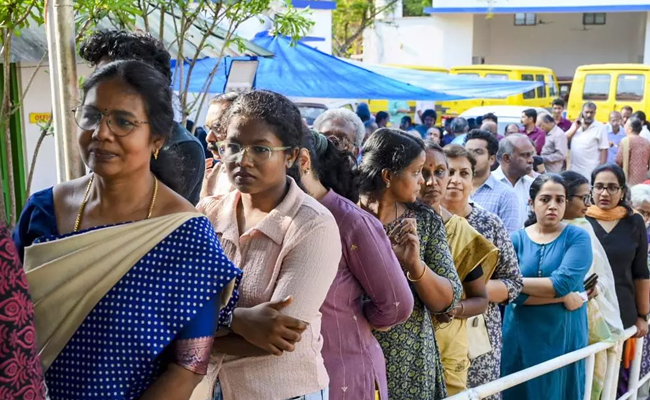
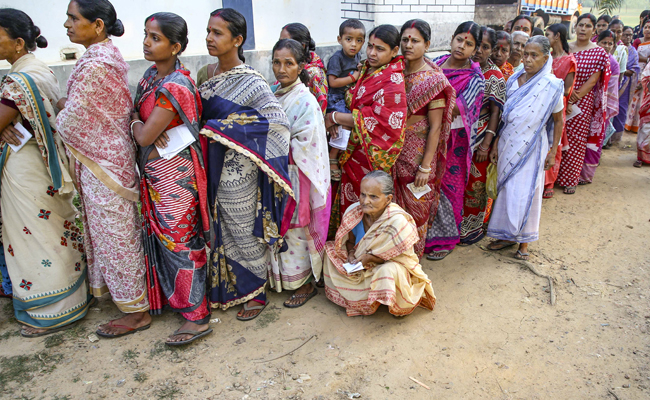
Bengaluru (PTI): At least 43.75 per cent of voters in Karnataka's Bagalkot, where polling for a by-election is underway, exercised their franchise by 1 pm on Thursday.
Davanagere South recorded a turnout of 37.17 per cent, the Chief Electoral Officer's (CEO) office said.
The bypolls were necessitated due to the demise of senior Congress MLAs H Y Meti (Bagalkot) and Shamanur Shivashankarappa (Davanagere South).
While the ruling Congress faces the challenge of retaining both seats, the BJP is aiming to wrest them and deliver a setback to its rival, which is currently witnessing an "internal power struggle" over leadership.
A total of over 2.59 lakh eligible voters are expected to cast their votes at around 319 polling stations in Bagalkot, where nine candidates are in the fray.
In Davanagere South, over 2.31 lakh eligible voters are expected to vote across 284 polling stations, with 25 candidates contesting.
The BJP has fielded former MLA and 2023 defeated candidate Veerabhadrayya Charantimath from Bagalkot, and a fresh face, Srinivas T Dasakariyappa, from Davanagere South.
The Congress has given tickets to family members of the late legislators in both constituencies. Bagalkot candidate Umesh Meti is the son of H Y Meti, while Samarth Mallikarjun from Davanagere South is the grandson of Shamanur Shivashankarappa.
Samarth's father, S S Mallikarjun, is a minister in the Siddaramaiah-led Cabinet and in charge of Davanagere district, while his mother, Prabha Mallikarjun, is a Member of Parliament from the region.
The BJP is looking to make gains in the bypolls and energise its cadre ahead of the 2028 Assembly elections. For the Congress, retaining both seats is crucial, as a loss could be seen as a negative verdict on the performance of the Siddaramaiah-led government.
In the 2023 Assembly elections, H Y Meti defeated BJP's Charantimath by a margin of 5,878 votes in Bagalkot, while Shivashankarappa defeated BJP's B G Ajay Kumar by 27,888 votes in Davanagere South.