Cong govt is not honest on internal reservation, using it for politics ahead of bypolls: Vijayendra
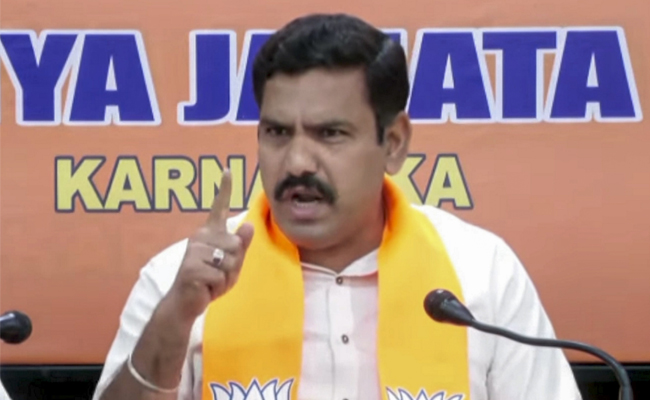
Bengaluru (PTI): Karnataka BJP president B Y Vijayendra on Tuesday said that the Congress government in the state and Chief Minister Siddaramaiah were not honest on internal reservation among SCs and were only trying to use the issue for politics ahead of bypolls for three Assembly segments.
The Karnataka Cabinet on Monday gave its consent to provide internal reservation among Scheduled Castes (SC) and decided to constitute a commission under a retired High Court judge that will be tasked with collecting empirical data.
"If at all Chief Minister Siddaramaiah was serious about internal reservation, also on the Kantharaj report (on Socio-Economic and Education Survey, popularly known as the caste census) he would have taken action long back, but Siddaramaiah and Congress party only believes in taking political advantage and creating more confusion on this particular issue," Vijayendra said in response to a question on internal reservation.
Speaking to reporters here, he said, "I don't think the chief minister or the Congress government is honest on this particular issue. The BJP has repeatedly made it clear (its stand) on the subject, but Siddaramaiah and Congress party when by-elections are round the corner, they are trying to politicise this issue, but they are not honest on this subject."
Channapatna, Shiggaon and Sandur Assembly segments are going for bypolls on November 13.
The BJP had recently urged the Congress government to implement the internal reservation as recommended by the previous BJP government.
Just ahead of the Assembly polls, the then BJP government's Cabinet had taken a decision on internal reservation, by recommending to Central government a six per cent internal quota for SC (Left), 5.5 per cent for SC (Right), 4.5 per cent for "touchables" (Banjara, Bhovi, Korcha, Kuruma etc) and one per cent for others.
The present Cabinet's decision on Monday was on the backdrop of a landmark verdict by the Supreme Court on August 1, which held that states are constitutionally empowered to make sub-classifications within the Scheduled Castes, which form a socially heterogeneous class, for granting reservation for the uplift of castes that are socially and educationally more backward.
A seven-judge constitution bench headed by Chief Justice D Y Chandrachud, by a majority of 6:1, set aside the apex court's five-judge bench verdict of 2004 in the EV Chinnaiah vs State of Andhra Pradesh case which had held that no sub-classification of Scheduled Castes (SCs) can be allowed as they are a homogeneous class in themselves.
Let the Truth be known. If you read VB and like VB, please be a VB Supporter and Help us deliver the Truth to one and all.
RR beat RCB by six wickets in IPL
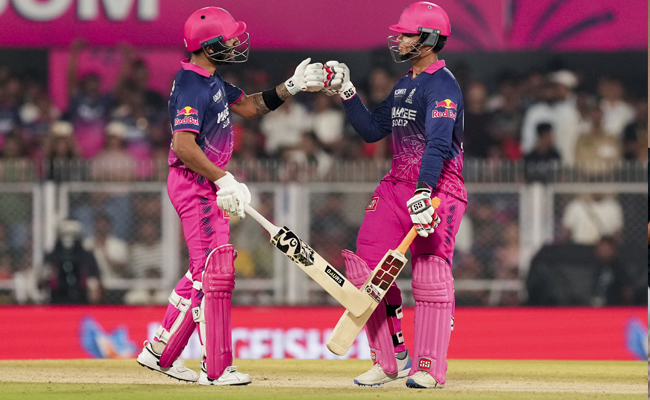
Guwahati (PTI): Blistering fifties by Vaibhav Sooryavanshi and Dhruv Jurel powered Rajasthan Royals to a six-wicket win over Royal Challengers Bengaluru in their IPL match here on Friday.
Sent in to bat, RCB rode on a fighting half-century by skipper Rajat Patidar (63) to post 201 for 8.
Virat Kohli (32), Romario Shepherd (22) and Venkatesh Iyer (29) also chipped in with useful contributions.
In reply, Sooryavanshi (78 off 26 balls) and Dhruv Jurel (81 not out off 43 balls) shared a 37-ball 108-run partnership for the second wicket to set the platform. Krunal Pandya (2/30) tried to bring them back with back-to-back wickets.
But Jurel, in the company of Ravindra Jadeja (24), completed the task with another 68-run stand, with two overs to spare.
For RR, Jofra Archer (2/33), Ravi Bishnoi (2/32) and Brijesh Sharma (2/37) took two wickets.
Brief scores:
Royal Challengers Bengaluru: 201 for 8 in 20 overs (Rajat Patidar 63; Jofra Archer 2/33, Ravi Bishnoi 2/32, Brijesh Sharma 2/37).
Rajasthan Royals: 202 for 4 in 18 overs (Vaibhav Sooryavanshi 78, Dhruv Jurel 80 not out; Krunal Pandya 2/30, Josh Hazlewood 2/44).