Cong questions secular credentials of JD(S) following its alliance with BJP

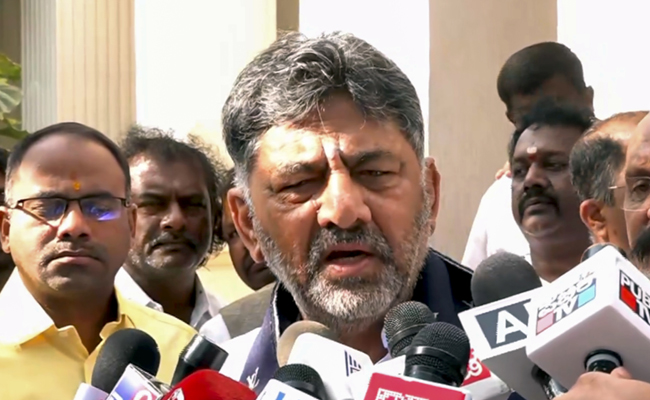
Bengaluru (PTI): Karnataka Congress leaders on Friday questioned the secular credentials of the Janata Dal (Secular), which has entered into an alliance with the BJP, and said that the coming together of the two parties will not have any impact on its own prospects in 2024 Lok Sabha polls.
Stating that former Prime Minister H D Deve Gowda-led JD(S) now stands exposed, Minister Priyank Kharge even mocked the collaboration saying that the BJP was the "B-team" of the JD(S) in the newly formed alliance.
After days of talk about a tie-up between the BJP and the JD(S), the decision was finalised today following a meeting of the leader of the regional party and former Chief Minister H D Kumaraswamy with Home Minister Amit Shah and BJP National President J P Nadda.
"There is nothing surprising. If you saw, BJP was moving lethargically after losing the election in Karnataka. It was very evident that the BJP's central leadership lost their complete confidence in the state leadership. That is why they did not even name the opposition leader in the upper house nor in the lower house," Kharge said, reacting to the BJP-JD(S) alliance.
Speaking to reporters here, he said that it is now "very evident that JD(S) is the primary partner and BJP has become the B-team" for the regional party.
"More importantly, JD(S) should write to the Election Commission and just drop the word 'Secular' from the party's name, because at one point of time, you claim to be secular and at the same time you are going ahead and joining hands with the most communal party in the history of independent India," he added.
Noting that irrespective of how much bonhomie and brotherhood the BJP and JD(S) project, it will not make any dent in the Congress's fortunes in Karnataka, Kharge said, adding that the Lok Sabha elections in Karnataka are going to be won by the Congress party.
"JD(S) has been exposed today, they had been claiming that they are secular and fooling a lot of people earlier. If you turn the pages of history and see, it was because of the JD(S) that BJP came to power in Karnataka. And again they are making the same mistake," he added.
Home Minister G Parameshwara said the BJP-JD(S) alliance will not affect the Congress in any way, and expressed confidence that his party would win more than 20 seats in the Lok Sabha polls.
"We will retain the vote share (42.88 per cent) that we got during the assembly polls in the Lok Sabha polls too. We don't have any feeling that their alliance will cause any hindrance for us. JD(S) had allied with Congress too, but ultimately what were the results? People of the state know," he said.
Pointing out that the JD(S) played politics all these years with its secular credentials, Parameshwara said today that the party leaders must explain what secularism is.
The BJP had swept the 2019 Lok Sabha polls in Karnataka, winning 25 seats, while an independent (Sumalatha Ambareesh from Mandya) backed by it won one seat. The Congress and JD(S) won one seat each.
In the 2019 LS elections, the BJP had won as many as 25 seats, while an independent (Sumalatha Ambareesh from Mandya) backed by it won one seat. The Congress and JD(S) managed to get just one seat each.
However, in the elections to the 224-member state assembly held in May this year, the Congress bagged 135 seats, while the BJP secured just 66 and the JD(S) 19.
JD(S) had contested the 2019 Lok Sabha polls in alliance with the Congress; at the time, both parties were running a coalition government under the Chief Ministership of Kumaraswamy.
JD(S) has earlier formed governments in coalition with both the BJP and Congress separately -- for 20 months from January 2006, and for 14 months from May 2018, respectively, with Kumaraswamy as chief minister.
Let the Truth be known. If you read VB and like VB, please be a VB Supporter and Help us deliver the Truth to one and all.
EC dismisses scope for wrongdoing at strongrooms; prohibitory orders around Kolkata counting centres
Kolkata (PTI): A day after West Bengal Chief Minister Mamata Banerjee spent hours at the EVM strongroom of her Bhabanipur constituency alleging possibilities of malpractices, Chief Electoral Officer (CEO) Manoj Agarwal on Friday asserted there is no scope for wrongdoing at the counting centres.
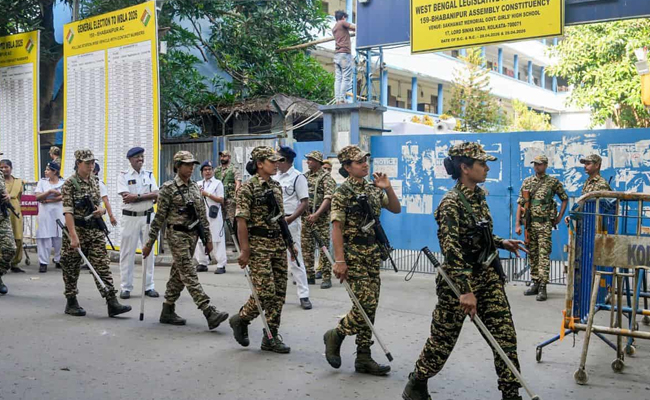
Following tensions around two counting centres in Kolkata late on Thursday, police clamped prohibitory orders on gatherings outside all seven strongrooms in the city.
Stating that round-the-clock CCTV monitoring of strongrooms was in place, Agarwal dismissed the allegations as "baseless".
TMC spokesperson and Beleghata constituency candidate Kunal Ghosh said that party workers and poll aspirants were keeping a strict vigil at the counting centres, where the EVMs are stored in strongrooms, upon directions of party supremo Mamata Banerjee.
"There is no scope for any wrongdoing given the arrangements made to secure the EVMs. The Centres have been kept under thorough CCTV coverage and their live-streamed footage can be seen from outside," Agarwal told reporters.
"One should have reason and evidence for making allegations," he said, maintaining that there were no grounds for levelling charges of EVM tampering or pre-counting malpractice.
Two counting centres in Kolkata witnessed high drama late on Thursday evening after TMC leaders alleged a lack of transparency and possible malpractice at the strongrooms housing sealed EVMs of the assembly polls, which concluded on April 29.
Mamata Banerjee herself landed up at the Sakhawat Memorial School counting centre and stayed put there for about four hours. She emerged from the premises past midnight and warned against any attempts to tamper with the counting process, demanding greater transparency.
TMC leaders and candidates Sashi Panja and Kunal Ghosh held a sit-in outside the Khudiram Anushilan Kendra counting centre on Thursday evening, alleging unauthorised activities inside the strongroom amid the absence of TMC agents.
Matters came to a head after a large number of supporters from both TMC and BJP camps gathered outside the venue, shouting slogans till they were dispersed by security forces.
The EC, however, dismissed the claim, clarifying that poll officials were engaged in the task of segregating postal ballots as per due process and the strongrooms remained secure, asserting all political parties for the mandatory segregation activity were duly notified.
On Friday, Kolkata Police imposed prohibitory orders under Section 163 of the BNSS around all seven designated strong rooms in the city.
As per the order issued by Police Commissioner Ajay Nand, the restrictions prohibited the assembly of five or more persons within a 200-metre radius of each strongroom, along with a ban on processions, demonstrations, and carrying of weapons or explosive materials.
The measure, which aims to prevent any breach of peace, violence, or disturbance during the storage of ballot papers and polled EVMs, will remain in force until the commencement of counting on May 4.
Besides the two counting centres in question, the prohibitory orders were also clamped around the Hastings House complex, APC Polytechnic College, St. Thomas Boys' High School, Ballygunge Government High School and the David Hare Training College counting premises.
A senior police officer said enhanced security arrangements have been made at Khudiram Anushilan Kendra, the counting centre for several assembly seats in north and east Kolkata housing EVM strong rooms.
"Additional CAPFs and armed police forces have also been deployed under the supervision of an additional commissioner and a deputy commissioner of police," Joint Commissioner of Police (Traffic), Kolkata, Rupesh Kumar, told reporters after visiting the area.
Expressing apprehension that unauthorised movements might occur when a section of postal ballots is brought in the evening, Kunal Ghosh said on Friday morning that the party's polling agents and candidates have been alerted about the matter.
Minister Shashi Panja, who also arrived at Khudiram Anushilan Kendra in the morning, maintained that "transparency" should be ensured for all strongroom activities.
Ghosh told reporters on Friday that though they had seen some movement in a strongroom that allegedly stored postal ballots, there was no such movement on Friday morning.
Meanwhile, Banerjee's challenger at Bhabanipur and BJP leader Suvendu Adhikari took a dig at the chief minister for her late-night visit to the counting centre.
"I want to reassure the people of Bhabanipur and of West Bengal that the TMC candidate and outgoing chief minister was prevented from taking any additional advantage. Despite her best intentions to the contrary, she wasn't allowed to act in violation of rules," Adhikari wrote on social media platforms, posting a picture of Banerjee sitting at what appeared to be an area outside the counting centre strong room.
"Till such time she was present there, my election agent, advocate Surjyanil Das personally positioned himself at the spot keeping a tight watch on her so that she isn't able to take recourse to improper means," he added.
Security forces kept a strict vigil in and around counting centres and strongrooms in Kolkata and other districts where EVM machines used in the state assembly elections are stored, an official said.
Sakhawat Memorial School in south Kolkata's Bhabanipur, which saw high drama till the early hours of Friday with the chief minister spending several hours at the counting centre, wore a peaceful look in the morning with security personnel guarding the area.