Cong-ruled states unable to fill job vacancies due to precarious financial condition: Pralhad Joshi
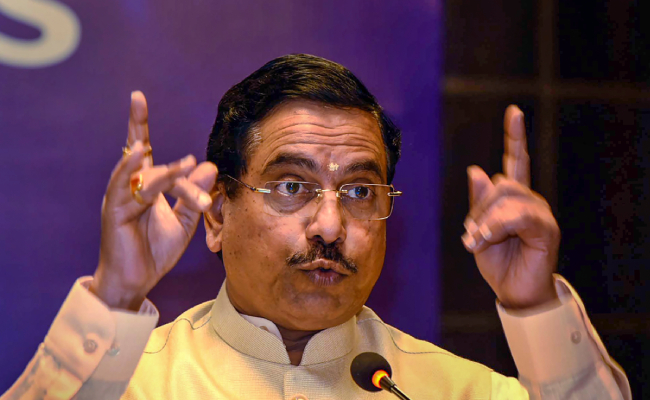
Hubballi (PTI): Union Minister Pralhad Joshi on Sunday alleged that precarious financial conditions in Congress-ruled states like Karnataka have led to governments being unable to fill up job vacancies.
He, however, defended the measures taken by the BJP-led government at the Centre, to increase the employment rate in the country.
Responding to a question related to Congress leader Rahul Gandhi reportedly targeting the BJP government at the Centre on the issue of unemployment, Joshi hit out at the former, accusing him of making statements based on what his advisers tell him, instead of himself going into details.
"Mr Rahul Gandhi doesn't always go into details. He will just give a reaction based on some feedback that his advisers give him. He doesn't go personally into details. Actually, post Covid, especially if I can say, employment rate has increased like anything, EPFO numbers itself show that," Joshi said.
Speaking to reporters here, he said as far as filling up vacancies in the central government are concerned, from 2022 to till date, every month there is Rozgar Mela, and every month 50,000 to one lakh people are being absorbed into the government.
"So far, in the last two-and-half years, more than seven-and-half lakh people have been recruited into various government departments and institutions," he added.
Noting that the ruling Congress in Karnataka has not filled more than 2 lakh vacancies in the state, the union minister said these vacancies have not been filled as the government is unable to pay the serving employees itself on time.
"They (Karnataka government) are not able to pay the serving employees on time. The payment of salary is delayed by ten to fifteen days to twenty days. Their (government) financial condition is precarious, so they are not filling up the vacancies," he claimed.
"Before talking about something else, I will ask Mr Rahul Gandhi to look at what is happening in Karnataka, Telangana and Himachal Pradesh. They have governments in three states and they are in very bad shape," he added.
Let the Truth be known. If you read VB and like VB, please be a VB Supporter and Help us deliver the Truth to one and all.
Compromised PM didn't sign trade deal with US, but a bargain for Adani's release: Rahul
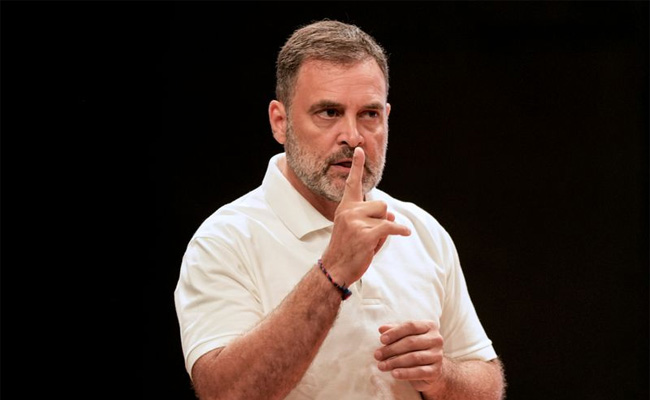
New Delhi (PTI): Congress leader Rahul Gandhi on Friday accused Prime Minister Narendra Modi of signing a trade deal with the US only to secure the "release" of billionaire businessman Gautam Adani.
"Compromised PM did not strike a trade deal, but a bargain for Adani's release," Gandhi said in a post in Hindi on X, after reports that the US has agreed to settle the lawsuit that accused Adani of hiding alleged bribery.
The US government has agreed to settle the lawsuit filed against Adani, who is accused of duping investors by concealing that his company's huge solar energy project in India was being facilitated by an alleged bribery scheme, according to court filings published Thursday.
Reacting to the reports, Congress general secretary in-charge communications Jairam Ramesh said it was now clear why the PM agreed to the "hopelessly one-sided Indo-US trade deal that was really a steal by the US".
"And it is also clear why he abruptly halted Operation Sindoor on May 10, 2025, acting on President Trump's threats rather than on our national interest. Reportedly, the Trump Administration is about to drop all charges of corruption against Modani," he said on X.
"How much more compromised can the PM get?" Ramesh asked.
In the lawsuit filed in late 2024, the Securities and Exchange Commission accused Adani Group Chairman Gautam Adani and his nephew Sagar Adani, who is a director at the group's renewable energy unit Adani Green Energy Ltd, of agreeing to pay about USD 265 million in bribes to Indian government officials between approximately 2020 and 2024 to obtain lucrative solar energy supply contracts on terms that expected to yield USD 2 billion of profit over 20 years.
It was alleged in the lawsuit that Adani Group raised USD 2 billion in loans and bonds, including from US firms, on the backs of false and misleading statements related to the firm's anti-bribery practices and policies.
The ports-to-energy conglomerate had denied the allegations.