Congress announcement of bearing travel cost of migrant workers 'street play': Minister K Sudhakar
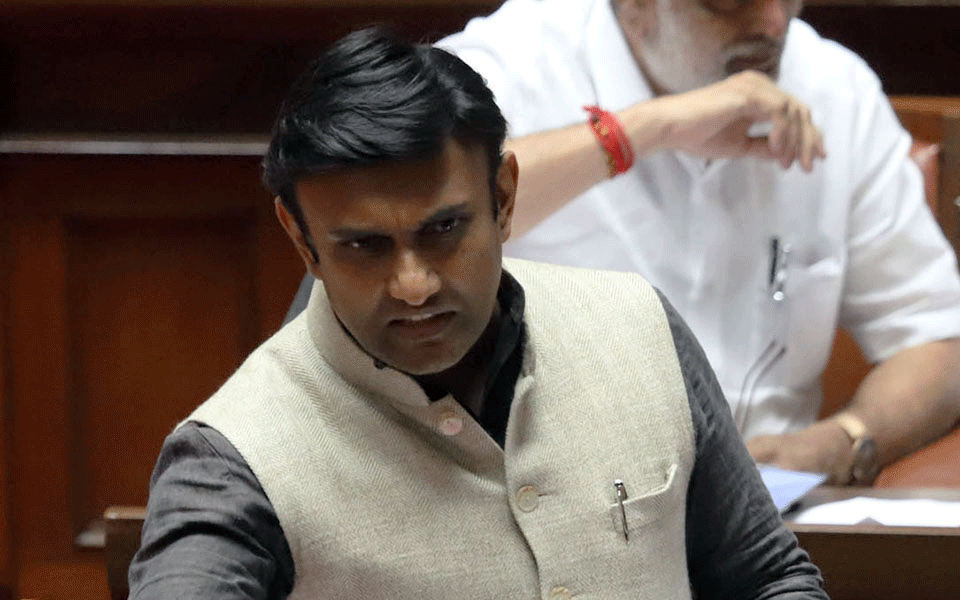
Bengaluru: Describing Congress' announcement to bear the cost of travel of migrant workers as "streetplay," Karnataka Medical Education Minister K Sudhakar on Tuesday accused the party of 'playing politics' even on the issue of COVID-19 and compared its mindset to Roman emperor Nero.
He said the Congress instead of giving money to the concerned as per rules, was advertising about it.
"Looking at Congress moving around in the streets and advertising about its willingness to pay the bus and train charges for the labourers, it is clear that it is a big street play.
Instead of giving money to the concerned as per rules, they are making loud claims about it in front of cameras," Sudhakar said in a tweet.
"There is no difference between your (Congress) mind set- looking at politics and gaining mileage out of it even on the issue of corona, and that of Nero, because Nero was fiddling when Rome was burning," he said in another tweet.
The Congress on Monday had said its state units will bear the cost of rail travel of needy migrant workers stranded at their workplaces due to the coronavirus-induced lockdown and seeking to return home.
Karnataka Congress Chief D K Shivakumar had announced giving Rs 1 crore cheque to Karnataka State Road Transport Corporation from the party for ensuring free transport to working class and labourers, who were suffering to reach home because of high rates being charged.
However, the KSRTC, which subsequently announced free travel for those stranded within the state, has not accepted the cheque and has instead asked it to be given to Chief Minister's relief fund.
On Monday, urging the state government to immediately take necessary action to arrange for trains to bring back all stranded Kannadigas from other states, Congress had said, it was also ready to bear the monetary costs to be paid to the Railways.
Let the Truth be known. If you read VB and like VB, please be a VB Supporter and Help us deliver the Truth to one and all.
Massive turnout in assembly polls across states, women voters outnumber men: EC data
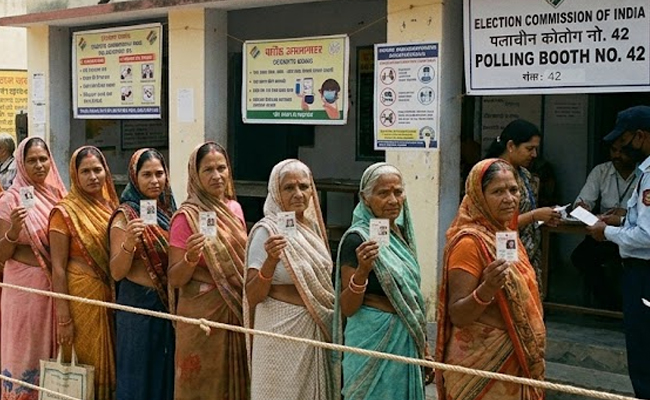
New Delhi (PTI): The recently-concluded assembly elections witnessed exceptionally high voter participation across states, with women voters outnumbering men in turnout percentages, according to Election Commission data.
West Bengal recorded the highest voter turnout among states, with 93.71 per cent polling in 293 constituencies where counting has been completed. The state saw over 6.38 crore votes cast, including postal ballots, against a total of more than 6.81 crore electors.
Women voters recorded a turnout of 93.8 per cent in the West Bengal Assembly polls, slightly higher than the 92.06 per cent participation among men.
The data for West Bengal does not include the figures for the Falta assembly constituency, which is scheduled for repolling.
Tamil Nadu registered an 85.01 per cent turnout, with nearly 4.8 crore votes polled from an electorate of 5.74 crore. Women voters recorded a turnout of 86.2 per cent, higher than the 83.77 per cent among men.
Assam also witnessed robust participation, with the final turnout touching 85.74 per cent. More than 2.15 crore votes were cast in the state, while female turnout at 86.53 per cent marginally exceeded the 84.95 per cent recorded among male voters.
Kerala registered a turnout of 78.11 per cent, with over 2.12 crore votes polled. Female voter participation stood at 81.17 per cent against 74.9 per cent among men.
Puducherry recorded a turnout of 89.82 per cent, with women voters again leading participation at 91.39 per cent. More than 8.5 lakh votes were polled in the Union territory.
Yet, women's representation among elected candidates remained modest.
Tamil Nadu elected 23 women MLAs (9.83 per cent) out of 234 members, West Bengal elected 37 women legislators (12.62 per cent) out of 293, while Kerala returned only 11 women MLAs (7.85 per cent) in the 140-member House.
Only two third-gender candidates contested the elections - one each from Tamil Nadu and Kerala, and both lost, forfeiting their deposits.
The elections also reflected extensive electoral mobilisation infrastructure. West Bengal had the highest number of polling stations at 85,092, followed by Tamil Nadu with 75,064 and Assam with 31,490.
In terms of candidates, Tamil Nadu saw the largest contest with 4,023 candidates in the fray across 234 constituencies, averaging 17 candidates per seat and peaking at 79 contestants in one constituency.
West Bengal pitted 2,920 candidates for 293 constituencies, while Kerala had the fewest contestants among the major states, with 883 candidates for 140 seats.
The data also showed relatively low NOTA votes across states. Tamil Nadu recorded the lowest NOTA share at 0.4 per cent of total votes polled, while Assam recorded the highest at 1.23 per cent. In West Bengal, 0.78 per cent of the total votes polled were NOTA, while it 0.77 per cent and 0.57 per cent of the electorate opted for None of the Above (NOTA) in Puducherry and Kerala, respectively.