Congress' Mekedatu 'padayatra' enters Bengaluru city
party chief apologises for traffic jams till Mar 3
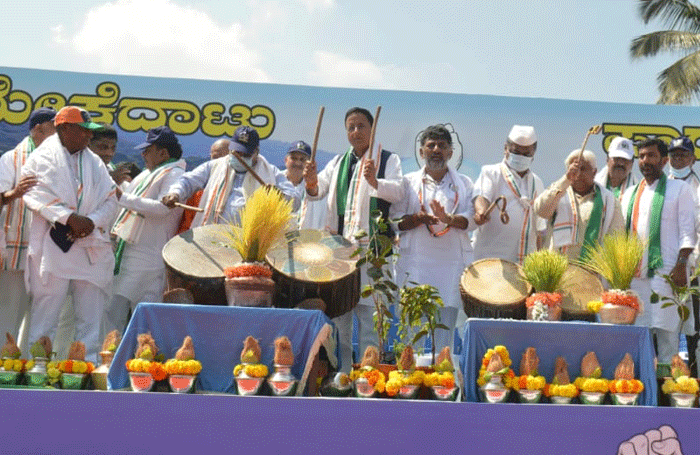
Bengaluru (PTI): With Congress' 'padayatra' (foot march), demanding implementation of the Mekedatu project across the Cauvery river, entering Bengaluru, party state President D K Shivakumar on Tuesday apologised to the people of the city, as their march is expected to create traffic jams in parts of the city till March 3.
Also accusing the ruling BJP of trying to stop the padayatra by creating trouble and booking cases against Congress leaders, citing violation of rules, out of "political vengeance", he said his party will not bow down to such threats.
"I want to apologise to the people of Bengaluru, as there will be traffic trouble in parts of Bengaluru for next three days. There may be traffic trouble for three days that's all, but it will solve your water related issues for the next 50 years. Our fight is for the people of the state and citizens of Bengaluru. So, please cooperate and march with us," Shivakumar said.
Speaking to reporters here, he claimed that apartment associations, factory owners, industrialists and common people have come forward to join the fight for water, cutting across party lines.
The padayatra on its third day today will be covering a distance of 15.8 km to reach Jayadeva Junction in the city from near Kengeri.
This is the second leg of the march that ended abruptly in Ramanagara on January 13, when the third wave of the COVID-19 had peaked.
The 'padayatra 2.0' with the theme Namma Neeru, Namma Hakku' (Our water, Our right), that resumed on Sunday, will culminate at the National College Ground in Basavanagudi in Bengaluru on March 3, after covering a total distance of 79.8 kilometres.
Noting that the padayatra has entered the city, the KPCC chief alleged that the Bruhat Bengaluru Mahanagara Palike (BBMP) Commissioner and Joint Commissioner through their staff have removed some banners put out by the party, and only after intervention of leaders it was stopped.
"If they had continued to remove our banners, I would have asked our workers to remove banners of Yediyurappa (greeting on his birthday), and by several legislators (BJP) on account of Shivaratri, put across the city. Law should be same for everyone," he said.
He even went on to ask BBMP Chief Commissioner Gaurav Gupta to name the Corporation office as BJP office, as he accused them of working in favour of the ruling party.
An FIR has been registered against 38 people under various sections of the Indian Penal Code and the Karnataka Epidemic Diseases Act, for holding the march on Sunday in violation of COVID-19 rules, which names Congress leaders like Shivakumar and Leader of Opposition in the assembly Siddaramaiah, among several others.
The prevailing COVID norms carry a ban on rallies, dharnas and protests.
Shivakumar alleged that the BJP government has not withdrawn COVID curbs and has extended it with an intention to stop Congress' padayatra, and it is nothing but politics.
He questioned as to how the BJP and saffron organisations are allowed to hold political events and rallies, and restrictions were only applicable to Congress' march and rallies.
"We won't fear jail threats...we will fight against it, summons have been issued to us, but our march will continue. Let police remove their uniform and wear BJP dress. They are just following their (BJP) instructions. Sun will rise and the sun will set, no one is permanent. We have a list of police officers who are troubling us, we will answer them when the time comes," he added.
The march is also being seen politically, keeping in mind the BBMP elections, with the padayatra covering about 15 assembly constituencies in the city in the days to come.
The Mekedatu multi-purpose (drinking and power) project involves building a balancing reservoir near Kanakapura in Ramanagara district, to which neighbouring Tamil Nadu is opposed.
The estimated Rs 9,000 crore project once completed is aimed at ensuring drinking water to Bengaluru and neighbouring areas (4.75 TMC) and it can also generate 400 MW power.
Let the Truth be known. If you read VB and like VB, please be a VB Supporter and Help us deliver the Truth to one and all.
NEET student hangs self in Rajasthan's Sikar
Jaipur (PTI): A student preparing for the NEET examination allegedly committed suicide by hanging himself in a rented room in Rajasthan's Sikar on Friday, police said.
According to the police, the student allegedly hanged himself from a ceiling fan using his sister's scarf while one sister was attending coaching classes and the other was in the bathroom.
He had appeared in the NEET UG exam 2026, which was cancelled due to paper leak, they said.
Udyog Nagar SHO Rajesh Kumar said that the deceased, identified as Pradeep Meghwal, was a resident of Kanika ki Dhani village in Jhunjhunu's Gudha Gaudji area.
He had been living in a rented room in Sikar's Jaldhari Nagar area with his two sisters while preparing for NEET over the last three years.
His elder sister later found him hanging and informed the landlord and police after bringing him down, officials said.
The SHO said the body was kept at SK Hospital mortuary, and a postmortem had not been conducted.
The student's father, Rajesh Kumar Meghwal, told police that Pradeep's NEET examination had gone well and the family was expecting him to score around 650 marks.
Former Rajasthan deputy chief minister Sachin Pilot expressed grief over the incident and linked it to anxiety among students after reports of irregularities and paper leaks in NEET 2026.
Pilot said repeated paper leak incidents and cancellation of examinations were affecting students' mental health and demanded a time-bound investigation and strict action against those responsible.