Congress to get Energy portfolio?
Bengaluru, June 5: Though JDS earlier wanted to keep Energy portfolio with it, it has planned to give it to the Congress.
It is said that Deve Gowda has thought of giving the Energy portfolio to Congress leader DK Shivakumar who played a major role in the formation of the JDS-Congress coalition government, as the Congress leader’s anger might cause problem to the existence of the government.
But JDS senior MLA HD Revanna and his wife Bhavani Revanna have declined to give up the Energy portfolio. It is said that they have demanded Bengaluru Urban Development portfolio to him if the Congress wanted Energy portfolio. But former chief minister Siddaramaiah is lobbying to get Bengaluru Urban Development portfolio to his close aid KJ George.
It is said that both the parties might once again sit together to finalise the sharing of portfolios.
Let the Truth be known. If you read VB and like VB, please be a VB Supporter and Help us deliver the Truth to one and all.
We need to recognise we have problem with Security Council: UN SG Guterres
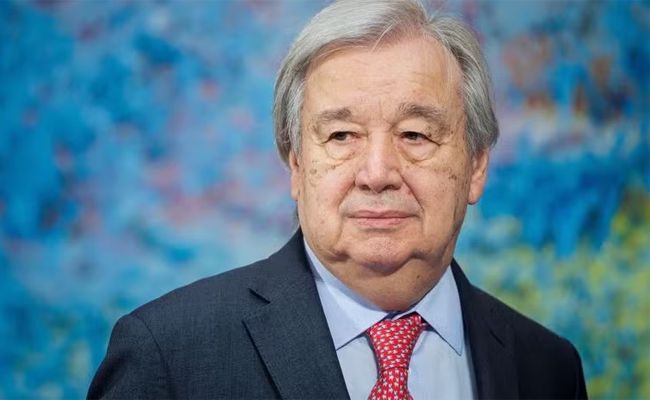
United Nations (PTI): In a sharp critique, UN chief Antonio Guterres said there is a need to recognise “we have a problem with the Security Council”, which does not reflect the current world and is not allowed to stop conflicts because of the use of veto by its permanent members.
“I think we need to recognise that we have a problem with the Security Council. The Security Council today no longer represents the world as the world exists. It represents the world after 1945,” Guterres said at a press conference in Beirut on Saturday in response to a question.
He pointed out that three permanent members of the 15-nation Council are from Europe, one from Asia, and one is the United States, while there are no permanent members from Africa or Latin America.
Even from Asia, that “obviously is a continent with an enormous weight in global population and global wealth”, there is just one permanent member - China.
“And so, the Council has a problem of legitimacy and a problem of efficiency because of the vetoes. And what we have witnessed is that time and time again, when we have situations of conflict and when it's necessary to stop the conflict, there is a veto that emerges, and that does not allow the Security Council to act. That, unfortunately, is something that we are witnessing time and time again, and I am not hoping that in the short term, things will change,” he said.
The Council is made up of five veto-wielding permanent members, China, France, Russia, the UK and the US, while 10 non-permanent members are elected to serve two-year terms at the horseshoe table and do not have veto powers.
India has been at the forefront of decades-long efforts calling for reform of the Security Council, including expansion in both its permanent and non-permanent categories, saying the 15-nation Council, founded in 1945, is not fit for purpose in the 21st Century and does not reflect contemporary geopolitical realities.
India has underscored that it rightly deserves to sit as a permanent member in the Security Council.
India last sat at the UN high table as a non-permanent member in 2021-22. A polarised Security Council has failed to deal with current peace and security challenges, with Council members sharply divided on conflicts such as the Ukraine war, the Israel-Hamas conflict and the latest US-Israel war against Iran.