Congress wants Centre to come out with White Paper on situation along the LAC with China

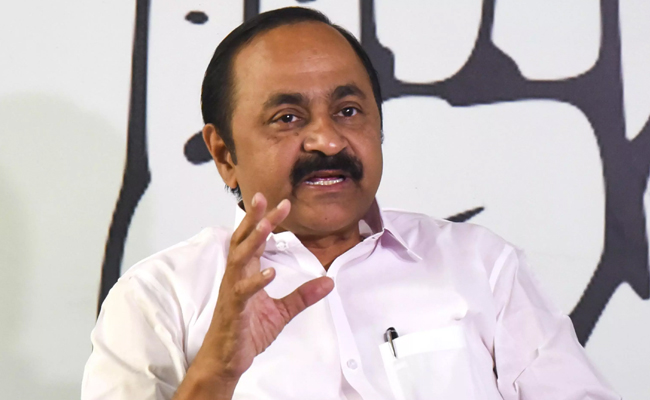
Bengaluru (PTI): Targeting the BJP-led NDA government at the Centre, senior Congress leader Manish Tewari on Tuesday urged the dispensation to immediately publish a White Paper on the situation prevailing along the Line of Actual Control (LAC) with China.
The former Union minister was addressing a press conference here to make a "critical appraisal" of the performance of the NDA government on its completion of nine years in office.
"The performance of any government is benchmarked on five parameters -- India's external security, the state of the economy, social cohesion, internal security, and India's relations with the world or its foreign policy. On each of the benchmarks in the past nine years, the NDA-BJP government has come up completely short," Tewari said.
Noting that India today is confronted with the most unprecedented external security challenge that it has faced in a number of decades, he said: "For the three years, the Chinese People's Liberation Army has not vacated its transgression into Indian territory -- all the buffer zones have been created in what is India's perception of its territory."
Unfortunately, rather than being upfront with the country about the Chinese transgression, the NDA government has not allowed a single discussion on the issue in Parliament since September 2020, the Congress leader said. All questions raised by Members of Parliament even from the ruling party have not been entertained on the grounds of national security, he opined.
"We (Congress) demand that the NDA-BJP government immediately publish a White Paper on what is the situation along the Line of Actual Control with China, how many buffer zones have been created, how many of those are in Indian territory, and how much of territory have we lost," he said, pointing at reports stating that India has lost access to 26 out of 65 patrolling points (PPs) along the LAC, which translates to about 2,000 square kilometres of territory.
Regarding India's foreign policy, Tewari asked External Affairs Minister S Jaishankar as to why the needle hasn't moved a single millimetre in the past nine years on India getting a permanent seat in the UN Security Council (UNSC).
"Also, why has India not got the membership of the Nuclear Suppliers Group? Why is it that no SAARC summit has been held since 2015? What is the government doing to counter rising Chinese influence in India's neighborhood? and does India have the counter strategy for the growing Russian-Chinese convergence?" he asked.
While dwelling on the internal security scenario, the former Union minister pointing at the situation in Manipur said it is after so many days that the Union Home Minister (Amit Shah) has found it appropriate to go and visit the state.
He also questioned the government as to why is it "scared and petrified" of holding elections in Jammu and Kashmir.
Speaking about the economic situation in the country, the Congress leader said food inflation has been the single biggest problem for household budgets across the country.
Highlighting high fuel prices and growing disparity between rich and poor, he also attacked the BJP government alleging it has failed in job creation.
Noting that even in the states where the BJP is ruling, the party has not fought elections based on performance, and Karnataka is the latest example, Tewari said.
"There is a concerted attempt to keep the communal temperature of the country on the slow burn, because it helps the politics of polarisation of the NDA-BJP, but it harms the country," the Congress leader said.
Across the board except for hype and hoopla, the Central government has nothing in terms of performance on its balance sheet, he said, adding: "Karnataka has chosen wisely in the recent election, and I would like to urge the people of India to choose wisely in 2024, because your choice would determine whether India remains a democracy or it goes down the path which will not be in India's interest."
Complementing the people of Karnataka for voting in Congress to power in the state, Tewari said they have shown the path to the rest of the country as to how the politics of polarisation can be kept aside and real issues brought to the fore, which help the destinies of both Karnataka and the rest of the country.
He also expressed confidence that the Congress government in the state would fulfil all the commitments made to the people of the state ahead of the elections.
Let the Truth be known. If you read VB and like VB, please be a VB Supporter and Help us deliver the Truth to one and all.
Bengaluru: PUC student dies by suicide, hours after results were declared
Bengaluru (PTI): A second-year Pre-University Course student allegedly died by suicide at her residence here, hours after the exam results were announced, police said on Friday.
Tanushree (17), a science student, reportedly failed in three subjects, which is suspected to be the trigger behind her taking such an extreme step, they said.
However, no suicide note was recovered from the spot, except her hall ticket, which was found lying on the bed.
According to police, the incident came to light on Thursday around 3.30 pm, shortly after the results were announced.
She hung herself from the ceiling fan when no one was at home. Her mother had gone to work, a senior police officer said.
Citing preliminary inquiry, the officer said it is a clear-cut case of suicide. She was apparently distressed over failing in three subjects and had also called her friends to discuss the same.
When she did not respond to their calls and messages later, her friends decided to check on her, he said.
Based on her mother's complaint, a case of unnatural death has been filed, with Hebbal police investigation indicating it to be a case of suicide, police added.
(Assistance for overcoming suicidal thoughts is available on the state’s health helpline 104, Tele-MANAS 14416.)