Consider ground realities, rethink age of consent in POCSO Act: K'taka HC to Law Commission

Bengaluru, Nov 6: The Karnataka High Court has directed the Law Commission of India to reconsider the age of consent in Protection of Children from Sexual Offences (POCSO) Act.
In the judgement passed on November 5, a division bench of Justices Suraj Govindaraj and G Basavaraja said, “Having come across several cases relating to minor girls above 16 years having fallen in love and eloped and in the meantime, having had sexual intercourse with the boy, we are of the considered opinion that the Law Commission of India would have to rethink on the age criteria, so as to take into consideration the ground realities." The court heard an appeal by the police challenging the acquittal of a POCSO accused. It found that the girl, then 17, had eloped with the boy in 2017. Though the girl's parents had filed the complaint, all the witnesses turned hostile.
While the case continued, the two had married and now have two children.
Confirming his acquittal, the court however gave directions to the Law Commission as well as the Education Department in Karnataka.
The HC said that it was lack of awareness of POCSO and IPC that is resulting in many offences being committed by young persons.
“It is also seen that many of the above offences which are deemed offences to have been committed as a result of or on account of lack of knowledge on the part of the minor girl and the boy.
Many a time the boy and girl involved are either closely related or very well known to each other being classmates or otherwise,” the court observed.
Though lack of knowledge of law is not an excuse for committing a crime, the HC said students should be made aware of the POCSO Act.
“It is required that students especially at least of IX standard onwards, are educated on the aspects of POCSO Act, the acts which are criminalized under the POCSO Act as also under the Indian Penal Code,” it said.
Therefore, the Principal Secretary of the Education Department was directed to constitute a committee to formulate suitable education material in relation to the above and thereafter issue necessary directions to all schools be it government or private, stating that such students are to be educated and forewarned of the consequences of their action, if in violation of the POCSO Act or the IPC.” The case was relisted for December 5 for the Department to file a compliance report.
Let the Truth be known. If you read VB and like VB, please be a VB Supporter and Help us deliver the Truth to one and all.
Bengaluru airport introduces AI-based system to enhance safety at vehicle-aircraft intersections
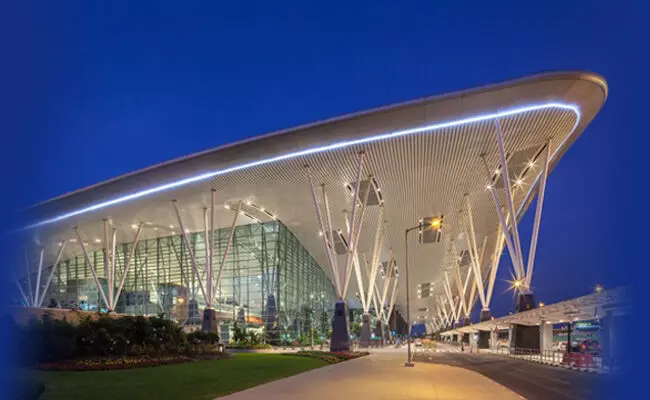
Bengaluru: Bangalore International Airport Limited (BIAL) has introduced an integrated smart airside safety system at Kempegowda International Airport to improve operational safety at key intersection zones.
According to The Hindu, the system has been designed to enhance safety at Cross Service Roads (CSRs), where aircraft and ground vehicle movements intersect.
According to BIAL, the system integrates AI-based computer vision, automation, and centralised monitoring to manage right-of-way movements and reduce the risk of human error.
“CRSs are among the most sensitive areas within airport operations, requiring precise and seamless coordination between aircraft and ground vehicles. Traditionally, right of way protection at these intersections relied on manual or semi-manual inset light activation, creating dependencies on human intervention, increasing the risk of delays and limiting operational visibility,” TH quoted BIAL as saying.
The new system uses real-time detection of vehicle movement, risk assessment, and automated signalling. AI-enabled cameras identify potential conflicts and trigger automated inset light signals to ensure aircraft priority. Normal operations resume once the area is confirmed clear.
“Based on these detections, the system triggers automated inset light activation to protect aircraft right‑of‑way and restores normal signalling once the intersection is confirmed clear. A centralised monitoring and analytics platform digitally logs all events, strengthening governance, compliance, and operational control,” BIAL said.
By embedding technology into operations, the system creates a data-driven separation layer between aircraft and ground vehicles, significantly reducing human error, especially during night and low-visibility conditions.
“Precision-led signal activation improves traffic flow, minimises unnecessary stoppage and enhances turnaround efficiency. It also establishes a scalable foundation for predictive safety analytics, enabling trend analysis, peak-hour optimisation, compliance mapping and risk forecasting to support continuous improvement and stronger airside governance,” BIAL said.