COVID-19 negative report mandatory for teachers and students ahead of opening of colleges
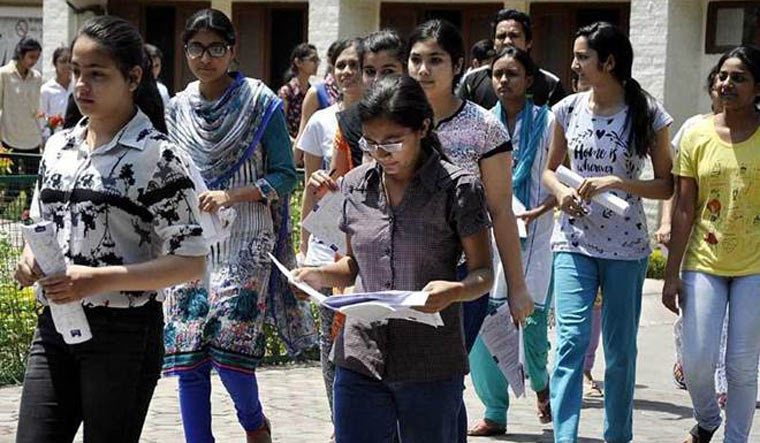
Bengaluru: A COVID-19 RT-PCR negative test report will be mandatory for all the teachers, students, and non-teaching staff with the Karnataka Government deciding to reopen the degree, medical and engineering colleges.
After eight months of COVID-19 induced lockdown, the Karnataka government has decided to start the degree, engineering, and diploma colleges from November 17 and Medical, nursing, AYUSH, and paramedical colleges from December 1.
In view of the reopening of colleges, the Commissioner of Health and Family Welfare Pankaj Kumar Pandey passed the order making the RT-PCR test report mandatory.
"As per SoP issued from Government of Karnataka, all teachers, students, and non-teaching staff members of colleges and hostels shall produce a COVID-19 RT-PCR negative test report, which is done within 72 hours before the day of joining," the order said.
Pandey instructed the health staff to collect the samples from teachers, students, and non-teaching staff of both colleges and hostels, without any delays and facilitate quick testing.
He directed all the labs to carry out testing of these samples through a pooled (1:5) testing process and upload the results on the ICMR portal immediately.
Deputy Commissioners of all districts and the Special Commissioner (Health) of the Bruhat Bengaluru Mahanagara Palike have been asked to monitor and ensure the testing is carried out in a smooth manner.
Pandey said the test results will be sent by SMS to registered mobile numbers in the ICMR portal.
It can also be accessed by visiting www.covidwar.karnataka.goV.in/servicel, for lab reports, he added.
Let the Truth be known. If you read VB and like VB, please be a VB Supporter and Help us deliver the Truth to one and all.
Allen, Raghuvanshi, Green power KKR to 29-run win over GT

Kolkata (PTI): Finn Allen blasted a 35-ball 93, while Angkrish Raghuvanshi hit an unbeaten 44-ball 82 as Kolkata Knight Riders kept their playoff hopes alive with a 29-run win over Gujarat Titans in the IPL match here on Saturday.
Sent in to bat, Allen went on a six-hitting spree, smashing 10 maximums and four boundaries to add 95 off 41 balls with Raghuvanshi (82).
Raghuvanshi then shared another 108 off 53 balls with Cameron Green (52 not out) to power KKR to a challenging 247 for 2.
In reply, GT could manage 218-4, riding on skipper Shubman Gill's 49-ball 85 and a 35-ball 57 from Jos Buttler. Opener Sai Sudarsan was retired hurt but returned to make a 28-ball 53 not out.
Sunil Narine (2/29) claimed two wickets and Saurabh Dubey snapped one for KKR.
For GT, Mohammed Siraj (1/50), Sai Kishore (1/38) were the wicket-takers.
Brief Score:
KKR: 247 for 2 in 20 overs (Finn Allen 93, Angkrish Raghuvanshi 82 not out, Camero Green 52 not out; Mohammed Siraj 1/50).
GT: 218 for 4 in 20 overs (Shubman Gill 85, Sunil Narine 2/29).