COVID-19: Public celebration of Ganesh festival restricted to 3 days in Bengaluru
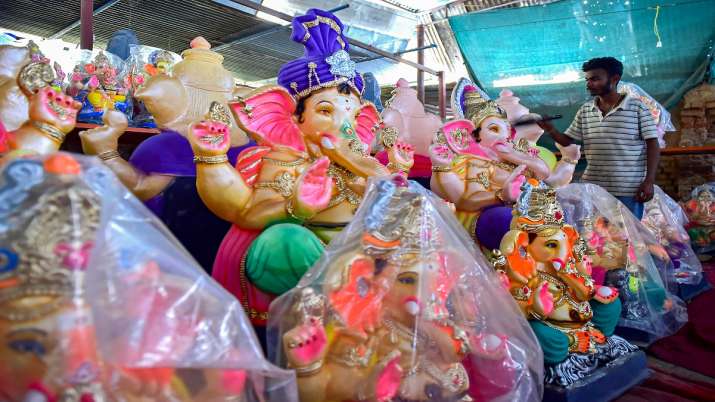
Bengaluru, Sep 7: The Bengaluru civic agency has permitted only three-day Ganesha Pooja celebrations in the city in public places against the Karnataka government order allowing five days' of festivities in the state, to keep COVID-19 infections in check.
"Ganesha festival will not be allowed for more than three days in Bengaluru city. There should not be any procession while bringing the idol or during immersion," the Bruhat Bengaluru Mahanagara Palike (BBMP) Chief Commissioner Gaurav Gupta said in a circular.
The instruction came after Gupta had a meeting with senior district level officers and Bengaluru police commissioner Kamal Pant.
Later talking to reporters, Gupta said the BBMP had last year permitted Ganesha festival for three days, which will continue this year as well.
He said the decision to have it for only three days was taken after inputs from the police that there were possibilities of large gatherings participating in the public celebrations.
Gupta also said that Ganesha idols made of plaster of Paris have been banned.
He asked people to immerse the traditional Ganesha idol, made up of biodegradable material in their homes in buckets or mobile tankers of the civic agency.
"Idols installed at homes should be immersed at home only or in our mobile tank. Ganeshas installed at public places should be of (a maximum of) four feet height and should be immersed in mobile tanks. We are also creating immersion tanks. We have also arrived at a decision to ban immersion of idols in lakes," Gupta said.
Pant said one Ganesha idol at public place in each ward is permitted, for which the organisers will have to get the nod from the BBMP and then inform the deputy commissioner of police of the area.
A BBMP official the number of infections in the city is still on the higher side and hence it was decided to limit public celebrations to a maximum of three days.
Let the Truth be known. If you read VB and like VB, please be a VB Supporter and Help us deliver the Truth to one and all.
Delhi: Father, son held for killing 19-year-old woman in suspected honour killing

New Delhi (PTI): The Delhi Police has arrested a man and his son for allegedly murdering his 19-year-old daughter in west Delhi's Hari Nagar area, an official said on Friday.
The case first came to light on April 1 after a PCR call was received around 2 pm, alleging that a woman had been killed by her family members and her body was being taken for last rites, he said.
The accused, identified as Mohammad Maneer (55), a vegetable vendor, and his son Meraj Ali (19), were arrested in connection with the case, the officer said.
The victim had been in a relationship with a man from her native place for the past two years, which was opposed by her father, Maneer and brother Meraj, he said.
"When the girl did not end the relationship despite objections, the family killed her," the officer said.
On April 1, the police said that when their team reached the spot, they found that the woman's body was being taken for burial.
Acting on the input, the burial process was stopped over suspicion of honour killing.
"Police intercepted the family members and took possession of the body," he said.
Police said that the man who had made the PCR told them that the woman was in love with his cousin.
During the inquiry, police also interacted with the PCR caller, who said his cousin, a friend of the deceased, had informed him about the situation and suspected foul play, prompting him to alert the police control room.
The body of the woman was subsequently shifted to the mortuary of Deen Dayal Upadhyay Hospital for preservation and postmortem.
Police said that both the crime team and the forensic science laboratory (FSL) team were called to inspect the scene and collect evidence.
Police said that, as per the postmortem report, the cause of death was identified as smothering, indicating that the woman was suffocated.
A preliminary inquiry also revealed that the family had initiated preparations for the last rites soon after the woman's death, raising suspicion about the circumstances.
Initial investigation pointed to the family's opposition to the woman's relationship.
"The family members of the woman saw her with the man, and she was taken back home. We got to know that she was beaten up and even locked inside the house for some days," a source said.
Further investigation into the matter is underway, police added.