COVID-19: Toll in K'taka rises to 29; 22 new cases reported; CM reiterates appeal to migrant workers
Bengaluru: Karnataka Chief Minister B S Yediyurappa on Tuesday appealed to migrant labourers stranded in the state due to COVID-19 lockdown not to leave for their home towns and assured them work, as the state reported two deaths and 22 new cases.
With this the death toll in the state increased to 29; while the total number of infections surged to 673.
Meanwhile, the state is also bracing for the return of about 10,000 people from the state stranded abroad.
"I appeal to labourers with folded hands don't pay heed to any rumours, it is the responsibility of the government to see to that you get work at the place you were working... don't take hasty decision of going to your natives.
Stay here and work, as in the past," the Chief Minister said pointing to easing of norms allowing construction and industrial activities in non-red zones.
This is the second appeal made by Yediyurappa to the migrant workers since last week and it came after a group of builders met him here amid fears of shortage of labourers.
The government had recently allowed one-time inter- state and inter-district movement of those stranded due to the coronavirus-induced lockdown.
"As of 5 pm of May 5, cumulatively 673 COVID-19 positive cases have been confirmed in the state, it includes 29 deaths and 331 discharges," the health department said in its bulletin.
Out of 312 active cases, 306 patients are in isolation at designated hospitals and are stable, while 6 are in ICU.
Ten patients who have recovered, have been discharged on Monday.
Two patients have died in the state, they are- 62- year-old woman from Vijayapura, who was a known case of COPD (Chronic obstructive pulmonary disease) and BA (Bronchial Asthama) and was admitted on May 3 to ICU of designated hospital in the district with complaint of breathlessness.
She died today due to cardiac arrest.
While the other is a 50-year-old woman from Davanagere with complaint of breathlessness (diagnosed as SARI) and died today at a designated hospital in the district.
Of the 22 new cases reported, 12 are from Davangere, three from Bengaluru urban, two from Bagalkote and one each from Ballari, Dakshina Kannada, Uttara Kannada, Haveri and Dharwad.
Among them 17 are contacts of patients already tested positive, two are with Influenza Like Illness (ILI), one each with travel history to Uttarakhand and Mumbai, while the other's contact is under tracing.
Contact tracing has been initiated and is in progress for all the cases, the department said.
"In March, Karnataka was in third place, today we are in 13th place...the average compounded daily growth rate of positive cases during the last five days shows- the national average at 5.97 per cent, while Karnataka's is 3.13 per cent," Minister S Suresh Kumar, who is spokesperson for COVID-19 in Karnataka told reporters.
From across the state most number of infections have been reported in Bengaluru urban with 153 cases, followed by Mysuru 88 and Belagavi 71.
Out of total 331 patients discharged so far maximum 80 are from Mysuru, 75 from Bengaluru urban, 26 from Belagavi.
A total of 83,806 samples were tested so far, out of which 4,613 were tested on Tuesday alone.
So far 78,860 samples have reported as negative, and out of them 4,196 were reported negative on Tuesday.
Meanwhile, in continuation to the Government of India decision on allowing Indian citizens to come back to country from abroad, the Commissioner Health and Family Welfare Services, Karnataka, has issued Standard Operative Procedure for handling international travelers landing in the state.
Health Commissioner Pankaj Kumar Pandey said passengers may come through Bengaluru and Mangaluru airports and Karawar and Mangaluru sea ports in the state, where we will have large number of health screening teams.
Stating that following screening passengers will be divided into two sets, one symptomatic and other asymptomatic, he said, symptomatic will be taken to dedicated COVID health centres (isolation hospitals) and non-symptomatic will be taken to hotels or hotels of choice, where they will be quarantined on cost.
For both symptomatic and asymptomatic swab tests will done, he said, adding that an approximate list of 10,000 passengers has come from the Central government and the first set of passengers may land in the state on May 8.
The government has issued the notification on the regulations under 'Karnataka Epidemic Disease Regulation, 2020', making it mandatory on wearing mask and maintaining social distance.
It has fixed penalty of Rs 200 in Municipal Corporation area and Rs 100 in areas other than the Municipal Corporation areas.
Let the Truth be known. If you read VB and like VB, please be a VB Supporter and Help us deliver the Truth to one and all.
Massive turnout in assembly polls across states, women voters outnumber men: EC data
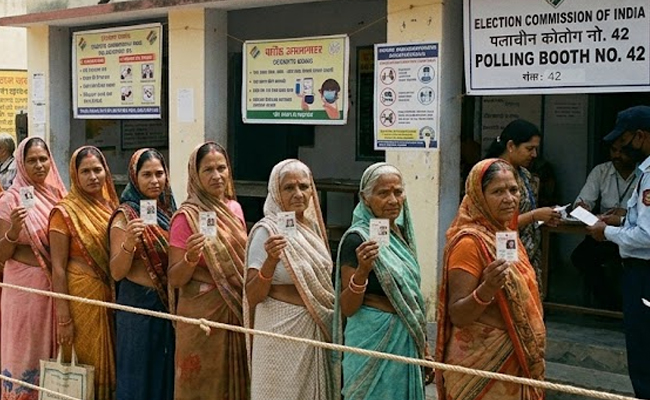
New Delhi (PTI): The recently-concluded assembly elections witnessed exceptionally high voter participation across states, with women voters outnumbering men in turnout percentages, according to Election Commission data.
West Bengal recorded the highest voter turnout among states, with 93.71 per cent polling in 293 constituencies where counting has been completed. The state saw over 6.38 crore votes cast, including postal ballots, against a total of more than 6.81 crore electors.
Women voters recorded a turnout of 93.8 per cent in the West Bengal Assembly polls, slightly higher than the 92.06 per cent participation among men.
The data for West Bengal does not include the figures for the Falta assembly constituency, which is scheduled for repolling.
Tamil Nadu registered an 85.01 per cent turnout, with nearly 4.8 crore votes polled from an electorate of 5.74 crore. Women voters recorded a turnout of 86.2 per cent, higher than the 83.77 per cent among men.
Assam also witnessed robust participation, with the final turnout touching 85.74 per cent. More than 2.15 crore votes were cast in the state, while female turnout at 86.53 per cent marginally exceeded the 84.95 per cent recorded among male voters.
Kerala registered a turnout of 78.11 per cent, with over 2.12 crore votes polled. Female voter participation stood at 81.17 per cent against 74.9 per cent among men.
Puducherry recorded a turnout of 89.82 per cent, with women voters again leading participation at 91.39 per cent. More than 8.5 lakh votes were polled in the Union territory.
Yet, women's representation among elected candidates remained modest.
Tamil Nadu elected 23 women MLAs (9.83 per cent) out of 234 members, West Bengal elected 37 women legislators (12.62 per cent) out of 293, while Kerala returned only 11 women MLAs (7.85 per cent) in the 140-member House.
Only two third-gender candidates contested the elections - one each from Tamil Nadu and Kerala, and both lost, forfeiting their deposits.
The elections also reflected extensive electoral mobilisation infrastructure. West Bengal had the highest number of polling stations at 85,092, followed by Tamil Nadu with 75,064 and Assam with 31,490.
In terms of candidates, Tamil Nadu saw the largest contest with 4,023 candidates in the fray across 234 constituencies, averaging 17 candidates per seat and peaking at 79 contestants in one constituency.
West Bengal pitted 2,920 candidates for 293 constituencies, while Kerala had the fewest contestants among the major states, with 883 candidates for 140 seats.
The data also showed relatively low NOTA votes across states. Tamil Nadu recorded the lowest NOTA share at 0.4 per cent of total votes polled, while Assam recorded the highest at 1.23 per cent. In West Bengal, 0.78 per cent of the total votes polled were NOTA, while it 0.77 per cent and 0.57 per cent of the electorate opted for None of the Above (NOTA) in Puducherry and Kerala, respectively.