Curtail election victory celebrations to contain COVID spread: Ex-PM Deve Gowda
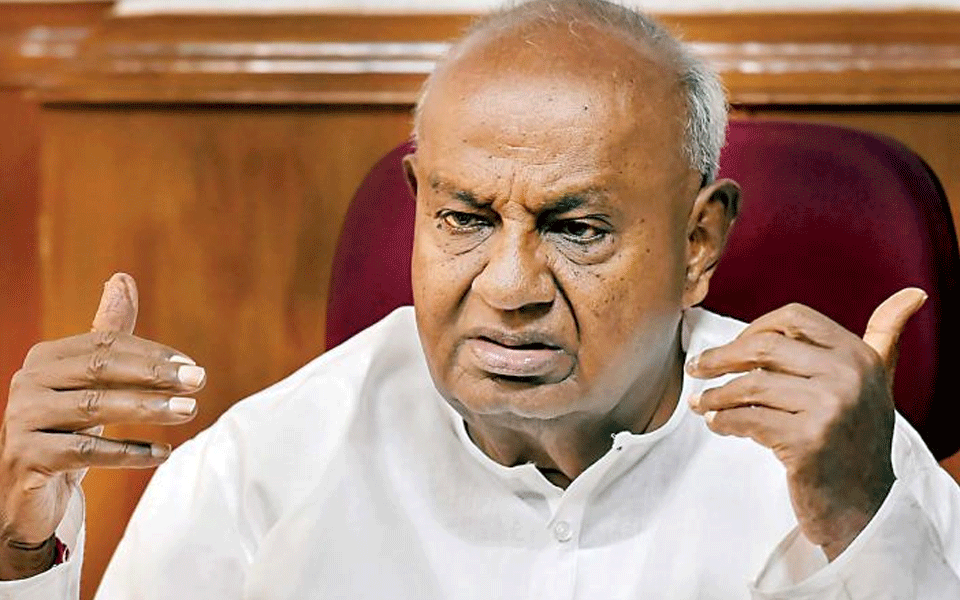
Bengaluru: Former Prime Minister H D Deve Gowda has called for curtailing election victory celebrations, and postponement of all byelections and local elections by six months as part of measures to fight the COVID-19 pandemic.
All large public gatherings should be banned for the next six months, the JD(S) supremo said in a letter to Prime Minister Narendra Modi offering a few suggestions to contain the spread.
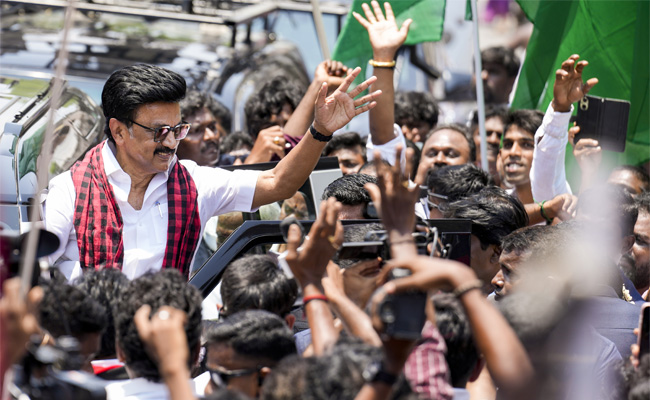
"Steps should be taken immediately to curtail election victory celebrations in States that have gone to polls this month. Since no state legislature's term is expiring after May this year, all byelections and local elections should be postponed by six months," the Rajya Sabha member said.
During this period, Gowda said, the Election Commission can evolve new rules for conduct of safe elections, and simultaneously, the vaccination programme has to be accelerated.
He assured the Prime Minister that he will support all constructive decisions and initiatives that the Union government may take under his leadership, to contain the pandemic, spread the vaccination programme, and save lives.
Stating that he believes that this is a time to act and act swiftly, Gowda said health administration and Covid management has to be quickly decentralised.
Medical professionals at all levels have to be urgently hired on short contracts to help district administrations, he said, adding, the authority to hire medical and para-medical personnel should be given to district collectors, district health officers and district hospitals.
According to him, it is not sufficient to have a war room at the state-level, in state capitals, but there should be war rooms at all district headquarters.
The focus currently has been on big cities.
But there is a greater danger lurking in non-urban districts and taluk centres. Village clusters also need urgent attention.
The Ministry of Rural Development and Panchayat Raj has to be deployed to coordinate these efforts.
All government departments have a role in this health crisis and not just the Ministry of Health, he suggested.
Gowda said there is no clear messaging on the vaccination front, and there is a lot of confusion among people, especially after the surge of the second wave.
Since many people who had taken the first and second dose of vaccination have also been infected there is lurking cynicism about the vaccines, he said.
It has to be clearly told that vaccines are the only best thing we have to protect not just our own lives but those of others too.
"Science has to be placed above every belief we may have and faith we follow".
Gowda said deadlines have to be set for people to get vaccinated as soon as state governments are confident of their vaccine stocks. Elected representatives at all levels have to be given specific targets to ensure vaccination in their respective constituencies.
Stating that the pricing of vaccines has created a lot of confusion, Gowda said private players are talking out of turn when such an enormous public health issue threatens humanity.
"Pricing should be done keeping in mind the poorest in the land. If the government decides to give vaccines free to all citizens that would be a great humanitarian gesture," he said.
Grace marks should be given in the NEET postgraduate examination for doctors who have been working in Covid hospitals this academic year, Gowda said, adding, this is because a majority of them have spent their time in Covid duties and have had little time to focus on their exam preparation.
"We should provide government job to one family member of Covid warriors who have lost their lives," he said. State governments, Gowda said, can create an informal communication network to help each other.
One Minister in each State can be put in-charge to both seek help from other state governments as well as offer help. This too is cooperative federalism.
"Members of the opposition with administrative experience should also be roped in. The virus does not understand political partisanship. This is a national crisis, and we should fight it as one nation," he said.
The Government of India should establish state-of- the-art vaccination production centres, one in north India and one in south India, in the immediate future, Gowda said.
According to him, plans and efforts to build long term public health infrastructure should begin immediately, and a larger percentage of our resources should be kept aside for public health.
Let the Truth be known. If you read VB and like VB, please be a VB Supporter and Help us deliver the Truth to one and all.
HC seeks mechanism on disclosure of complaints against judges after SC says no data maintained
New Delhi: The Delhi High Court sought suggestions for a framework to balance transparency and judicial independence on April 1, after the Supreme Court submitted that it does not maintain judge-specific data on complaints alleging corruption or misconduct.
The submission was made by Advocate Rukhmini Bobde. He appeared for the Supreme Court’s Central Public Information Officer, before Justice Purushaindra Kumar Kaurav in a petition filed by journalist and RTI activist Saurav Das. The case concerns an RTI application filed by Das in April 2023 seeking information on whether any complaints had been received against Justice T. Raja, former Acting Chief Justice of the Madras High Court, and if so, the number of such complaints and action taken.
According to a detailed report published by The Wire, the CPIO declined the request and stated that the information was “not maintained in the manner as sought for.” The first appellate authority upheld the decision. Although the Central Information Commission remanded the matter, the CPIO reaffirmed the refusal on similar grounds, which led Das to move the high court through Advocate Prashant Bhushan.
At the hearing, Justice Kaurav observed that the issue had wider institutional implications. It directed both sides to propose a mechanism that would protect the reputation of judges while ensuring public access to information regarding the handling of complaints. The case, Saurav Das v. CPIO, Supreme Court of India has been listed for further hearing on May 7.
During the arguments, Bhushan cited numbers released by the Union Law Ministry in Parliament in February 2026, which said that 8,630 complaints had been filed against sitting judges between 2016 and 2025. The Supreme Court provided data showing that complaints increased from 729 in 2016 to 1,102 in 2025. Bhushan questioned how aggregate data could be calculated without identifying the judges against whom complaints were filed.
Bobde responded that the data shared with Parliament reflected only total complaints against all sitting judges and did not involve judge-wise categorisation. She referred to the RTI request as a "fishing and roving inquiry." She also claimed that the Registry could not be forced to spend resources to collect material that was not stored in the format sought. She referenced the 2019 Constitution Bench decision in Supreme Court of India v. Subhash Chandra Agarwal, which allows for rejection if compliance will disproportionately divert resources, as her justification.
The high court questioned how no judge-specific information was maintained and expressed concern that disclosure of large aggregate figures without clarity on how complaints were handled could affect public perception. Justice Kaurav noted that an applicant could not be denied information solely on technical grounds relating to format.
Bhushan argued that the RTI request did not seek details of complaint contents or collegium deliberations but merely whether complaints were received and what action followed, submitting that transparency in the handling of complaints was essential to maintain public confidence.
The Supreme Court’s in-house procedure for examining complaints, adopted in 1999, provides for scrutiny by the Chief Justice of India and, where warranted, inquiry by a committee of judges. There is no statutory requirement for public reporting of outcomes.