Death of five tigers: Discovery of cow carcass strengthens poisoning doubt
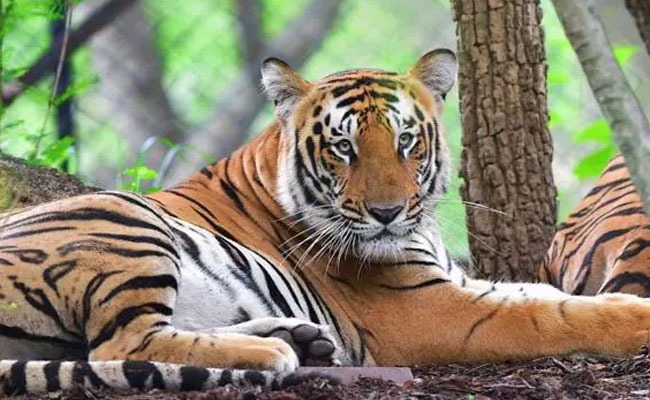
Bengaluru (PTI): The discovery of a seemingly stale carcass of a cow in Hugyam forest range in Mahadeshwara Hills on Friday strengthens the doubt that the death of a tigress and her four cubs could be due to poisoning, officials said.
These five tigers were found dead in this forest on Thursday.
It is suspected that the miscreants had poisoned the cow, and after eating it, the tigress and its cubs might have died.
"Either the bovine was poisoned before being left in the forest, or the owner of the cattle, after spotting the dead cow, would have spread poison on its body, which the tigress and her cubs ate and died," the officer said.
Karnataka Forest Minister Eshwar Khandre too backed the same theory.
He said someone might have poisoned the cattle, which led to the death of the big cats.
"Our government has taken the matter very seriously, and we will investigate it from all angles. We will not spare those behind it," Khandre told reporters.
While the autopsy on the mother tigress was done on Thursday itself, the postmortem on the four cubs was underway on Friday, the forest officials said.
The tigress and the cubs were found dead during routine morning patrol by vigilant frontline staff, officials said.
A five-member team of experts on Thursday undertook a comprehensive necropsy following NTCA (National Tiger Conservation Authority) protocols.
The tissue, blood, and stomach samples were being processed for toxicology, histopathology, and DNA profiling, forest officials said.
Following the incident, the forest department has strengthened monitoring and anti-poaching vigilance across the Hugyam range.
According to Kandre, real-time drone surveillance, infrared cameras, and GPS-based M-STRIPES patrols have been escalated across the range, and all Anti-Poaching Camps (APCs) are on high alert.
Intensive sweeps for snares, poison baits, and traps are being conducted, and a confidential informer network with reward mechanisms is operational for actionable intelligence, Khandre had said on Thursday.
Karnataka had the second highest number of tigers in the country, with 563 of these big cats, after Madhya Pradesh, which has 785, as per the Status of Tigers, Co-predators and Prey in India 2022 report.
The report was released by the National Tiger Conservation Authority (NTCA).
Let the Truth be known. If you read VB and like VB, please be a VB Supporter and Help us deliver the Truth to one and all.
Power tariffs under BESCOM to rise from May 1

Bengaluru (PTI): Power bills for consumers under the Bangalore Electricity Supply Company Limited (BESCOM) will go up from May 1, following an order issued by the Karnataka Electricity Regulatory Commission (KERC) on Friday.
The hike comes after KERC allowed the BESCOM to recover a revenue deficit of Rs 2,068 crore incurred in 2024-25, from the consumers.
As a result, for every unit of electricity consumed in 2024-25, the customers will be charged an additional 56 paise, it said.
"BESCOM shall calculate, for each of the active consumers of FY2024-25 the amount to be recovered based on their actual energy consumption during FY2024-25. Such amount shall be recovered during FY 2026-27 in equal monthly instalments, to be called as 'FY25 True up Charges', commencing from the first meter reading date falling on or after 1 May 2026 and concluding with the reading date ending on 30 April 2027," the order said.
"It is further ordered that BESCOM shall maintain a separate head of account, allocated for the purpose, to record the adjustment of the said amount to ensure full recovery of the deficit," it added.
Similarly Chamundeshwari Electricity Supply Corporation Limited (CESC) has also recorded a revenue deficit of Rs 121.71 crore and can collect an additional 15 paisa per unit for consumption in 2024-25, official sources said.