Defence Minister Rajnath Singh inaugurates Missile Integration facility at BEL
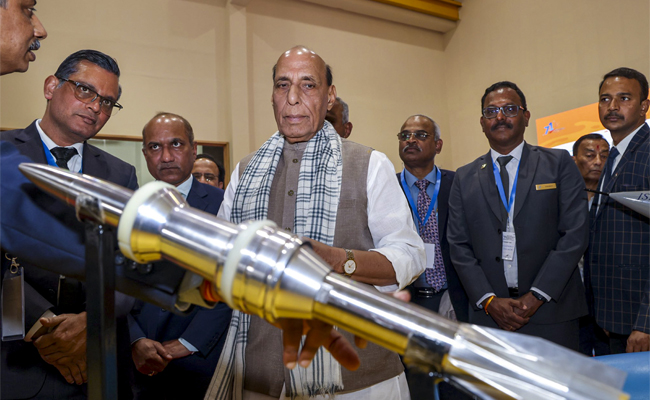
Bengaluru (PTI): Defence Minister Rajnath Singh on Monday visited the Bharat Electronics Ltd here, and inaugurated the Missile Integration facility at the premises, officials said.
He also flagged-off the Akash 3rd and 4th Regiment Combat systems and unveiled the Mountain Fire Control Radar, they said.
Singh also remotely inaugurated the Centre of Excellence for Artificial Intelligence (CoE-AI) located in Pune, and formally launched the company’s AI Policy.
According to an official statement, the Union Minister was briefed on a range of advanced indigenous defence technologies, including AI-based solutions developed by Indian start-ups, highlighting the growing emphasis on innovation and indigenisation in the defence ecosystem.
He commended BEL (Bharat Electronics Limited) for making headway in cutting-edge technologies such as electronic warfare systems, avionics, naval platforms, electro-optics, and tank electronics.
“BEL has strengthened the network-centric operations. Its integrated systems, real-time data sharing, and decision support capabilities have taken our combat effectiveness to a new level,” Singh said.
The Defence Minister was apprised of the ongoing R&D activities at BEL aligned with major national defence programmes, including the Quick Reaction Surface to Air Missile Systems (QRSAM), Light Combat Aircraft Mark II (LCA Mk II), Advanced Medium Combat Aircraft (AMCA), Project Kusha (MR SAM/LR SAM), Counter Drone Systems, Naval Weapon Control Systems, etc.
The briefing highlighted that indigenous R&D initiatives are enhancing operational preparedness across land, air, naval, and strategic domains, while reducing dependence on foreign technologies.
Singh acknowledged the fact that the systems developed in airspace defence, and counter-drone operations have demonstrated that India’s indigenous solutions can meet global standards.
According to him, indigenously developed air defence and anti-drone systems were effectively utilised to neutralise threats during Operation Sindoor.
“The advancement in threat prediction, early warning, and response mechanisms using AI instills operational confidence in our soldiers. They’re assured that a strong scientific and engineering ecosystem always stands with them,” he added.
Singh underscored the importance of achieving victory with indigenous weapons and technologies in today’s times, saying that only a self-reliant win gives the country renewed confidence.
The defence minister stressed that AI and quantum computing are no longer futuristic concepts, and their use in real-time decision-making, autonomous systems, cyber defence, and precision operations is changing battlefield dynamics.
For India to become a developed nation, he exhorted BEL, other DPSUs and industry partners to stay ahead of the curve in the new revolution that lies ahead.
He encouraged the R&D community at BEL to collaborate with start-ups, industry, and academia for agile product development using the latest technologies in AI and autonomous systems.
Singh also stressed upon the need for BEL to prioritise cross-disciplinary collaboration, innovation, and rapid prototyping to create world-class products, aligning with the vision of a 'Viksit Bharat'.
"Indigenisation initiatives undertaken by Central Research Laboratories, CoE-Electronics Warfare and Photonics, CoE-Communication, CoE-Radar and Weapon Systems and Product Development and Innovation Centre of BEL were showcased during the briefing. The start-ups and industry partners also exhibited their products," the statement said.
Singh also interacted with start-ups and young scientists and motivated them to come out with more and more advanced Indigenous technologies.
Let the Truth be known. If you read VB and like VB, please be a VB Supporter and Help us deliver the Truth to one and all.
Karnataka Speaker Khader finishes fourth in Dirt Prix event
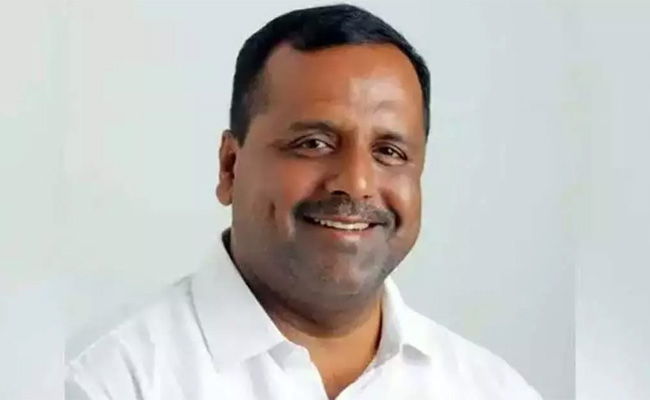
Mangaluru (PTI): Karnataka Legislative Assembly Speaker U T Khader on Sunday finished fourth in a dirt track racing event organised by the Indian Motor Sports Club here.
Driving a Volkswagen Polo GT, Khader narrowly missed a podium finish, ending just seconds behind the third-place finisher.
An avid motorsport enthusiast since his college days, Khader has participated in several racing events involving both motorcycles and cars.
Organisers said his performance on the dirt track was consistent with his previous racing record.
Speaking informally after the event, Khader said he continues to follow motorsport and enjoys driving, describing the experience as a "refreshing change" from his official responsibilities.
The Dirt Prix event saw participation from multiple racers and was aimed at promoting grassroots motorsport.