Delegation of Kannadiga NRI leaders led by Dr. Ronald Colaco meets CM, DCM
Seeks immediate action on pending NRI Ministry, grievance cell, ₹1,000 Crore Fund
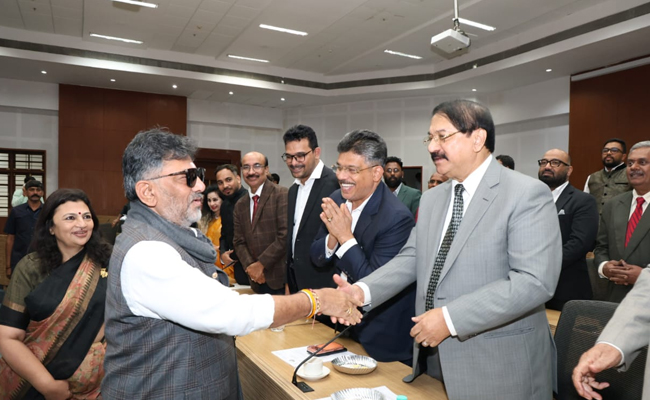
Bengaluru: A large delegation of Kannadiga NRIs representing organisations across several countries met Chief Minister Siddaramaiah and Deputy Chief Minister D. K. Shivakumar in Bengaluru to press for long-pending commitments made to the global diaspora. The delegation was led by Dr Ronald Colaco, who has been entrusted by various NRI organisations to place before the government their concerns and expectations. Zakaria Jokatte from Saudi Arabia was among the members representing the Middle East diaspora during the meeting.
The appeal was formally presented through a detailed memorandum and pointwise presentation submitted to both leaders. The delegation reminded the government of two major promises included in the 2023 Assembly Election Manifesto: the creation of a separate Ministry and Department for NRI Kannadigas, and the setting up of a ₹1,000 crore revolving fund to support investments and relocation plans of Kannadiga NRIs.
The memorandum noted that more than half the government’s term has passed without progress on either commitment, leading to disappointment among Kannadigas living abroad. It stated that many NRIs feel their concerns remain unaddressed, their contributions undervalued, and their issues unprotected due to the absence of an institutional mechanism. The presentation explained that Karnataka, despite having one of the largest skilled diasporas, still lacks a structured NRI department even though several states — including Kerala, Gujarat, Punjab, Tamil Nadu, Andhra Pradesh, Telangana, Uttar Pradesh, and Goa — already have dedicated units and diaspora policies.
The delegation said that fulfilling the manifesto would help rebuild confidence, restore goodwill, and strengthen Karnataka’s global engagement.
The first appeal placed before the CM and DCM was the immediate creation of an “NRI Kannadiga Affairs Ministry and Department.” According to the representation, this department would act as a single-window authority to handle all NRI-related matters. This includes investment facilitation, grievance redressal, property and legal disputes, and support for cultural and educational exchanges. It would also strengthen Karnataka’s international connections for trade, tourism, technology transfer, and global partnerships.
The supporting pointwise presentation submitted by the delegates said that without a nodal department, NRI complaints continue to remain scattered between various departments such as Home, Revenue, Police, Urban and Rural Development, Industries, Labour, and sub-registrar offices. As a result, many cases remain unresolved for years.
The delegation urged the government to act quickly on the second manifesto promise by putting in place the ₹1,000 crore revolving fund meant to support NRKs who want to invest in industries, services, start-ups, or skill-based projects in Karnataka. The memorandum said the fund would help generate employment, bring new investments, and support the return of skilled Kannadigas who wish to settle back home. It stressed that the fund should be seen not as an expenditure but as an investment that would yield large economic benefits and strengthen the State’s economy.
The delegation also placed several supplementary recommendations, including:
* Formation of an NRI Grievance Redressal Cell to address property fraud, land disputes, delayed legal processes, and other issues commonly faced by NRIs.
* An annual Global Kannadiga Conclave hosted by the government to bring together investors, professionals, and community leaders.
* Simplified procedures to help NRIs take part in state development projects, CSR activities, cultural preservation efforts, and tourism promotion.
* Introduction of an NRI Identity Card to help NRKs access government services during visits to Karnataka.
* Formal partnerships with NRI associations abroad for cultural, educational, and trade-related initiatives.
The memorandum described the global diaspora as Karnataka’s “ambassadors” who contribute to the State’s identity, remittances, investments, technology links, cultural promotion, and economic growth. The pointwise presentation added that NRKs face unique challenges—such as property fraud, forgery, land grabbing, and delayed legal remedies—because they live abroad and cannot pursue matters for years. It stated that a dedicated mechanism is not a luxury but a necessity.
The delegation included Kannadiga representatives from the UAE, Saudi Arabia, Qatar, Bahrain, Poland, Italy, Sweden, Australia, Germany, Kuwait, and the USA. The list features members such as Zakaria Jokatte from Saudi Arabia, Dr Ravi Shetty from Qatar, Praveen Kumar Shetty from the UAE, Ajith Bangera from Bahrain, Harsha Jagadeesh from Sweden, and many others from across 38 entries recorded in the official list submitted to the government.
Dr Ronald Colaco, presenting the appeal on behalf of global NRK organisations, told the CM and DCM that Kannadiga NRIs remain a vital part of Karnataka’s cultural and economic base. He said their contributions in remittances, philanthropy, skill-building, and global reputation continue to support the State silently and significantly. The delegation urged the government to take up the implementation of the promised NRI Ministry and the revolving fund at the earliest to rebuild confidence and goodwill among Kannadigas worldwide.


Let the Truth be known. If you read VB and like VB, please be a VB Supporter and Help us deliver the Truth to one and all.
Four children drown in lake while trying to catch ducks in Chikkamagaluru

Chikkamagaluru: Four children drowned in a lake in Aralaguppe village after reportedly going to catch ducks, police said.
The deceased have been identified as Mahdia, Arunus, Nayus, and Abdul Rehman. The children were aged between 5 and 14 years. Another child, Armaan (4), escaped unhurt.
Police said the incident occurred at Karanji Lake in Aralaguppe village. Rural police visited the spot and are investigating the case. A case has been registered at the local rural police station.