Delhi court sends Congress leader D K Shivakumar to judicial custody till Oct 1
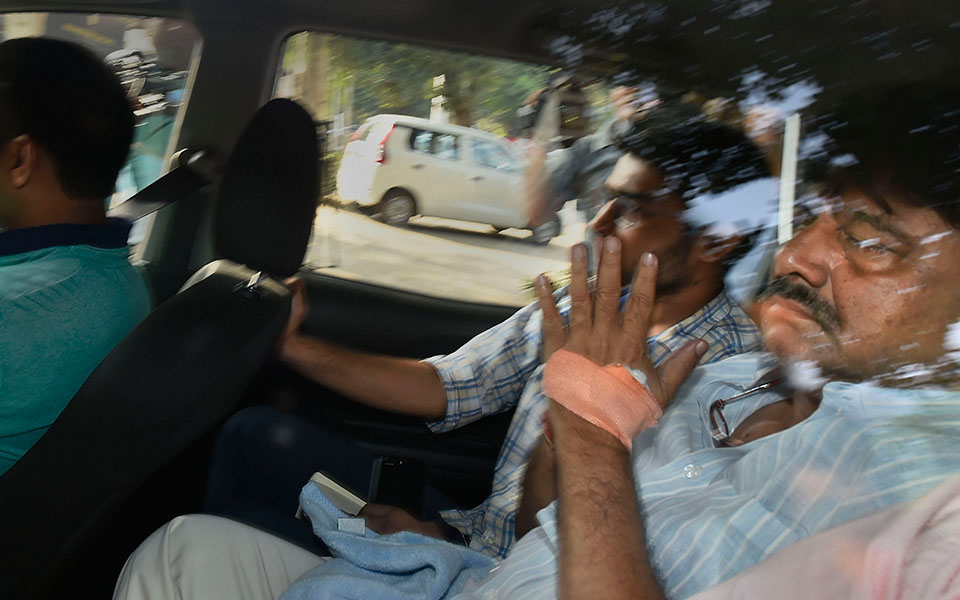
New Delhi, Sep 17: A Delhi court Tuesday sent Karnataka Congress leader D K Shivakumar, arrested in a money laundering case by Enforcement Directorate, to 14-day judicial custody.
Special judge Ajay Kumar Kuhar directed the ED to take Shivakumar to hospital first and to see whether doctor suggests admitting him there.
"It is directed that the accused be first taken to the hospital and only after his medical condition is opined to be stable, he be sent to judicial custody in Central Jail, Tihar... The accused is remanded to judicial custody till October 1," the judge said in the order.
The court has listed Shivakumar's bail plea for hearing on Wednesday at 3.30 pm.
The judge said that in case the MLA is admitted to the hospital, his custody be taken over by the Superintendent of Tihar jail and the doctors hand over his custody only on his discharge.
"In case, he is admitted in the hospital, his custody shall be taken over by the Superintendent Central jail, Tihar who shall provide guards for the accused. In case of his admission in the hospital, the doctors shall hand over his custody to the Superintendent, Central jail, Tihar only on his discharge," said the judge.
The judge also said that in case Shivakumar was taken to Tihar jail, then the authorities permit him to take his medicines subject to the approval of doctor on duty in the jail.
The court took into consideration the medical records of Shivakumar, which said that he suffered from hypertension and fluctuating blood pressure and has undergone angioplasty earlier and is on a heavy medical dosage.
The probe agency claimed in the court that his interrogation was yet to be completed and sought permission from the judge to question him during the judicial custody.
Additional Solicitor General (ASG) K M Nataraj and Special Public Prosecutors Amit Mahajan, N K Matta and Nitesh Rana, appearing for the ED, told the court that Shivakumar's health condition did not allow his effective questioning.
The Congress leader's counsels opposed the ED plea for judicial custody and sought his bail on medical grounds.
Senior advocates A M Singhvi and Mukul Rohatgi, appearing for Shivakumar, submitted in the court that the MLA's health condition was very serious and he was close to a heart attack; therefore, he be granted bail.
The ASG told the court that Shivakumar was taken to hospital as directed by court and due to his aliment, his interrogation could not be continued.
Singhvi further said that only Rs 41 lakh was recovered from Shivakumar and not Rs 8.5 crore, as alleged by the ED and now surprisingly the figure has become Rs 143 crore.
He alleged that ED is biased and mala fide and is lying before the court about the investigation.
The agency's claim about 317 bank accounts was only to spoil Shivakumar's image in media and public, he added.
Rohatgi, also representing Shivakumar and seeking bail for him, said he was a 7-time MLA and not a flight risk.
It is a case based on documentary evidence and there was no ground to keep Shivakumar in custody as he has no criminal antecedent, he said.
Rohatgi further said that this is a case of granting bail and the court can impose conditions; if not, then granting medical bail to Shivakumar should be considered.
Opposing the bail plea, ED said that it had taken care of his medical conditions.
It also alleged that laundering of money took place through bank accounts of the MLA and his family members.
Shivakumar, arrested on September 3 by the ED in a money laundering case, was produced before the court Tuesday on the expiry of his custodial interrogation.
Let the Truth be known. If you read VB and like VB, please be a VB Supporter and Help us deliver the Truth to one and all.
AIITA welcomes Karnataka’s ban on obscene songs in school events

Bhatkal: The Karnataka unit of the All India Ideal Teachers Association (AIITA) has welcomed the Karnataka government’s decision to strictly ban school children from dancing to obscene songs during educational and cultural programmes in government, aided, and private schools across the state.
AIITA Karnataka State President M. R. Manvi congratulated the government for taking what he termed an important step to preserve the sanctity of education.
“Such decisions to safeguard the dignity of school children and uphold the values of education are the need of the hour. This rule should not be limited to government schools alone but must be strictly implemented in all private educational institutions as well,” he said.
He further urged the government to address other concerns within school programmes.
“The government should not only prohibit obscene dances in the name of school anniversaries, but also ensure that plays and dialogues that incite religious hatred are avoided. Schools should be centres of harmony, not platforms for spreading hatred,” he added.
According to a recent circular issued by the Department of School Education and Literacy, obscene dances are adversely affecting the mental health and moral values of students.
In this regard, schools have been advised to use songs that promote nationalism, positive thinking, the greatness of Kannada culture, and value-based traditions instead of inappropriate content during programmes.
The circular also emphasises that students should be dressed in decent attire.
AIITA also backed the department’s warning that disciplinary action would be taken against head teachers if such guidelines are violated. The association has further demanded that district Deputy Directors of Public Instruction strictly monitor the implementation of these rules.