Delhi Police allegedly attempt to arrest civil rights activist Nadeem Khan in B'luru without warrant
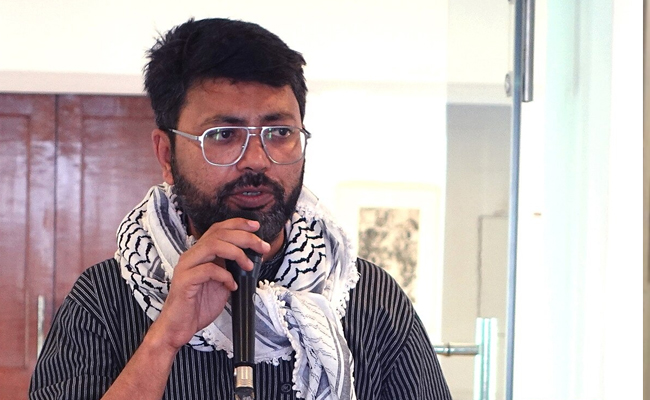
Bengaluru: On November 30, Delhi Police allegedly attempted to arrest human rights activist and National General Secretary of the Association for Protection of Civil Rights (APCR), Nadeem Khan, without a warrant.
Four officers, including the Station House Officer (SHO) of Shaheen Bagh Police Station in Delhi, arrived at Khan's residence in Sampigehalli, Bengaluru, at approximately 5 PM. The officers allegedly tried to detain Khan for an investigation into an FIR (No. 0280/2024) filed earlier that day at Shaheen Bagh Police Station in Delhi.
The FIR, filed in relation to an exhibition organised by Khan that highlighted recent incidents of hate crimes and hate speeches in India, as well as the Supreme Court’s guidelines on mob violence, includes alleged violations under Sections 196, 353(2), and 61. These offences carry punishments of less than three years, and under Arnesh Kumar v. State of Bihar and Section 35 of the BNSS Act, arrest is prohibited for offences punishable with less than seven years of imprisonment without a warrant or an order from the magistrate. Despite this, the police reportedly continued to intimidate Khan and his family. Local police from Sampigehalli were reportedly not informed about the operation.
Adv. Mohammed Niyaz, State Secretary of APCR Karnataka, who spoke to Vartha Bharati, condemned the police action. He stated that the officers initially claimed they were there to detain Nadeem Khan but changed their version when questioned about the non followance of the procedure, saying they were not there to arrest him but merely to deliver a notice.
Earlier, on November 29, around 20-25 police officers had visited the APCR office in Delhi without notice or any legal justification. They reportedly inquired about Khan and other members of the organization. The police officers were said to have misbehaved with lawyers when asked about the basis for their visit.
Adv. Niyaz also confirmed that Khan had left for Delhi and would continue to challenge the attempt to arrest him and the FIR through legal means.
Let the Truth be known. If you read VB and like VB, please be a VB Supporter and Help us deliver the Truth to one and all.
Pune journalist booked on voyeurism charge for filming woman at lodge

Pune (PTI): Police have registered a case of voyeurism against a television journalist in Pune for allegedly filming a woman in an objectionable position without her consent at a lodge in the city, officials said on Saturday.
The FIR was filed against Rohan Kadam under Bharatiya Nyaya Sanhita (BNS) sections 77 (voyeurism) and 3(5) (common intention) at the Vishrambaug police station here, while the complaint mentions that he was accompanied by three other journalists, they said.
The incident took place on April 8 when the accused had checked into a room at a lodge in Budhwar Peth, which houses a red light area.
In her complaint, the woman said that while she was wearing her saree after establishing "physical relations with a customer", she realised that an unidentified person was filming her through a net above the partition wall between the rooms.
She opened the door of her room and knocked on the adjacent door, asking the person to come out, the FIR said.
"The woman sought clarification from Kadam, who gave vague answers and refused to show his phone. When the lodge operator, the woman and others questioned him, he claimed that they were a group of four journalists conducting a sting operation," it said.
Police said Kadam was assaulted when he allegedly tried to flee from the spot.
The woman later approached the Vishrambaug police station and lodged a complaint.
"We have registered a case in this regard and further probe is on," a police officer said.
Meanwhile, the Pune Union of Working Journalists (PUWJ) has written a letter to city Police Commissioner Amitesh Kumar, seeking action against the journalist for the alleged act.
In the letter, the journalists' body said there were murmurs that some journalists and others were trying to ensure that no offence is registered in the matter.
"We do not agree with this and clarify that PUWJ will not come in the way of the probe," the letter stated.