DK Shivakumar invites Kannadiga NRIs' suggestions to Congress manifesto for K'taka polls
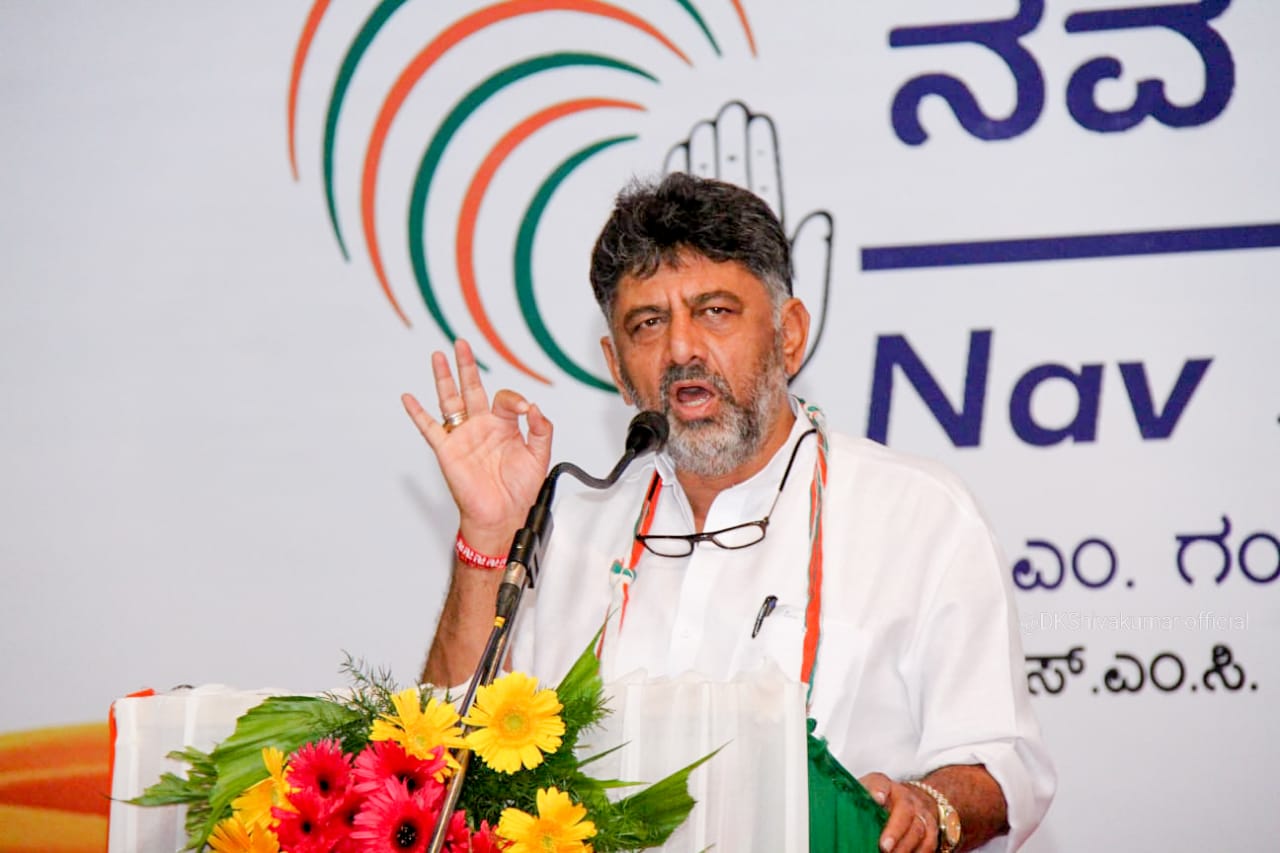
Bengaluru: Preparing for the assembly elections, Karnataka Congress president D K Shivakumar on Tuesday invited Kannadiga Non Resident Indians (NRIs) to share their suggestions for the party's manifesto ''Global Karnataka, Better Karnataka''.
Karnataka is likely to go for assembly polls by April-May next year.
''Kannadigas have made India proud by serving at the global level. The contributions of Kannadigas are unparalleled as many world leaders are recognising India through Bengaluru and Karnataka. But today, Karnataka has also got a stigma. We need to cleanse it and make our state and its identity proud,'' Shivakumar said in the video statement.
Insisting that Kannadiga NRIs should suggest as to how the state and its governance change for better, he said, ''I'm seeking advice from you to make Global Karnataka, a Better Karnataka.'' The KPCC chief also requested Kannadigas settled across the world to share their frank and fair opinions along with suggestions about the areas where the state needs to improve its functioning and also the ways how innovations can be incorporated.
Former State Congress president Dr G Parameshwara-led Manifesto Committee will finalise the draft. The party has shared an email id 'makekarnatakaproud@gmail.com' for people to share their suggestions for the manifesto.
Congress aims to come back to power by winning at least 150 out of 224 seats in the Karnataka assembly.
ಕರ್ನಾಟಕದ ಅಭಿವೃದ್ಧಿಯಲ್ಲಿ ಮಹತ್ವದ ಪಾತ್ರ ವಹಿಸುತ್ತಿರುವ ಅನಿವಾಸಿ ಕನ್ನಡಿಗರಲ್ಲಿ ನನ್ನದೊಂದು ಮನವಿ. ಬೆಟರ್ ಕರ್ನಾಟಕ, ಗ್ಲೋಬಲ್ ಕರ್ನಾಟಕ ನಿರ್ಮಾಣದ ಕನಸಿಗಾಗಿ ನಮ್ಮೊಂದಿಗೆ ಕೈ ಜೋಡಿಸಿ.
— DK Shivakumar (@DKShivakumar) December 13, 2022
ನಿಮ್ಮ ಸಲಹೆಗಳನ್ನು makekarnatakaproud@gmail.com ಗೆ ಕಳಿಸಿ. pic.twitter.com/pvTC4Rc60Q
Let the Truth be known. If you read VB and like VB, please be a VB Supporter and Help us deliver the Truth to one and all.
MP cruise boat tragedy: Search ops expanded to trace four missing passengers
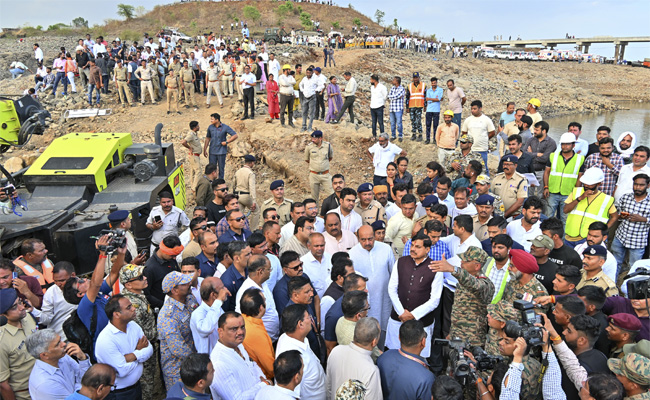
Jabalpur (PTI): Army divers and disaster response teams on Saturday expanded their search at Bargi Dam in Madhya Pradesh to locate a man and three children still missing after the cruise boat tragedy that claimed nine lives two days ago, officials said.
With 28 of the 41 identified passengers onboard the ill-fated cruise boat rescued safely, police are preparing to register an FIR in connection with the accident that occurred at the reservoir in Jabalpur district on Thursday evening, they said.
The search radius has been expanded to 5 km in the backwaters of the Bargi Dam, located downstream of the Narmada River, area sub-divisional officer of police (SDOP) Anjul Ayank Mishra told PTI.
Nine people drowned in the incident, while 28 were rescued, and efforts are ongoing to trace the missing persons, he said.
ALSO READ: Alleging unauthorised sorting of postal ballot covers, TMC files complaint with EC
According to the police, more than 200 rescuers, including around 20 Army divers airlifted from Agra, began the search operation at 5 am on Saturday to trace Kamraj, an employee of the Ordnance Factory in Khamaria, his son Tamil (5), Vijay Soni (6) and Mayuram (5).
Mishra said that an inquest case has been registered and the post-mortem of nine deceased persons has been completed.
"Our priority is to search for the missing persons. We will soon register an FIR," he said.
Investigators have said that CCTV footage near the boarding point showed 43 people heading towards the ill-fated boat, and the names of 41 persons, who boarded the vessel, have been ascertained so far.
Collector Raghvendra Singh confirmed that a search is underway for four missing persons.
The rescue operation, being carried out by the National Disaster Response Force (NDRF), State Disaster Response Force (SDRF) and local divers, was briefly affected around 9 am due to strong winds.
The state government on Friday ordered a probe into the incident and dismissed three crew members after survivors alleged negligence and safety lapses, including failure to provide life jackets.
The government also banned the operation of similar vessels in the state.
The boat, operated by the state tourism department, sank during a sudden storm around 6 pm on Thursday, and the wreckage was retrieved from the dam water on Friday, after the rescuers confirmed that there were no more bodies inside.
Eyewitnesses have said that strong winds made the water choppy, prompting passengers to raise an alarm and ask the crew to steer the vessel towards the riverbank.
A survivor alleged negligence by the crew and described a last-minute scramble for life jackets.