DK Shivakumar welcomes BJP’s black flags in Chennai, says good wishes to 'poor man' Annamalai
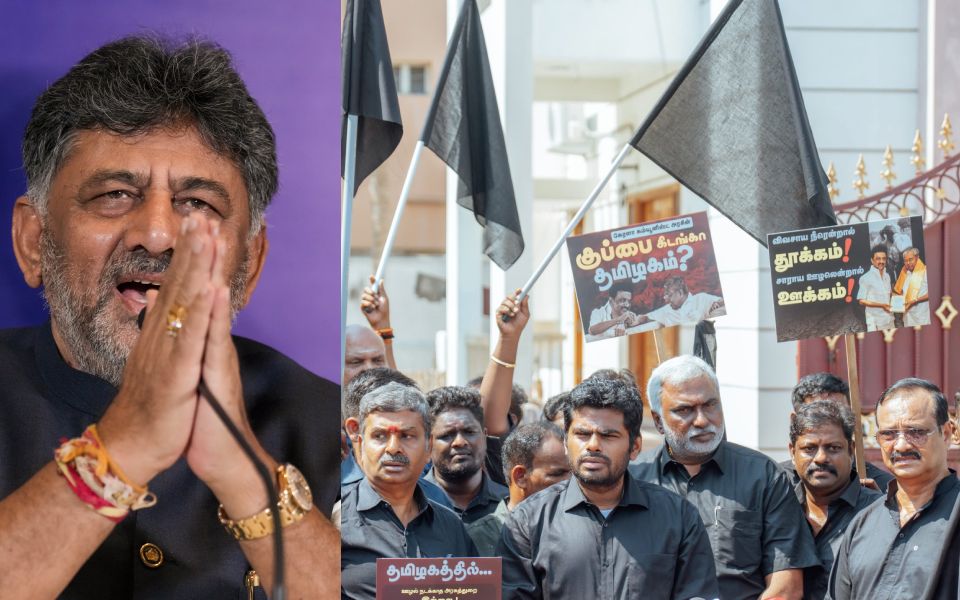
Chennai/Bengaluru, Mar 22 (PTI): Karnataka Deputy Chief Minister D K Shivakumar said he welcomed the black flags shown to him by the BJP when he reached Chennai on Saturday.
Shivakumar was in Chennai on an invitation by DMK chief and Tamil Nadu Chief Minister M K Stalin to participate in a meeting to discuss the fallout of delimitation.
Some state governments, especially the southern states, have expressed their apprehensions that they would lose their hold if the delimitation happened based on the population.
Calling the BJP Tamil Nadu president K Annamalai a "poor man", Shivakumar said he had served Karnataka during his stint as an IPS officer.
"I welcome all these BJP black flags. I was never afraid when they sent me to Tihar Jail (in New Delhi)," Shivakumar told reporters responding to a query in Chennai.
Shivakumar was booked and jailed along with others for alleged offences under the Prevention of Money Laundering Act (PMLA). The Supreme Court later quashed the money laundering case against him.
"This officer (Annamalai), poor man, is from my state. He has served us. He knows our strength. Let him do his job. I wish him all the best," the Deputy CM told reporters.
In reply, Annamalai thanked Shivakumar for wishing "this poor man".
"Yes, I diligently served Karnataka's people as a Police Officer. Thanks for the noteworthy mention Thiru @DKShivakumar avare," the BJP TN chief said in a social media post on 'X'.
"Also, thank you for wishing this poor man & my best wishes to you in your undying efforts in the pursuit of becoming the CM of Karnataka by toppling Thiru Siddaramaiah from his chair!" he added.
The BJP has opposed the meeting convened by Stalin.
Yes, I diligently served Karnataka's people as a Police Officer. Thanks for the noteworthy mention Thiru @DKShivakumar avare.
— K.Annamalai (@annamalai_k) March 22, 2025
Also, thank you for wishing this poor man & my best wishes to you in your undying efforts in the pursuit of becoming the CM of Karnataka by toppling… pic.twitter.com/U5ZN8emCOF
Let the Truth be known. If you read VB and like VB, please be a VB Supporter and Help us deliver the Truth to one and all.
'Ab kya hoga, ye rab jane...': Tharoor takes dig at failed US-Iran talks in Pakistan
 (3)_vb_24.jpeg)
New Delhi (PTI): Senior Congress leader Shashi Tharoor on Monday took a swipe at the "failed" US-Iran peace talks in Pakistan with an Urdu couplet, saying only god knows now what will happen.
"Ab kya hoga, ye rab jane; Na woh mane, na ye mane (only god knows what will happen now as both sides did not agree)," Tharoor said on X, tagging a post-talks video clip of US Vice President J D Vance, who led the American delegation at the negotiations in Islamabad.
The United States and Iran failed to reach a peace deal at their historic 21-hour talks in Pakistan, leaving the fate of a tenuous two-week ceasefire in doubt, with both sides attempting to hold each other responsible for the collapse of the negotiations.
अब क्या होगा, ये रब जाने
— Shashi Tharoor (@ShashiTharoor) April 13, 2026
ना वो माने, ना ये माने https://t.co/DYrXpa7C8h
Vance said the Iranian side did not accept Washington's terms for ending the war even as the US presented its "final and best offer".
Hours after the talks collapsed, US President Donald Trump said on social media that the negotiations with Tehran failed as "Iran is unwilling to give up its nuclear ambitions".
Trump said the US Navy will actively interdict any vessel in international waters found to have paid tolls to Iran for transiting through the Strait of Hormuz, a critical shipping route that handles roughly 20 per cent of global oil and LNG (Liquefied Natural Gas).
Iranian Parliament Speaker Mohammad Bagher Ghalibaf, the head of the Iranian negotiation team, said it is for the US to decide whether it can "earn our trust or not".
The Iranian foreign ministry, without elaborating, said the US side resorted to "excessive" and "illegal demands".
The failure to reach an agreement has dimmed the prospect of reopening the Strait of Hormuz to stabilise the global energy marke