Driver can't be punished for death of petitioner's pet dog as there is no enmity, says K'taka HC
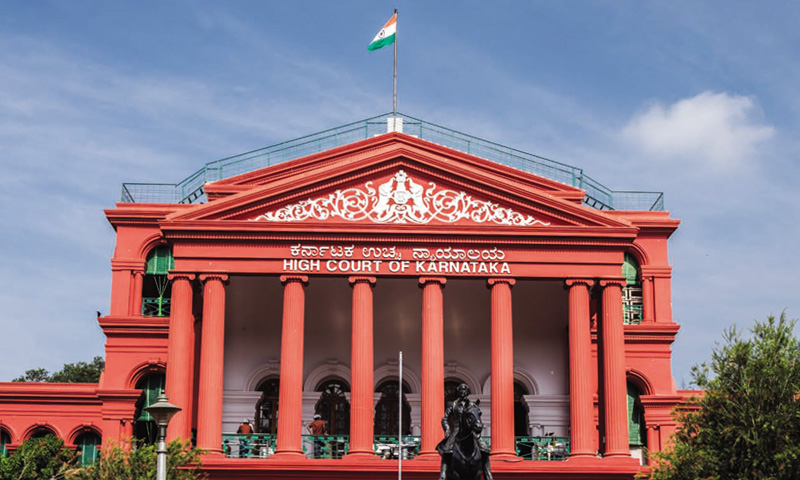
Bengaluru, Oct 29: The Karnataka High Court has quashed a case pending in a lower court against a car driver who was charged under various sections of the Indian Penal Code (IPC) and Motor Vehicles Act for causing an accident that led to the death of a petitioner's pet dog.
Prathap Kumar G was driving his sports utility vehicle (SUV) in Vijayanagar, Bengaluru, on February 24, 2018 when his car hit a pet dog named Memphi. Dhiraj Rakheja, whose mother was taking the dog for a walk, filed a complaint.
The Vijayanagar police investigating officer conducted the investigation and filed a charge sheet against the petitioner for offences under Section 134(A & B) and 187 of the Motor Vehicles Act, and Sections 279, 428, and 429 of IPC. The case was pending before the Metropolitan Magistrate Traffic Court-II, Bengaluru.
Quashing the case pending before the lower court, Justice Suraj Govindraj in his October 21 judgement said, "Having come to a conclusion that there is no offence made out under Section 134 (a) and (b) of M.V Act, Section 187 of M.V Act, Section 279 of IPC as also under Section 428 and 429 of IPC, I am of the considered opinion that the continuation of the criminal proceedings would only be an abuse of process of court and would cause injustice to the petitioner to suffer the ignominy of a criminal trial."
On the question of whether an offence under Section 134 (A & B) of the Motor Vehicles Act, 1988 would get attracted in the event of an accident involving a pet animal, the High Court said, "I am of the considered opinion that the said provision relates only to injury to a person, a dog or animal not being a person would not come within the ambit of Section 134 (a) and (b) of M.V Act. This section deals with 'Duty of driver in case of accident and injury to a person'."
The charge under Section 187 (punishment for offences relating to accident) was also rejected for the same reason.
Rejecting the claim under Section 279 (rash driving or riding on a public way), the High Court said: "In the present circumstances, the penal provision of Section 279 of IPC if read and understood in its literal sense which is the interpretation required to be given to all penal provisions, endangering a pet or causing hurt or injury to a pet/animal would not be one, which is punishable under Section 279 of IPC."
The court said that the only offence if at all is attributed would likely be under Section 428 (mischief) or Section 429 (mischief by killing an animal whose value is above Rs 50) of the IPC.
"It is required that there must be mens rea or animus for the accused to have committed such an offence. Admittedly, the petitioner is not known to the complainant and/or his family members nor that the petitioner has any enmity with the deceased pet dog Memphi. Hence, there cannot be any animus said to be existence in the petitioner to cause the death of the said pet Memphi," the High Court stated.
Let the Truth be known. If you read VB and like VB, please be a VB Supporter and Help us deliver the Truth to one and all.
CM Siddaramaiah alleges ‘criminal conspiracy’ in Sringeri recount, vows legal action
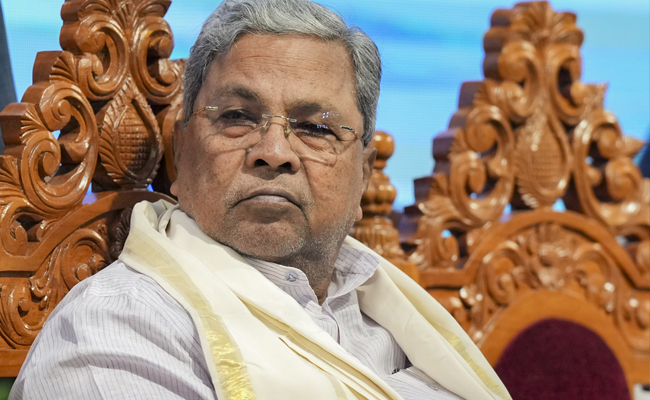
Bengaluru (PTI): Alleging a “criminal conspiracy” by BJP candidate D N Jeevaraj in the Sringeri Assembly poll recounting, Karnataka CM Siddaramaiah on Tuesday said the outcome was manipulated after valid postal ballot votes in favour of Congress leader T D Raje Gowda were tampered with during the recounting process.
Following a Karnataka High Court order on an election petition filed by Jeevaraj, challenging Raje Gowda’s election, the reverification and recounting were conducted on Saturday.
After the reverification and recount of postal ballots for the Sringeri Assembly constituency, votes polled in favour of Raje Gowda were reduced by 255, the returning officer said.
A report on the matter has been submitted to the Election Commission of India for further action, the officer added.
Congress leader Raje Gowda had won the 2023 Assembly polls from Sringeri by 201 votes, defeating his nearest rival Jeevaraj.
Addressing a press conference in Bengaluru, Siddaramaiah said the High Court had directed the recounting of postal ballots and that irregularities were noticed during the exercise conducted on May 2.
“This is a clear case of criminal conspiracy,” Siddaramaiah said, alleging that valid votes cast in favour of Raje Gowda were altered after being accepted by counting agents of all parties, including Congress, BJP, and JD(S).
He claimed that during the recounting of postal ballots, 255 votes were initially accepted as valid by all agents but were later tampered with by subordinate officials.
“There is a second mark on the votes polled in favour of Raje Gowda. They had accepted these as valid votes. Subsequently, another mark was made by officials. This is a clear case of criminal conspiracy,” he said.
When asked who was behind the alleged conspiracy, the CM replied, “It was hatched by Jeevaraj and others. It is planned.”
Siddaramaiah further alleged that the returning officer acted improperly by declaring the result despite the presence of an Election Commission observer during the recounting.
“Immediately after the counting, the returning officer announced the result. He should not have done so; this is against the law,” he said.
He pointed out that Raje Gowda had originally won by 201 votes, but after the recounting, the BJP candidate was declared the winner by 52 votes.
“The BJP has committed a criminal act of conspiracy. This is not vote chori but vote dacoity,” he alleged.
The CM said a police complaint had already been filed by Raje Gowda’s election agent, Sudhir Kumar, and emphasised the need for electoral integrity.
“We want transparency and free and fair elections. That is what our Constitution mandates,” he added.
Stating that the government would pursue legal remedies, Siddaramaiah said, “We are preparing an appeal challenging the returning officer’s announcement in a court of law.”
Responding to a separate query on elections in other states, the CM said there appeared to be an anti-incumbency factor in West Bengal, while results in Tamil Nadu were “surprising,” adding that Vijay’s party was emerging as the largest there.
Following the victory of party candidates in Bagalkote and Davanagere South, Siddaramaiah expressed confidence about future electoral prospects in Karnataka.
“Even in 2028, we will win the Assembly elections. We will come back,” the CM said.
Siddaramaiah added that he would order a forensic examination into the alleged tampering of postal ballots.