E-commerce firm dupes investors of crores

Bengaluru: An e-commerce firm has been accused of cheating consumers of crores of rupees after promising them huge returns. The multi-crore scam, which is believed to be spread across the country, is being investigated by Central Crime Branch (CCB) of city police.
Chandrashekar Gupta Gala, director of e-commerce company Easy Pay Cash (EPC), is the prime accused in the case.
According to a victim, Chandrashekar started the company in June 2017 and set up his office in HSR Layout. Posing himself as the networking business head, he lured people with attractive offers to invest in his company.
According to a Times of India report, Chandrashekar allegedly sought investments initially in three slabs of Rs 9,000, Rs 27,000 and Rs 81,000 which, he promised, would fetch the investors returns of Rs 100, Rs 300 and Rs 1,000, respectively, over next 200 days. The profits were to include the principle investment too. Primary investors who bring in additional investors were promised extra returns in the range of Rs 15 to Rs 500 per day for the 200-day cycle.
The scheme was promoted aggressively on WhatsApp and YouTube for a long time; sources said TOI. According to another investor, Vinod Naik, the firm claimed to make investments in crypto-currencies.
Let the Truth be known. If you read VB and like VB, please be a VB Supporter and Help us deliver the Truth to one and all.
Two die, six injured as wall of house collapses in Bihar
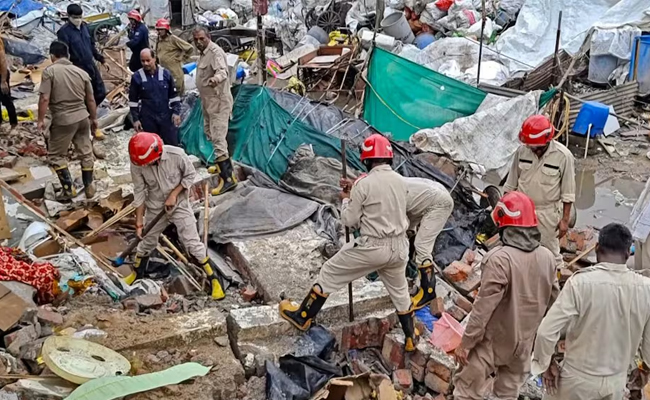
Aurangabad (Bihar) (PTI): Two persons were killed and six others injured after the wall of a house collapsed on them in Bihar’s Aurangabad district, police said on Sunday.
The deceased have been identified as Akhileshwar Yadav (55) and Satyanarayan Yadav (65), a senior officer said.
The incident took place on Saturday night when the people had gathered to watch a wedding ceremony in the Obra area, he said.
According to villagers, the wall of a house where the wedding ceremony was going on suddenly collapsed on them, Obra Police Station SHO Nitish Kumar said.
A police team reached the spot after receiving the information, the SHO said.
"Two died on the spot, and the six injured were immediately taken to the nearest government hospital. Their condition is stated to be out of danger," the station house officer said.
The bodies were sent for the post-mortem examinations, said the SHO, adding that the matter was being examined.