Expert committee to be formed to examine changing syllabus in higher education: G.T Devegowda
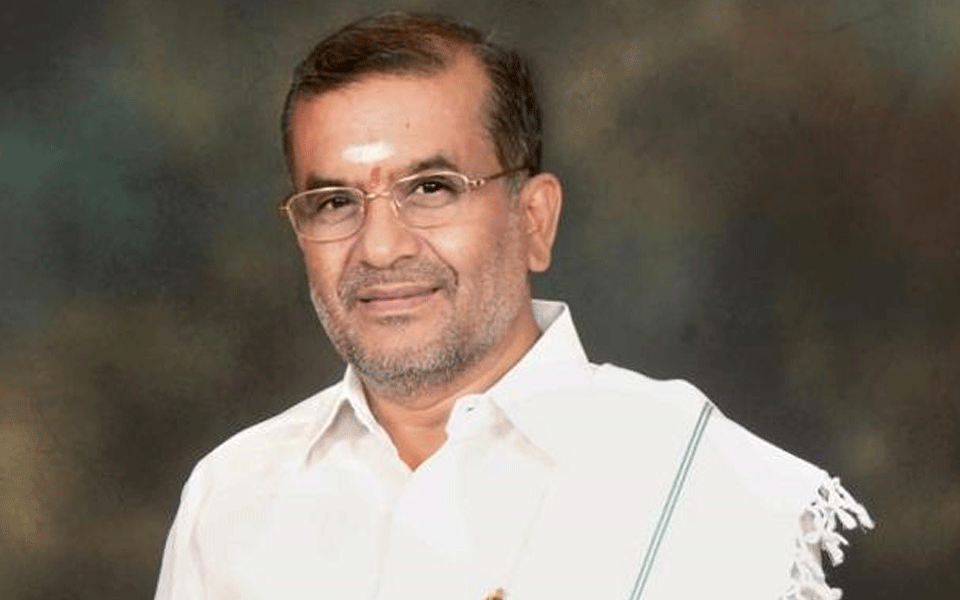
Bengaluru, Jan 9: Karnataka Higher Education Minister G.T Devegowda Wednesday said that an expert committee would be constituted to look into changing the syllabus for higher education courses in the state.
Stating that government was making all efforts to increase enrollment in higher education courses, he also said his department was mullingholding online examinations for the Common Entrance Test (CET).
During the meeting of Vice-Chancellors of all universities here tomorrow, discussions would be held on changing the syllabus in accordance with the need that exists today in the fast changing world, Devegowda said.
"Syllabus in higher education has not undergone any change for a long period now...additional subjects can also be added under courses like BA.
In accordance with changing times, a lot of changes have happened and we need to bring in programmes that train our youngsters accordingly," he told reporters here.
"We will however continue with things in the syllabus that exist and holds good for today's requirements," he said, adding that an expert committee would be constituted for this purpose.
The Minister said discussions would be towards ensuring that the exams conducted by the Karnataka Examination Authority is through the online process.
"CET and other things that are there we want to do it online, make it paperless. We want to do it from next year.
that's our decision," he said, adding that it was planned to introduce software, for which a meeting has been called on January 19 to take a decision.
The minister said that the move was aimed at ending complaints about malpractices in the CET exams.
Pointing out that there are 10 state-run engineering colleges in Karnataka, he said steps would be taken to provide all basic facilities to make them on par with noted private colleges.
Steps have also been taken to appoint teaching staff and principles to government and aided colleges, he said, adding that the government would appoint 3,800 lecturers and 394 principals before the start of the next academic year.
Universities had been asked to open skill development centres and adopt villages to encourage youngsters to enroll for higher education, by conducting various awareness programmes there, he said.
"Now enrollment or admissions for higher education is about 25 per cent. We have to create more awareness among youngsters so that they enroll for higher education. I want Universities to work in this regard," he said.
The Minister said various steps, like introducing a biometric system to track attendance of teachers, was being planned by the government to improve the quality of education.
"The government is taking steps one after the other. By next year, you will see some results," he said.
Let the Truth be known. If you read VB and like VB, please be a VB Supporter and Help us deliver the Truth to one and all.
Rickelton's ton in vain as SRH beat MI by 6 wickets
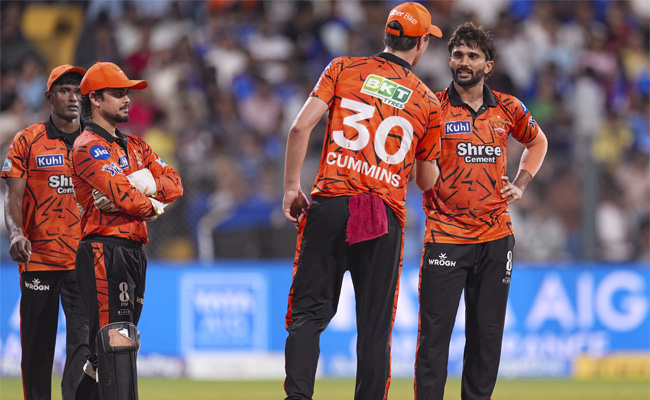
Mumbai (PTI): Ryan Rickelton's whirlwind unbeaten ton was overshadowed by Heinrich Klaasen's unbeaten 65 as Sunrisers Hyderabad defeated Mumbai Indians by six wickets in an IPL match here on Wednesday.
Chasing an imposing 244-run target, Travis Head (76 off 30) and Abhishek Sharma (45 off 24) shared 129 runs for the opening wicket to set the platform for SRH.
Klaasen (65 not out off 30 balls) then displayed his all-round hitting abilities to guide SRH home with the help of Nitish Kumar Reddy (21) and Salil Arora (30 not out off 10) in 18.4 overs.
Earlier, Rickelton's knock powered MI to 243 for five.
MI rode on a 93-run stand between Rickelton (123 not out off 55 balls) and Will Jacks (46 off 22) in 7.1 overs for the opening stand to power the side.
MI skipper Hardik Pandya scored a valuable 31 off 15 balls before being dismissed.
Praful Hinge (2/54), Eshan Malinga (1/29), Sakib Hasan (1/39) and Nitish Kumar Reddy (1/31) were the wicket-takers for SRH.
Brief Scores:
Mumbai Indian: 243 for 5 in 20 overs (Ryan Rickelton 123 not out; Praful Hinge 2/54).
Sunrisers Hyderabad: 249 for 4 in 18.4 overs (Travis Head 76, Heinrich Klaasen 65 not out; AM Ghazanfar 2/51).