Falling groundwater levels lead to large-scale aquifer recharge project in Athani

Athani: The Minor Irrigation Department of Athani has suggested an experimental groundwater recharge project aimed at raising the rapidly dropping water table. This project will include injecting surface water from seasonal streams and nalas directly into subsurface aquifers via a network of pierced borewells.
According to Deccan Herald, the department plans to drill around 1,000 borewells across Athani taluk in Belagavi district, with each borewell spaced roughly 500 metres apart along 10 to 12 nalas, under the proposal. The project is estimated to cost ₹25 crore and will be taken up as a Managed Aquifer Recharge initiative. This method will allow surface water to be channelled into aquifers for long-term storage.
According to officials, the project is being considered following severe groundwater depletion, as farmers are now drilling borewells beyond depths of 800 feet to access water. DH quoted Praveen Patil, assistant executive engineer of the Minor Irrigation Department in Athani, as saying that sustained over-extraction has pushed groundwater levels to alarming lows and that the department has been studying the geology of the area for nearly a decade. He further said that the department believes conditions are suitable for implementing the recharge plan.
The department conducted a pilot exercise along the Agrani river. Two borewells were drilled on the riverbank, allowing floodwater to flow naturally into the wells during high discharge, while officials also observed a positive impact on groundwater levels within a radius of nearly two kilometres from the test sites.
Calling Managed Aquifer Recharge a proven technique that can replenish groundwater faster and in larger volumes compared to conventional methods, experts told DH that the process uses storm water, surface runoff or treated wastewater to recharge aquifers during periods of surplus availability.
According to water expert Veena Srinivasan, recharging efforts may fail if silt accumulation is not addressed. She further told DH that long-term groundwater sustainability necessitates adjustments in agricultural practices that can maintain soil moisture while allowing precipitation to percolate naturally.
DH quoted S Vishwanath, a water conservation specialist, who called Managed Aquifer Recharge an environmentally sound technique as it uses monsoon flows rather than summer water extraction. Warning about poor design or a lack of filtration, he said it might lead borewells to fill with silt and pollutants, which may render the system inoperable.
Let the Truth be known. If you read VB and like VB, please be a VB Supporter and Help us deliver the Truth to one and all.
Explosive device kills 13, injures 38 on bus in southwestern Colombia as violence persists
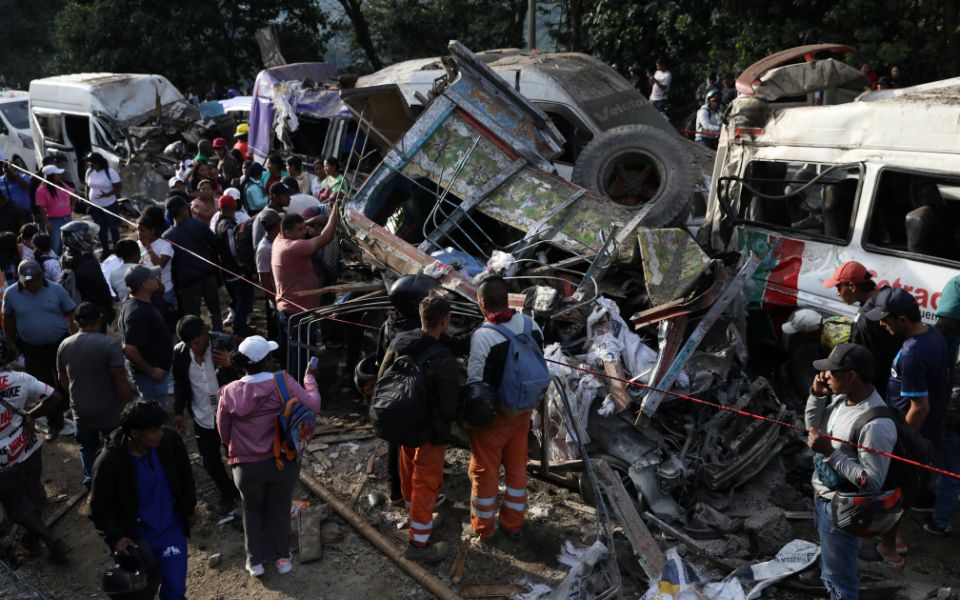
Bogota (Colombia) (PTI): An explosive device killed 13 people travelling on a bus in southwestern Colombia on Saturday, an attack the country's army chief described as a “terrorist act" that also left at least 38 injured as violence linked to drug trafficking in the region escalates.
Octavio Guzman, the governor of the region of Cauca, said on X that the device was set off while the bus was travelling along the Panamerican Highway in the municipality of Cajibio. Five children were among the injured, Cauca Health Secretary Carolina Camargo told Noticias Caracol, a TV news program.
Gen. Hugo Lopez, commander of Colombia's Armed Forces, told a news conference that it was a “terrorist act" and blamed the network of a man known as “Ivan Mordisco” — one of Colombia's most wanted figures — and the Jaime Martínez faction. Both are dissidents of the now-defunct Revolutionary Armed Forces of Colombia that operate in the region.
Neither Ivan Mordisco nor the Jaime Martínez faction abide by the peace agreement signed with the state in 2016.
Colombian President Gustavo Petro condemned the attack on X.
“Those who carried out the attack and killed seven civilians — and wounded 17 others — in Cajibío — many of them Indigenous people — are terrorists, fascists, and drug traffickers,” he wrote.
The attack is the latest in a spate of explosions that have attempted to target public infrastructure. At least 26 incidents have taken place in the past two days in southwestern Colombia, which Lopez said have only affected civilians.
They included a shooting at a police station in the rural area of Jamundi, and an attack on a Civil Aviation radar facility in El Tambo, where authorities took down three explosives-laden drones earlier on Saturday. No one was hurt.
On Friday, two vehicles rigged with explosives were detonated near military units in Cali and Palmira, causing material damage.
The escalation of violence in that region — a territory contested by illegal armed groups linked to drug trafficking — prompted the mobilisation of high-ranking officials on Saturday. Led by Defence Minister Pedro Sanchez, the delegation that includes regional governors and local authorities, was meeting in Palmira when the deadly explosion occurred.
“These criminals seek to instil fear, but we will respond with firmness,” Sanchez said on X.
Meanwhile, Francisca Toro, governor of Valle del Cauca, has called upon the national government to provide “immediate support.” In a message on X, Toro called for a reinforcement of public security forces, enhanced intelligence operations and “decisive actions” against crime in the face of a “terrorist-level escalation.”
According to authorities, Cauca and Valle del Cauca serve as a critical hub for illicit activities of illegal armed groups vying for control over sea and river access routes leading to the port of Buenaventura — a key transit point used to traffic drugs to Central America and Europe.
The government has also offered a reward of more than 1 million dollars for information leading to the capture of “Marlon,” who is identified as the leader of the region's dissident group. On Friday, local authorities offered more than USD 14,000 for information leading to the identification and location of those behind the attacks in Cali and Palmira.