Family alleges medical negligence at Chamrajnagar hospital after 10-year-old boy dies after surgery
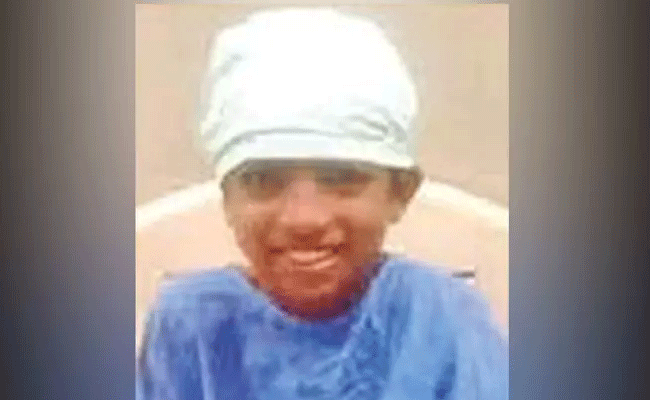
Chamarajnagar: In a tragic incident, the family of a 10-year-old boy who underwent appendicitis surgery at a private hospital in Kollegal, Chamarajnagar, has accused the medical staff of negligence, leading to the boy's death.
The young victim, identified as R Vijay, hailing from Halehampapur village in Kollegal, was initially admitted to the hospital after complaining of severe stomach pain.
Upon diagnosis, doctors recommended an appendectomy, which was conducted the following day. However, tragedy struck when Vijay did not wake up from the surgery, despite two hours having passed. Alarmed, his family members contacted the hospital staff, who confirmed the news that the boy had passed away.
Furious and distraught, Vijay's relatives blamed the hospital staff and doctors for their alleged negligence in caring for the young patient. They subsequently staged a protest outside the medical facility, demanding the immediate arrest of the surgeon, anesthetist, and nurses involved in Vijay's treatment.
The situation escalated as locals joined the protest, pelting stones at the hospital and causing damage to its windows. Dalit leaders, Shekhar Buddha and B Basavanna, also arrived at the scene, calling for the Deputy Commissioner of Chamarajnagar, Shilpa Nag, and the District Health Officer, Dr. Vishweshwaraiah, to visit the hospital and ensure justice for the grieving family. They warned that they would not perform Vijay's funeral rites until their demands were met.
In response to the protest, Deputy Superintendent of Police Somegowda and a police team were dispatched to maintain order at the hospital. Vijay's family members have filed a formal complaint with the Kollegal Town Police Station, leading to an ongoing police investigation into the matter.
Let the Truth be known. If you read VB and like VB, please be a VB Supporter and Help us deliver the Truth to one and all.
ICSE, ISC results: Girls outperform boys, pass rate over 99%
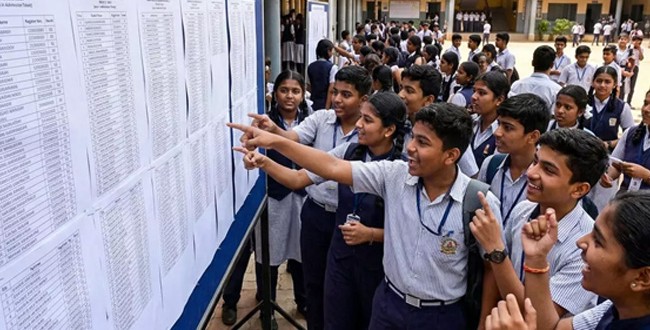
New Delhi (PTI): The Council for the Indian School Certificate Examinations on Thursday announced the Class 10 and Class 12 results for 2026, with overall pass percentages of 99.18 per cent and 99.13 per cent, respectively.
A total of 2,58,721 candidates appeared for the Indian Certificate of Secondary Education (ICSE), or Class 10, examination.
About 1,03,316 students took the Indian School Certificate (ISC), or Class 12, exam.
Girls outperformed boys in both examinations.
In ICSE, girls recorded a pass percentage of 99.46 per cent compared to 98.93 per cent for boys.
In ISC, girls achieved a 99.48 per cent pass percentage, while those of boys stood at 98.81 per cent.
Students can now access their scorecards on the official website cisce.org.