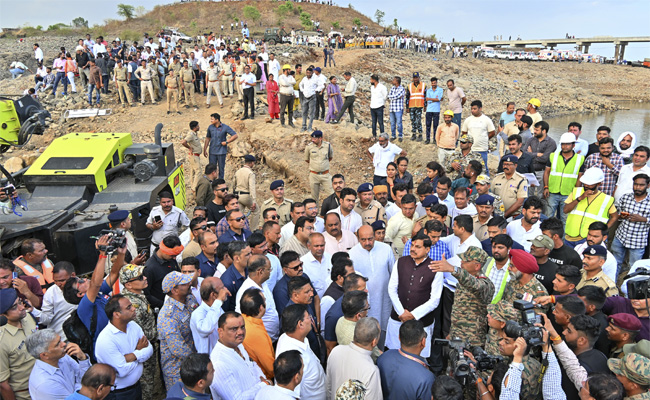
Flood relief: Govt has taken steps "beyond its limits", says CM Yediyurappa
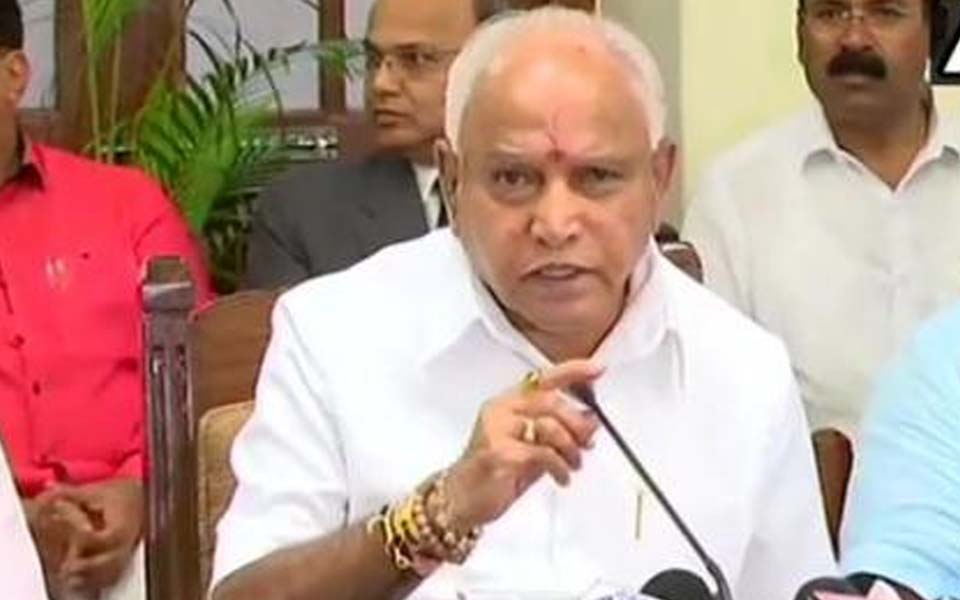
Bengaluru, Oct 11: Strongly defending his government's flood relief measures, Karnataka Chief Minister B S Yediyurappa on Friday said his administration has taken steps "beyond its limits".
Listing out the financial aid being given to the affected and displaced, he claimed that no other state had been able to give such a large amount of relief in the past.
Replying in the assembly to the debate on the situation in flood ravaged regions and relief work taken up so far, he pointed out that rains in early August was a record in 110 years, resulting in floods and large-scale destruction.
"The state government has gone beyond its limits to give relief to the affected and displaced due to rains and floods..
Within our limits we have done the best possible and in the next budget we will provision more to help those affected," Yediyurappa said.
He claimed that it was the first time that any state government was providing such large-scale relief.
"I'm saying this with responsibility... We fully understand that if a government cannot respond to the needs of its people in distress, it is like dead."
Noting that Rs five lakh each was being given for reconstruction to those whose houses have been damaged, he said Rs one lakh was being released now for laying foundation.
On crop loss compensation, he said NDRF norms stipulated that Rs 6,800 per hectare was to be given. The state would now add Rs 10,000 per hectare to it, he said.
For horticulture crops, the state would add Rs 10,000 per hectare to the Rs 13,500 per hectare that was to be given as per norms, he said.
For irrigated land Rs 18,000 per hectare is the norm and the government would add Rs 10,000 per hectare, he said.
Yediyurappa said Rs 25,000 would be given to damaged looms and shops and pointed out that for the first time Rs 10,000 has been given as immediate relief to people affected by floods, which was to the tune of Rs 203 crore.
A total of 2798 villages in 103 taluks of 22 districts was hit by floods and around seven lakh people were shifted to safer areas.
Ninety one people died and about 3,400 heads of cattle perished in the rains and floods.
In his reply, Revenue Minister R Ashoka said complete transparency was being maintained in providing relief as money was being deposited in bank accounts of beneficiaries through RTGS.
"We have taken precaution so that there is no room for corruption," he said.
He said 7,54,191 hectares of agriculture crops, 1.09 lakh hectares if horticulture crop, 1.06 lakh ha coffee and 244.48 ha of silk were damaged in the floods and 21,818 km of roads, 11,063 government buildings were also damaged.
Pointing out that the centre has released Rs 1,200 crore as interim relief, he said Rs 1,035 crore would be used as assistance for those whose crops were damaged.
The minister also clarified that the treasure was not empty as being alleged and that Rs 1,391 crore was in the account of Deputy Commissioners of various districts.
On the drought in some parts of the state, he said 49 taluks are facing drought and an announcement would be made in this regard within two to three days.
Unhappy with the government's response and demanding more compensation to the affected, Congress staged a walk out.
A move by senior Congress MLA H K Patil to move a motion, seeking to declare floods in the state as a "national calamity" was also objected by the ruling side.
Earlier, participating in the debate, Opposition leader Siddaramaiah targeted the government over its "failure" in providing relief to affected and said "if you (government) can't address the needs of the people in distress, quit."
He also urged the government to spend money generously for relief work from its treasury and try to get more funds from the centre for the purpose.
JD(S) leader H D Kumaraswamy asked the government to take it as a "challenge" and respond to the needs of the people.
"This is not an issue or time to do politics," he said as he extended his party's cooperation to the government in relief measures and requested that all anomalies be cleared.
Let the Truth be known. If you read VB and like VB, please be a VB Supporter and Help us deliver the Truth to one and all.
EC can choose counting personnel, no further order needed: SC on TMC plea
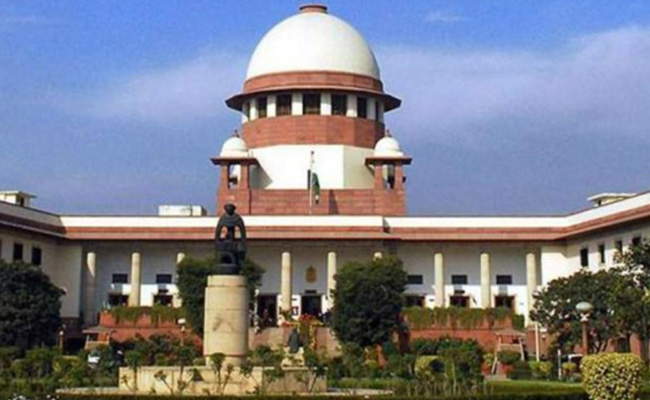
New Delhi (PTI): The Supreme Court on Saturday said no further order was necessary on the TMC's plea challenging the Calcutta High Court's dismissal of its petition against an Election Commission circular on the deployment of central government personnel for vote counting in West Bengal.
A special bench of Justices P S Narasimha and Joymalya Bagchi said the Election Commission can choose the counting personnel, and its April 13 circular, which provides for deployment of state government employees as well, cannot be said to be incorrect.
The poll body said the apprehensions of Trinamool Congress (TMC) of any wrongdoing is misplaced, as the circular very clearly states that there will be a mix of central and state government employees.
The Election Commission assured the court that the circular would be implemented in letter and spirit, and there would be state government employees also during the counting of votes on May 4.
At the outset, senior advocate Kapil Sibal, appearing for the TMC, said the circular was dated April 13, but they came to know about it on April 29.
ALSO READ: Anbumani asks PM Modi to ban sale of cigarettes for those born after 2009
He said there are four issues: One, the circular appointing Central employees was issued to DEOs on April 13, but came to their knowledge only on April 29; Two, the Election Commission says it has apprehensions of irregularity, despite having a Central nominee in the counting process; Three, the poll body already has a Central government officer at each counting table in the form of a micro observer, and four, the commission has not appointed state nominees even though the circular provides so.
Sibal submitted that the Chief Electoral Officer's communication states that there are apprehensions expressed from various quarters regarding possible irregularities in counting.
"That is like pointing a finger at the state government..." Sibal said, adding, "There must be some data. Where is (the proof of) the apprehension (raised) from each booth? They have not disclosed this. And why not tell us that they are going to have a Central government nominee?"
The bench, which held a special sitting, told Sibal that even if the Election Commission's circular had provided for the appointment of Central employees as both the counting supervisor and the counting assistant, the court could not have faulted the decision.
"The option is open for the Election Commission: whether the counting supervisor and assistant may be of the Central or the state government. When that option is open, we cannot hold that the notification is contrary to regulations. Even if the EC says that both of them can be Central government employees, we could not have faulted them. Because regulations say that either the Central government or state government officers can be appointed," Justice Bagchi told Sibal.
Sibal then submitted that the court may ask the Election Commission to follow the impugned circular in its entirety, which provides for a state government nominee.
"All we want is, in terms of the circular, the state government nominee should be there," he said.
Justice Bagchi asked if he wants compliance with the circular, then why is the TMC before the court.
Senior advocate D S Naidu, appearing for the Election Commission, submitted that the returning officer is a state government employee with overarching power to deploy personnel from any pool of government employees.
"We are saying that there will be state government employees during the counting of votes," Naidu submitted, adding that each candidate will also have their own counting agent.
"The TMC's apprehension of any wrongdoing is completely misplaced," he reiterated.
The bench then disposed of the plea, saying that no further order is necessary and reiterated that the Election Commission will follow its circular in letter and spirit.
Polling for the 294-member West Bengal Assembly was held in two phases -- April 23 and April 29. The counting of votes will be taken up on May 4.
On April 30, the Calcutta High Court dismissed the TMC's petition against the Election Commission circular, saying there was no illegality in the poll panel's decision to appoint counting supervisors and assistants from Central government and Public Sector Undertaking (PSU) employees, instead of the state government staff.
In the high court, the TMC had challenged an April 13 communication issued by the additional chief electoral officer of West Bengal that stated that at least one of the counting supervisors or assistants at each table should be a Central government or PSU employee.
The TMC's counsel had argued before the high court that the communication was issued without jurisdiction and was based on mere apprehension.
The EC's counsel had contended before the high court that the Representation of the People Act, 1951, allows delegation of the commission's functions and that the directive was valid.
The poll panel's counsel had also submitted that the communication was issued on April 13, but the petition was filed only on April 30, close to the counting date, alleging that the move was intended to stall the process.
The high court had not agreed with the TMC's allegation that its main opponent, the Bharatiya Janata Party (BJP), controls the employees of the Central government or PSUs, making them susceptible to suggestions and control by the Union government.
It had also noted that apart from the counting supervisors and assistants, micro-observers, counting agents of candidates, and other personnel would also be present in the counting hall.