Former CM Yediyurappa attacks Congress govt on Cauvery issue
Says Cong understanding with ally DMK led to 'today's situation'
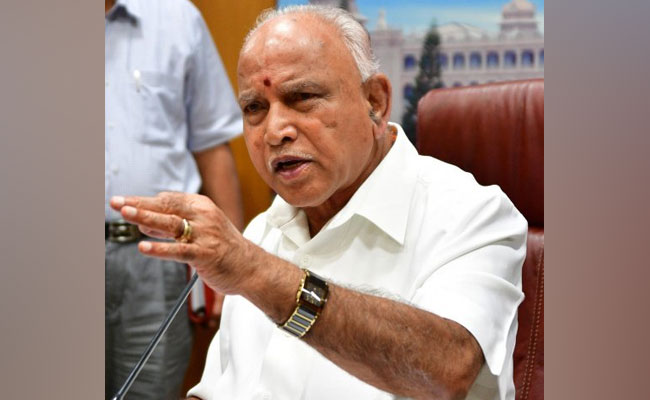
Bengaluru (PTI): Accusing the Siddaramaiah-led Congress government of "failure" on the Cauvery issue after the Supreme Court today refused to interfere in orders to release water to Tamil Nadu, former chief ministers B S Yediyurappa and Basavaraj Bommai on Thursday urged it to file a review petition before the apex court.
The BJP leaders' attack on the state government came after the Supreme Court today refused to interfere with orders of the Cauvery Water Management Authority (CWMA) and Cauvery Water Regulation Committee (CWRC), directing Karnataka to release 5,000 cusecs of water to Tamil Nadu.
Karnataka has been maintaining that it is not in a position to release water, taking into account its own need for drinking water and irrigation for standing crops in the Cauvery basin areas, as there has been water scarcity due to deficit monsoon rains.
"Based on the statistics we (Karnataka) provide, the Supreme Court gives its order. Law and Water Resources departments have completely failed in putting forward the argument effectively. Looking at today's SC order, it proves that the government had gone to the court without doing proper homework, and has failed to provide proper records," Yediyurappa said.
Speaking to reporters following the SC order, he said the state government has to speak to Tamil Nadu, where Congress's ally DMK is in power, instead of "unnecessarily" trying to pull the central government into the issue.
"I urge the chief minister to file an appeal before the Supreme Court, bringing the factual ground situation to its notice. Let the Supreme Court send a team and assess the water levels in the reservoirs here, and on the basis of that whatever order they give we are ready to abide by it. The state government should appeal for this," he added.
Noting that the government has committed mistakes one after the other since the Cauvery issue flared up this year, Yediyurappa said that water was released to Tamil Nadu even before the SC order on it.
"I feel that their (Cong govt) understanding (political) with DMK has led to today's situation...whatever has to happen has happened. As SC has also said that it will not interfere with CWMA order, we will be in a fix, because there will be scarcity for drinking water," he said, as he also appealed to people to maintain peace.
The CWMA on Monday asked Karnataka to continue releasing 5,000 cusecs of water to Tamil Nadu for another 15 days, after the CWRC made such a recommendation last week.
Alleging the state government failed to understand the importance of the Cauvery issue and neglected it, Bommai said the government should have been cautious as soon as the pre-monsoon failed, but instead they started acting only after the CWMA order came.
Noting that filing a review petition before the SC and ensuring that the quantum of water release is reduced is the only way now, he said the BJP doesn't want to do politics on the Cauvery issue, but it is a fact that the government has failed on it.
Asking the government to take into account the drinking water needs of the entire Cauvery basin districts, and also the standing crops there while making its argument, Bommai, who had earlier served as water resources minister, urged the administration to give Rs 25,000 per acre compensation to farmers for crop damage due to lack of water for irrigation, after a survey.
On the state's Congress government demanding the central government's intervention on the issue, he asked, "When the case is in SC, can any government interfere and do anything?
"They know everything, but to divert the attention they are making such statements."
Let the Truth be known. If you read VB and like VB, please be a VB Supporter and Help us deliver the Truth to one and all.
Nursing college student from Kerala dies by suicide at hostel, parents allege foul play
Bengaluru (PTI): A 19-year-old student from Kerala, who was studying at a private nursing college here, allegedly died by suicide in his hostel room, police said on Friday.
The deceased was identified as Adhityan P A, a second-year student at a nursing college in Bommasandra, they said.
On April 29, he was found hanging from a ceiling fan in his hostel room, police said, adding that he left behind a suicide note stating that no one was responsible for his death.
Preliminary investigation suggested that he may have been suffering from depression, and there may have been other issues which are being probed, a senior police officer said.
According to police, in his complaint, the deceased's father, Pradeep S, claimed that a college representative informed him upon his arrival in Bengaluru that his son had died under suspicious circumstances and that it was a case of suicide in the college hostel.
"However, I firmly believe that my son would not have taken such a step. He was of good character and mentally strong. Therefore, I strongly suspect foul play in his death," he claimed.
He also highlighted an incident that occurred approximately 20 days ago, when his son informed him that some of his hostel roommates were involved in drug use and were caught by hostel authorities.
"They were warned along with my son, although he was innocent and not involved in the incident. This situation may be relevant to the present case," he stated.
The complainant has urged the police to conduct a thorough and impartial investigation into the matter and take appropriate legal action.
A case of unnatural death has been registered at Hebbagudi Police Station here. Further investigation is underway, and all allegations are being examined, police said.