
Former PM HD Devegowda refuses to comment on Prajwal Revanna's disqualification; Here's what he said
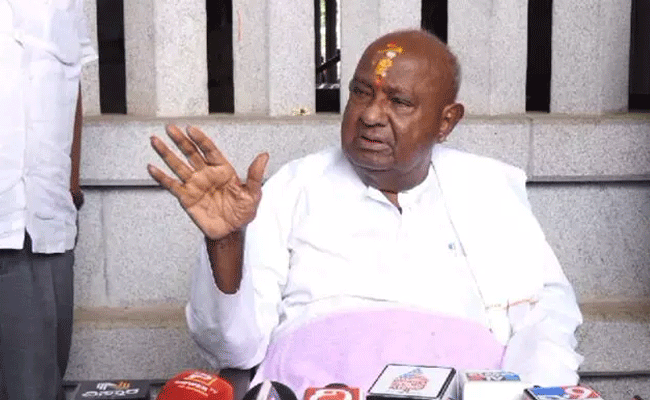
Hassan: Former Prime Minister and JD(S) supremo on Sunday declined to comment over the disqualification of the party’s only Lok Shaba member Prajwal Revanna, without reading the copy of the high court order. “I have not received a copy of the High Court order regarding the disqualification, and will not be commenting on the matter without seeing it,” he added.
Addressing reporters here, he said, “there is nothing to cover up pertaining to the matter, his parliament membership has been declared void in the verdict, and it does not suit a former Prime Minister commenting on the matter without reading the court order. The process of appealing the Supreme Court and bringing a stay will be done naturally. I should not comment regarding what is happening there.”
Stressing on uniting for the fight on the Cauvery River issue, he stated that he is 93 years old and would continue to fight for the party as much as he can. He further added that, “We should fight unitedly on the Cauvery issue. He said that the irrigation ministers are giving different statements on different occasions.”
“Meanwhile, the BJP and Congress should work on protecting the interests of the state. We must learn from Tamil Nadu where regional parties are working together. Even the people from the media should also cooperate,” he stated.
Let the Truth be known. If you read VB and like VB, please be a VB Supporter and Help us deliver the Truth to one and all.
Karnataka sees drop in groundwater use, surge in recharge capacity: 2025 report
_vb_86.jpeg)
Bengaluru (PTI): Karnataka has recorded a significant decline in groundwater usage alongside a notable increase in annual recharge capacity, reflecting the impact of sustained water conservation efforts and good rainfall, Minister N S Boseraju said on Wednesday.
Releasing the 2025 Groundwater Assessment Report at Vikas Soudha, he said the gains are the result of good rainfall, focused policy interventions, and large-scale water conservation initiatives implemented over the past two years under the leadership of Chief Minister Siddaramaiah and Deputy Chief Minister D K Shivakumar.
According to the report, overall groundwater extraction has reduced from 68.44 per cent in 2024 to 66.49 per cent in 2025, indicating more responsible and sustainable usage patterns across the state.
At the same time, annual groundwater recharge capacity has increased from 18.74 billion cubic metres (BCM) in 2024 to 19.28 BCM in 2025, while annual extractable groundwater resources rose from 16.88 BCM to 17.41 BCM, the minister’s office said in a statement.
“This simultaneous reduction in usage and increase in recharge reflects our government’s commitment to long-term water sustainability,” the Minor Irrigation, Science and Technology Minister said.
The improvement has been driven largely by the expansion of water conservation structures (WCS) across the state.
Recharge through such structures increased by 29.11 per cent, from 0.81 BCM to 1.04 BCM within a year, the report stated.
Notably, the number of water conservation works has risen sharply from 3.15 lakh in 2024 to 3.94 lakh in 2025, strengthening the state’s groundwater recharge ecosystem.
The report indicates improvement in groundwater status across 11 taluks, with several regions moving to safer categories.
Highlighting these changes, the minister pointed out that Chamarajanagar taluk has improved from "over-exploited" to "critical".
Similarly, taluks including Athani, Channapatna, Molakalmuru, Ranebennur, Savanur, and Shiggaon have successfully transitioned from "semi-critical" to "safe" status.
Domestic groundwater extraction has also declined by 0.58 per cent, dropping from 1,21,731 hectare-metres (ham) in 2024 to 1,21,023 ham in 2025. Officials attribute this to increased reliance on surface water under the Jal Jeevan Mission (JJM).
Boseraju said that initiatives such as lake rejuvenation, year-round water supply through treated and surface water, sustained public awareness campaigns, and good rainfall have played a key role in reducing over-extraction and enhancing recharge.
“Instead of depending solely on the 120-day monsoon, we are ensuring water availability throughout all 365 days through scientific management. This has strengthened long-term water security for both farmers and urban residents,” he said.
Announcing a major technological step forward in future governance, the minister added, “To further safeguard our resources, we are rolling out the Digital Water Stack (DWS) initiative. Under this framework, we will soon initiate space technology and AI-based satellite surveillance to obtain real-time data for continuous groundwater monitoring.”
_vb_85.jpeg)
_vb_92.jpeg)
_vb_51.jpeg)