Gadag doctor held in 22-hour 'digital arrest' by cyber fraud gang
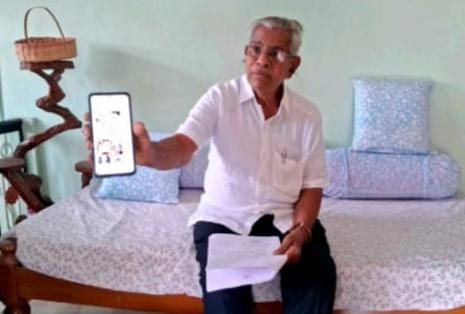
Gadag: In a disturbing case of cybercrime, a private doctor from Mulagund town in Karnataka’s Gadag district was subjected to a 22-hour-long digital arrest by a gang of cyber fraudsters posing as officials from a national investigative agency.
The incident took place on June 11 when Dr. S.C. Chavadi received a video call at 3:07 PM from individuals claiming to be officers of the "National Investigation Authority of India." They falsely accused him of being involved in a large-scale money laundering case via a Canara Bank account and claimed that a criminal case had been registered in his name at the Kaloba Police Station in Mumbai.
Despite Dr. Chavadi not having any account with Canara Bank, the fraudsters alleged that an arrest warrant had been issued against him. They instructed him to gather and share details of all his financial and property-related documents and warned him that he was under active investigation. To lend credibility to their claims, they even showed him the name and photograph of a local police officer from Mulagund.
In what is now being described as a digital arrest, Dr. Chavadi was kept under psychological pressure through continuous video calls for nearly 22 hours. An individual claiming to be an Inspector named Vijaykumar initially interrogated him and justified the remote questioning due to the doctor’s age. He was warned to remain silent about the matter and act normally with his family, as dangerous criminals, allegedly led by one Naresh Goyal, were "monitoring" him and could be near his home.
The next day around noon, another person claiming to be DCP Dayanayak resumed the video interrogation, telling Dr. Chavadi that the matter would be taken to the Supreme Court and that he would eventually need to appoint legal representation.
The ordeal ended only when locals, sensing something was wrong, alerted the police and rushed to Dr. Chavadi’s residence. Upon their arrival, they attempted to force open the door, prompting Dr. Chavadi to unlock it. As soon as a local police officer, CPI Sangamesh Shivayogi, began speaking over video call, the fraudsters abruptly terminated the call and vanished.
A formal complaint has been registered at the Gadag Cyber Crime Police Station, and investigations are ongoing.
CPI Shivayogi urged citizens not to fall prey to such digital arrests, which are emerging as a new form of cyber intimidation. “People must remain calm and report any suspicious digital communication to the nearest police station immediately. Never share personal information or documents over video calls from unknown sources,” he said.
Let the Truth be known. If you read VB and like VB, please be a VB Supporter and Help us deliver the Truth to one and all.
Chhattisgarh govt enforces austerity measures, restricts foreign travel and cuts convoy vehicles

Raipur (PTI): The Chhattisgarh government on Saturday rolled out a set of austerity measures, including restricted use of convoy vehicles for the chief minister, ministers and heads of state-run bodies, besides curbs on foreign travel at government expense.
The state has decided to implement the cost-saving steps with immediate effect to ensure efficient management of financial resources and discipline in public spending, said a directive issued by Finance Secretary Rohit Yadav.
The move follows Prime Minister Narendra Modi’s appeal for austerity amid the ongoing conflict in West Asia.
The order said that only essential vehicles should be used in the convoys of the CM, ministers and office-bearers of corporations, boards and commissions, while ensuring restrained use of other government resources.
It also directed departments to take steps for a phased conversion of all official vehicles into electric vehicles in order to promote the use of EVs.
As part of fuel-saving measures, expenditure on petrol and diesel for government vehicles should be kept to a minimum, the directive said.
Vehicle pooling arrangements should also be implemented for officials of departments travelling to the same destination, it added.
The order further stated that foreign travel of government employees at state expenses will be completely prohibited except under extremely unavoidable circumstances. In such cases, prior approval of the CM will be mandatory.
To reduce administrative expenditure, departments have been instructed to hold physical meetings preferably only once a month and encourage virtual and online meetings. Regular departmental review meetings should compulsorily be conducted through video conferencing, it said.
The government also stressed the need for energy conservation in its offices, directing that all electrical equipment, including lights, fans, air-conditioners and computers, must be switched off after office hours.
The directive will remain effective till September 30 this year.
Amid the war involving the US, Israel and Iran, Modi has suggested reducing petrol and diesel consumption, using metro rail services in cities, carpooling, increased use of EVs, utilising railway services for parcel movement and working from home to conserve foreign exchange.