German Chancellor's visit to Bengaluru was private, pre-scheduled; BJP 'politicising' it: Minister
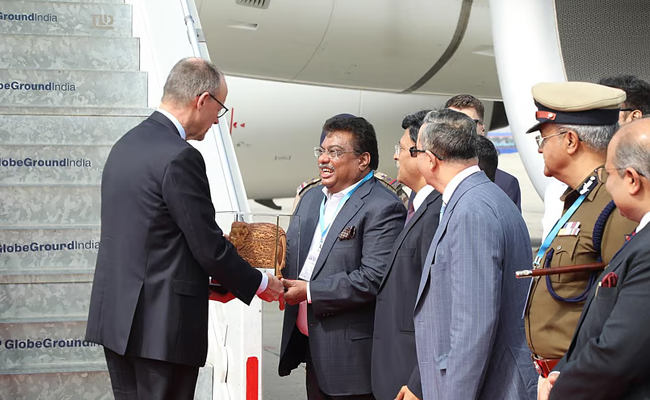
Bengaluru (PTI): Karnataka Minister M B Patil on Wednesday defended Chief Minister Siddaramaiah and Deputy CM D K Shivakumar, saying they did not receive German Chancellor Friedrich Merz during his visit here as it was a private, pre-scheduled programme.
Patil accused the opposition BJP of "politicising" the visit of an international dignitary and termed it "irresponsible."
Merz visited Bengaluru on Tuesday, the second day of his two-day visit to India. He was received at the Kempegowda International Airport by Patil and senior state officials.
The opposition BJP, taking a dig at Siddaramaiah and Shivakumar, alleged that they skipped receiving the German chancellor and instead chose to be in Mysuru to receive Congress leader Rahul Gandhi, who was transiting to neighbouring Tamil Nadu.
“The Hon’ble German Federal Chancellor’s visit was entirely a private, pre-scheduled programme, limited to visits to Bosch and IISc, with no official talks with the state government,” Patil said in a post on 'X'.
ALSO READ: HC grants anticipatory bail to man accused of making derogatory posts on Kalladka Prabhakar Bhat
“In such a situation, the question of the CM or ministers formally receiving him does not arise. Had there been any government-level engagements, the Hon’ble chief minister himself would have led the reception,” he said.
Patil said that, as instructed by Siddaramaiah and in keeping with protocol, a formal welcome and see-off were extended.
“The BJP’s attempt to politicise even a private visit of an international dignitary is petty and irresponsible,” he claimed.
Accusing the Congress government of “misplaced priorities and missed opportunities”, Leader of the Opposition in the State Assembly R Ashoka earlier said that welcoming the head of government from one of the world’s strongest economies had been relegated to the back seat, while “political loyalty and high command pleasing” were given precedence over Karnataka’s global standing.
During his visit, Merz toured the India headquarters of German technology major Bosch at Adugodi and the Centre for Nano Science and Engineering (CeNSE) at the Indian Institute of Science, before departing from Bengaluru.
Home Minister G Parameshwara said the state government was not invited to any of the events attended by the German chancellor and added that it appeared he had arrived and departed without official state-level engagement.
“Patil went as minister-in-waiting, but the state government was not invited to any of the events he attended. He held a press conference, and the German delegation brought its own press. Even the local press was not invited,” Parameshwara said.
“In a way, he came and left without the state’s involvement. Such situations should not arise. We also want to show our respect to foreign dignitaries who visit our state,” he added.
Parameshwara said the state government would have acted in accordance with directions from the Ministry of External Affairs and added that when a foreign head of government visits a state, the state government should be given an opportunity to extend its respects.
Referring to India’s federal structure, he said that while practices may differ elsewhere, both the Centre and states have defined roles in India, and the state government should be involved when a foreign head of government visits.
When asked whether the Centre had officially informed the state government about the visit, Parameshwara said he was not aware and that there was a need to ascertain what directions were issued.
Let the Truth be known. If you read VB and like VB, please be a VB Supporter and Help us deliver the Truth to one and all.
Mamata alleges BJP disrupted her Bhabanipur rally, Suvendu claims 'she's nervous'
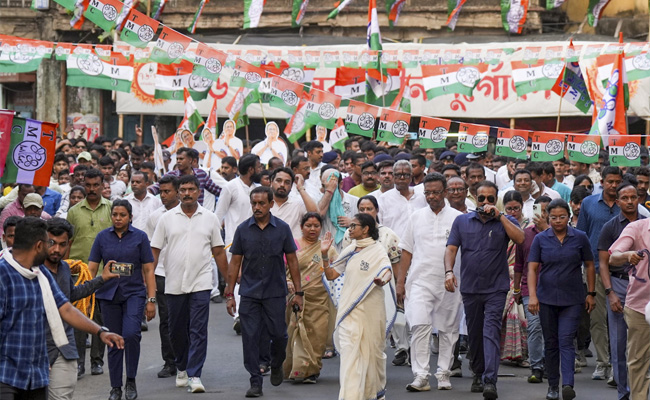
Kolkata (PTI): Chief Minister Mamata Banerjee cut short her speech at a rally in her Bhabanipur constituency, alleging that the BJP was deliberately playing loud music from a nearby public meeting.
A peeved Banerjee said despite having the required permission of the Election Commission, her rally in Chakraberia was disrupted by the BJP, "who want to capture Bengal by intimidation and threat".
"It is not possible for me to go ahead with this meeting. If they can do such a thing in my constituency, imagine how undemocratic the BJP is. If they behave like this, I have to take legal action," she said.
"This is an insult, humiliation. BJP is stepping on our toes to instigate trouble. Not possible to address the gathering in this situation. I am leaving the stage. Please vote for me in your protest," she added.
Banerjee was then seen calling someone over and venting her grievances.
Before leaving the stage, she said, "I will hold a rally tomorrow at the same spot."
TMC supporters then rushed towards the BJP rally, which was later addressed by Leader of the Opposition Suvendu Adhikari, but security personnel intervened and prevented the situation from escalating.
TMC workers later staged a demonstration outside the local police station and filed a complaint, alleging that the BJP violated the model code of conduct.
A senior TMC leader said another complaint will also be lodged with the Election Commission.
Asked about Banerjee's allegations, Adhikari told reporters after the rally he held nearby, "Her reaction shows she is nervous about the imminent loss."
"There was no violence, no obstruction in her meeting and her behaviour shows her nervousness. On May 4, people of Bhabanipur will celebrate the victory of the BJP," he claimed, alleging that the TMC also tried to disrupt his meeting by playing loud music.
South Kolkata's Bhabanipur, one of the battleground seats in the West Bengal elections, will vote in the second phase on April 29.