Govt led by Modi implementing Shivakumara Swamiji's teachings on ground: Amit Shah
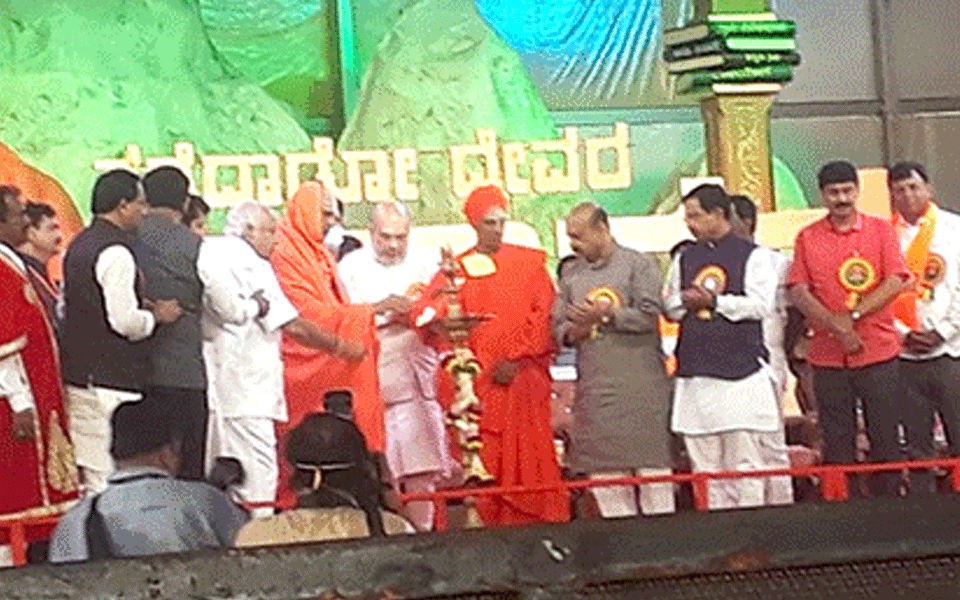
Tumakuru (KTK)(PTI): The Narendra Modi-led government is treading on the path shown by the late Shivakumara Swamiji of Siddaganga Mutt here by implementing 'Trividha Dasoha' (three-pronged commensality) offering free food, education and shelter, Union Minister for Home and Cooperation Amit Shah said on Friday.
Hailing the services of the pontiff, who passed away in 2019 at the age of 111 after serving the Lingayat Mutt for 88 years, Shah said feeding 10,000 children everyday, imparting free education to them and giving them shelter could be achieved by a 'Karma Yogi', which the Swamiji was.
The pontiff implemented the preaching of 12th century social reformer Basaveshwara on ground and turned the Mutt into a centre for elevating people, Shah said while participating in the 115th birth anniversary of Shivakumara Swamiji.
"No one in this Mutt goes hungry. Everyday 10,000 children from every section of the society get food, education and shelter," the Home Minister noted.
"The BJP government led by Prime Minister Narendra Modi at the Centre has implemented the principles of Shivakumara Swamiji on ground. We are giving five kg rice, given a new dimension to education through the new National Education Policy where anyone can get technical and medical education in their own language and gave roof to three crore people in seven years," Shah said.
He also said that during the COVID-19 pandemic, 80 crore people were given free meals. The Home Minister said the Centre is striving hard to ensure that every section of the society makes progress.
Shah said India is an ancient nation where many pilgrim centres came up based on their geographical locations and the quality.
However, new pilgrim centres too came up due to the good work of some saints and one such centre is Siddaganga Mutt where Shivakumara Swamiji had implemented the preaching of Basaveshwara on ground, the Home Minister explained.
"When a person spends his life to perform his sacred duties in the interest of society and God, an aura around him attracts many to tread on his path and makes others religious. The seer who lived for 111 years had such an aura around him that he would guide many for the coming centuries," Shah said.
Quoting former Prime Minister late Atal Bihari Vajpayee who had said 'Ganga in the North and Siddaganga in the South', Shah said taking a holy dip in the Ganga absolves sins of many past lives whereas visiting Siddaganga paves way for leading a virtuous life.
He also pointed out that the Mutt in the last 600 years, ever since it came into existence, has been a centre to implement the teachings of Basaveshwara.
The present pontiff of the Mutt, Siddalinga Swamiji, Karnataka Chief Minister Basavaraj Bommai, Union Ministers Pralhad Joshi, Bhagwant Khuba, state Ministers including Araga Jnanendra and former Chief Minister B S Yediyurappa were among those who attended the event.
Let the Truth be known. If you read VB and like VB, please be a VB Supporter and Help us deliver the Truth to one and all.
Two arrested in K'taka for assaulting minors, uploading CSAM content

Bengaluru (PTI): Two men were arrested for allegedly sexually assaulting two minor girls, recording the acts on mobile phones and uploading the videos online as child sexual abuse material, police said on Thursday.
The accused have been identified as Kiran Kumar (29), hailing from Chitradurga district, and Aditya M K (20), hailing from Shivamogga district, they said.
A probe was initiated after information was received from the NCRP portal regarding a suspected instance of creation of Child Sexual Abuse Material (CSAM) for online dissemination, police said.
Accordingly, a case was registered at Kaggalipura Police Station under relevant sections of the IT Act on May 10, they added.
Investigation revealed that two minor girl victims were exploited and videos were created and uploaded to the internet. The child victims have subsequently recorded their statements as per procedure and further necessary legal steps have been taken, Pronab Mohanty Director General of Police, Cyber Command, said in a statement.
Based on the statements of the victims, the accused persons, who allegedly assaulted the minors, recorded the acts on mobile phones and uploaded the videos online, were arrested, he said.
Following the probe, sections 65(2) (rape) and 70 (gangrape) of the Bharatiya Nyaya Sanhita, along with relevant sections of the POCSO Act, have been added to the FIR, police said.
Officials collected relevant information and on May 12, arrested the accused persons and seized three mobile phones belonging to them, in which the videos had allegedly been recorded, he said.
The accused were later produced before the court and taken into police custody for further investigation, he added.
According to him, in CSAM cases, police usually apprehend offenders who have downloaded such content or have kept them in their possession after obtaining them from elsewhere, usually the internet.
"The present case is one of the very few instances where content creators and uploaders have been apprehended," Mohanty added.