
Govt will not remain silent if Panchamasali protesters take law into their hands: CM Siddaramaiah
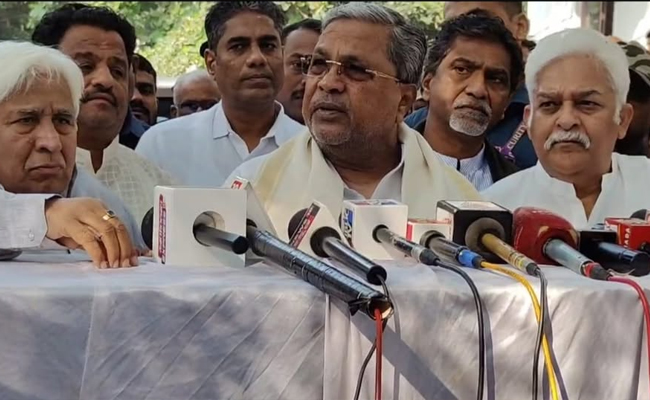
Bengaluru: Chief Minister Siddaramaiah has stated that the government will not remain silent if anyone takes the law into their own hands, causing trouble for the public. He was responding to recent protests by the Panchamasali community demanding reservations under Category 2A.
While acknowledging the right of the Panchamasali community to protest and seek reservations, Siddaramaiah emphasised that protests should be peaceful and within the boundaries of the law. He stressed that the law applies equally to everyone, including Swamijis, and no one is above it. According to Article 14 of the Constitution, all individuals are equal before the law, and they are entitled to equal protection under it.
Referring to the recent clashes during protests at Suvarna Soudha, the BJP alleged that the police had pelted stones at the Panchamasali community members. However, Siddaramaiah refuted this claim, saying that there is evidence to show that BJP members were responsible for stone-throwing and breaching barricades. He questioned why the Swamijis were sitting on the road and how over 20 police officers would be injured if the protesters did not throw stones.
Siddaramaiah further explained that the Panchamasali community members should approach the Backward Classes Commission for the permanent status of their reservation. He mentioned that during the BJP regime, the then-chairman of the Commission, Jayaprakash Hegde, had recommended that Categories 2A and 2B should remain as they are, with no new additions, and the 4% reservation under Category 2B should not be revoked.
He pointed out that during the BJP's tenure, there were no protests, but now the same BJP is supporting the ongoing struggle. Referring to the Muslim 4% reservation, which was removed, Siddaramaiah noted that during the BJP regime, a 2% reservation for the Okkaligas under Category 3A and Lingayats under Category 3B was provided. This move was questioned in court by a Muslim individual, Rasool, who challenged the changes. Siddaramaiah added that the BJP government had assured that there would be no changes to reservations back then.
The Chief Minister reiterated that the Panchamasali community had previously stated that their protest would be peaceful, but there was an attempt to take the law into their own hands. He clarified that three ministers, including Mahadeveppa, were sent to the protest site to ensure peace.
Let the Truth be known. If you read VB and like VB, please be a VB Supporter and Help us deliver the Truth to one and all.
Islamabad talks: JD Vance leads US delegation in historic face-to-face negotiations with Iran
_vb_17.jpeg)
Islamabad (PTI): A US delegation led by Vice President JD Vance held historic face-to-face talks with top Iranian negotiators in Pakistan on Saturday to reach a peace agreement to end the war in West Asia that has paralysed global energy markets and disrupted trade.
The Pakistan-brokered talks -- the first direct, high-level engagement between the two sides since the 1979 Islamic Revolution-- are being watched globally amid increasing expectations of a breakthrough.
Ahead of the trilateral negotiations in Islamabad's Serena hotel, the Vance-led US team and the Iranian delegation headed by Parliament Speaker Mohammad Bagher Ghalibaf held separate meetings with Pakistan Prime Minister Shehbaz Sharif.
"After Pakistan PM Sharif held separate meetings with both the delegations, formal round of direct negotiations between Iran and the United States has officially begun," a senior Pakistani official told PTI.
Pakistan’s state-run PTV said Iranian and US officials sat across the table for "landmark peace negotiations." The format of the talks was not very clear.
As the negotiations continued, the Iranian government said on social media that "talks between Iran and the US in Islamabad entered the expert-level stage as economic, military, legal, and nuclear committees joined in".
Without elaborating, it added that certain"technical details” are being finalised.
Sources in the Pakistani establishment said that the overall atmosphere in talks was "encouraging".
There were reports that talks may continue on Sunday if no breakthrough was achieved tonight.
Iran's semi-official Tasnim news agency reported that the negotiations have moved beyond general issues and entered technical-level discussions on "certain topics".
While Vance is accompanied by Special Envoy Steve Witkoff and Jared Kushner, President Donald Trump’s son-in-law, the Ghalibaf-led Iranian delegation comprised Foreign Minister Abbas Araghchi, Supreme National Defence Council Secretary Ali Akbar Ahmadian and Central Bank Governor Abdolnaser Hemmati.
The two sides travelled to Islamabad on Saturday for the talks, four days after Iran and the US announced a two-week ceasefire. However, a massive wave of Israeli strikes on Lebanon, killing more than 300 people, has left the truce in tatters.
While Tehran claimed the assault violated the terms of the ceasefire understanding, the US and Israel said Lebanon was not part of the deal.
Earlier, both delegations were received at the Nur Khan airbase by Deputy Prime Minister Ishaq Dar, Army Chief Field Marshal Asim Munir and Minister for Interior, Syed Mohsin Raza Naqvi.
In his meeting with the Iranian delegation, Prime Minister Sharif affirmed Pakistan's sincere resolve to continue playing its role as a mediator towards achieving meaningful results from the peace talks.
Sharif, during his meeting with the American delegation, expressed hope that the talks between the US and Iran would lead to durable peace in West Asia.
In a related development, Mohammad Reza Aref, Iran's first vice president, said the peace talks could produce a deal if the American side worked in the interest of the US in sync with President Donald Trump's America First approach.
"However, if we face representatives of 'Israel First', there will be no deal," he said on social media.
Aref cautioned that the world will face "greater costs" if there was no peace deal.
Tasnim news agency earlier reported that negotiations between Iran and the US will not begin until Tehran's "preconditions," including stopping Israeli hostilities against Lebanon and de-freezing of Iranian assets are met.
Quoting an "informed source", it later claimed that the American side has agreed to release Iran's frozen assets. However, there is no confirmation yet on the report.
The US delegation also comprised Andrew Baker, the Deputy National Security Advisor to the President and Michael Vance, Special Advisor to the Vice President for Asian Affairs.
A full suite of US experts on relevant subject areas are present in Islamabad, according to US officials.
Earlier, Parliament Speaker Ghalibaf shared a photo from inside the aeroplane while en route to Pakistan. In the photograph, he is seen standing in front of images of the Minab School students killed in strikes, which were placed on the aeroplane seats.
"My companions on this flight — Minab 168," Ghalibaf posted on social media with the photograph.
US President Donald Trump has already cautioned that the US will resume its military action against Iran if the talks do not produce a peace deal.
Before departing for Pakistan, Vance said he was looking forward to the negotiations and hoped they would be "positive".
"As the US president said, if the Iranians are willing to negotiate in good faith, we’re certainly willing to extend an open hand. If they're going to try to play us, they're going to find that the negotiating team is not that receptive," Vance said before boarding his plane for Islamabad.
After his arrival in Islamabad early Saturday, Ghalibaf told reporters about the issue of trust with the US, reminding them of Iran's past experience with that country.
"Twice within less than a year, in the middle of negotiations, and despite the Iranian side’s good faith, they attacked us," he said, adding: "We have goodwill, but we do not have trust (in Americans)."
He said if the American side is ready for a "genuine agreement," then it would see Tehran's readiness for it.
Iran has laid out a 10-point plan for the talks that included demands for the withdrawal of US forces from West Asia, the lifting of sanctions against Iran, and allowing it to control the Strait of Hormuz.
Pakistan led the diplomatic push to bring the two sides to the table, which became possible after an appeal by Prime Minister Sharif earlier this week, leading to a pause in the fighting.
Iran’s Foreign Minister Araghchi, who held a telephone call with the country's ambassador to Lebanon Mohammad Reza Shibani, earlier asserted that the US must live up to its ceasefire commitments, which he said included ensuring the truce covers Lebanon.
Iranian President Masoud Pezeshkian said that the Israeli attacks on Lebanon "blatantly violated" the initial ceasefire and would render negotiations meaningless.
A thick security blanket covered Islamabad, which was on ‘red alert’ ahead of the talks.
More than 10,000 police and security personnel have been deployed to ensure multi-layered security for the visiting delegates, officials said.
The Red Zone, housing key buildings, is protected by the army and the Rangers, and only authorised officials and residents are allowed to go through it.
The Iran-US negotiations are being closely watched globally, as their success or failure could have far-reaching implications for West Asia's security, global energy markets, and international diplomacy.
_vb_37.jpeg)
_vb_11.jpeg)