Guest lecturers across Karnataka seek regularisation after new hiring order

Bengaluru: Guest lecturers across Karnataka are expressing concerns over the Department of Collegiate Education’s recent notification inviting new applications for the 2025–26 academic year. Many lecturers, who have served in the same roles for several years, are reportedly being overlooked, despite their long-standing contributions to higher education.
Members of the State First Grade Colleges Guest Lecturers’ Welfare Association, quoted by The New Indian Express, have raised alarms after the department issued recruitment calls 4-5 times during the 2024-25 academic year, bypassing existing lecturers who have already proven their merit. They argue that fresh appointments are being made despite the Supreme Court's rulings allowing the regularisation of long-serving temporary staff in various sectors.
“These appointments are happening at the cost of experienced lecturers who have been working tirelessly for years. Instead of recognising our service, the department is treating us as replaceable,” TNIE quoted Santhosh NS, secretary of the association, as saying.
Guest lecturers are also expressing frustration over their compensation. Despite performing duties equivalent to full-time staff, often working 15-18 hours per week, they allege that they receive a fraction of an assistant professor’s salary.
“As per UGC Regulations 2018 and 2019, guest lecturers must be appointed on the same basis as full-time faculty, and their remuneration should reflect their workload - up to Rs 1,500 per hour and Rs 50,000 per month,” stated the association.
“We are 10,300 guest lecturers doing the work of full-time staff, but without recognition or security. The system is built on our backs, yet we remain invisible. We were selected through interviews and merit lists. We have been working for over 15-20 years. If this isn’t eligibility for regularisation, what is?” TNIE quoted Lokesh PC, president of the association, as saying.
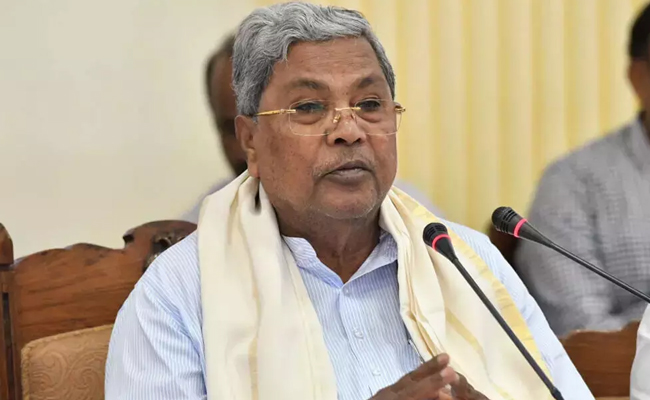
The association also pointed out that while Siddaramaiah had advocated for the regularisation of guest lecturers during his time as Leader of the Opposition, as Chief Minister, he has reportedly overlooked their service and sent many lecturers home.
Citing examples from other states where long-serving guest lecturers have been retained regardless of UGC qualifications, the association urged the Karnataka government to prioritise experience and loyalty over rigid formal criteria. They have demanded that the recent notification be withdrawn, allowing current lecturers to continue in their roles, with new appointments made only for vacant positions.
Let the Truth be known. If you read VB and like VB, please be a VB Supporter and Help us deliver the Truth to one and all.
Two arrested in K'taka for assaulting minors, uploading CSAM content

Bengaluru (PTI): Two men were arrested for allegedly sexually assaulting two minor girls, recording the acts on mobile phones and uploading the videos online as child sexual abuse material, police said on Thursday.
The accused have been identified as Kiran Kumar (29), hailing from Chitradurga district, and Aditya M K (20), hailing from Shivamogga district, they said.
A probe was initiated after information was received from the NCRP portal regarding a suspected instance of creation of Child Sexual Abuse Material (CSAM) for online dissemination, police said.
Accordingly, a case was registered at Kaggalipura Police Station under relevant sections of the IT Act on May 10, they added.
Investigation revealed that two minor girl victims were exploited and videos were created and uploaded to the internet. The child victims have subsequently recorded their statements as per procedure and further necessary legal steps have been taken, Pronab Mohanty Director General of Police, Cyber Command, said in a statement.
Based on the statements of the victims, the accused persons, who allegedly assaulted the minors, recorded the acts on mobile phones and uploaded the videos online, were arrested, he said.
Following the probe, sections 65(2) (rape) and 70 (gangrape) of the Bharatiya Nyaya Sanhita, along with relevant sections of the POCSO Act, have been added to the FIR, police said.
Officials collected relevant information and on May 12, arrested the accused persons and seized three mobile phones belonging to them, in which the videos had allegedly been recorded, he said.
The accused were later produced before the court and taken into police custody for further investigation, he added.
According to him, in CSAM cases, police usually apprehend offenders who have downloaded such content or have kept them in their possession after obtaining them from elsewhere, usually the internet.
"The present case is one of the very few instances where content creators and uploaders have been apprehended," Mohanty added.