HAL not contending to be offset partner of any OEM: HAL CMD R. Madhavan
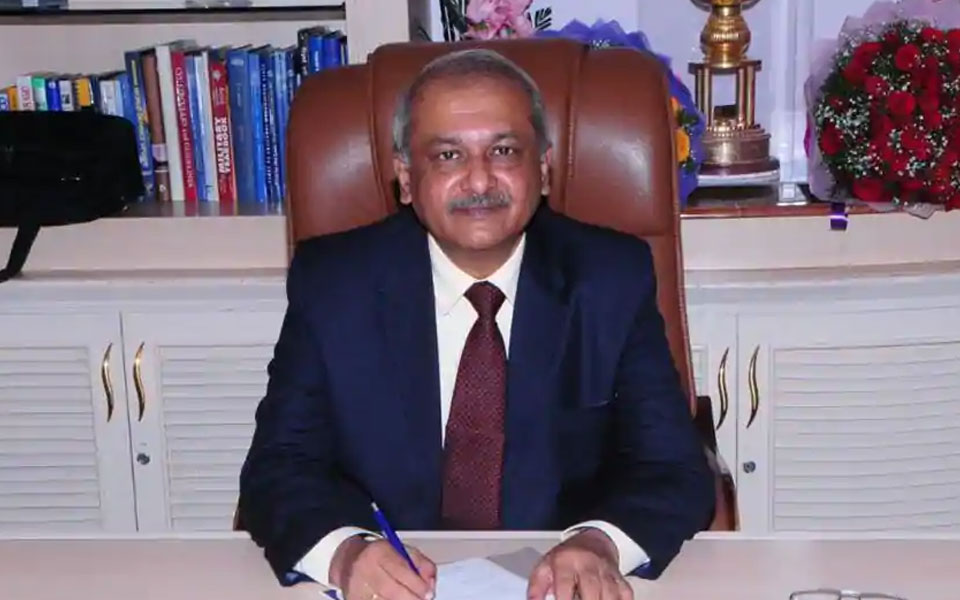
Bengaluru, Nov 7: Amid a political slugfest over the Rafale fighter jet deal, state-run HAL's Chairman and Managing Director R Madhavan Wednesday said the aircraft manufacturing company is contending not to be an offset partner of any original equipment manufacturer.
But it would like to be a "total technology transfer partner" for production of aircraft, he said.
Madhavan's reply came when he was asked to clarify on one among many charges that defence PSU Hindustan Aeronautics Limited (HAL) had been deprived of an offset contract from the Rafale deal.
"We are not contending to be an offset partner to any OEM, rather HAL would like to be a total technology transfer partner for production of aircraft," he told PTI here.
He also said HAL's basic focus was on manufacturing of aircraft, helicopters, associated accessories and their repair and overhaul, and not in garnering offset business.
Production of aircraft from transfer of technology is totally different from offsets, according to him.
Some portion of the offset business from various other programmes were being administered at the HAL, but it does not form a major business, Madhavan said.
"HAL will continue to get these offset business," he added.
The Congress recently accused the government of forcing Dassault Aviation to make Reliance Defence its offset partner for the Rs 58,000 crore deal to purchase 36 Rafale jets.
It alleged that the government was helping the Anil Ambani group get a contract worth Rs 30,000 crore from the deal.
However, the Reliance Group, in a statement, has said Dassault Aviation's investment in Reliance Airport Developers Limited has no link with the Rafale fighter jet deal, and has accused the Congress of resorting to "blatant lies" for political gains.
Reliance has also said the Indian government, the French government, Dassault and Reliance have clarified on multiple occasions that there was no offset contract for Rs 30,000 crore to Reliance as alleged by the Congress.
Earlier, in an interaction with the media on November 2, Madhavan had said that the HAL was completely out of the Rafale deal, but at one point of time, it was part of it, which did not kick-off.
"We are not in that (Rafale) business now. We were in it at one point of time. It is a direct purchase by the government and (I) cannot make any comments on pricing and policy changes," he had said.
Escalating his campaign against the Modi government over the Rafale deal, Congress president Rahul Gandhi last month accused it of destroying the "strategic asset", state-run aerospace company HAL, and told its employees that "Rafale is your right."
In an interaction, Gandhi had sought to reach out to present and former HAL employees, alleging that "temples of modern India are being attacked and destroyed; we cannot allow it to be done."
The Congress has also been demanding answers on why the HAL was not involved in the deal as finalised during the UPA regime.
However, the BJP and Reliance Defence have dismissed all the allegations as false.
Let the Truth be known. If you read VB and like VB, please be a VB Supporter and Help us deliver the Truth to one and all.
Samson's unbeaten 87 powers CSK to eight-wicket win over DC
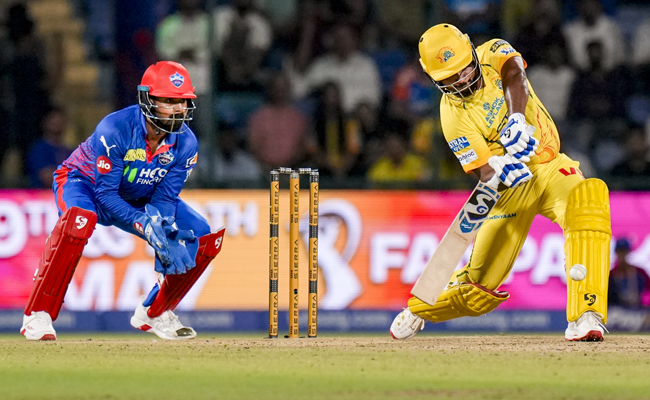
New Delhi (PTI): Sanju Samson bossed the chase with authority, anchoring a modest 156-run target with a fluent 87 not out as Chennai Super Kings outclassed Delhi Capitals by eight wickets in the IPL here on Tuesday.
Samson's knock came off just 52 balls with seven fours and six sixes, batting through the innings as CSK completed the chase in just 17.3 overs giving a huge boost to their net run-rate.
Electing to bat on a tricky surface, Delhi Capitals were restricted to 155/7.
West Indies left-arm spinner Akeal Hosein set the tone with the new ball, returning tidy figures of 1/19, including 14 dot balls.
Reduced to 69/5 in 11 overs, Delhi found some late impetus through Tristan Stubbs (38; 31 balls) and Sameer Rizvi (40 not out; 24 balls), who stitched together a crucial 65-run (off 47 balls) stand to give the innings a respectable total.
Brief Scores:
Delhi Capitals: 155 for 7 in 20 overs (Tristan Stubbs 38, Sameer Rizvi 40 not out; Noor Ahmed 2/22)
Chennai Super Kings 159 for two in 17.3 overs (Sanju Samson 87 not out, Kartik Sharma 41 not out). CSK win by eight wickets.