HD Kumaraswamy hits out at Karnataka Minister for ordering recovery of 281 acres of HMT land
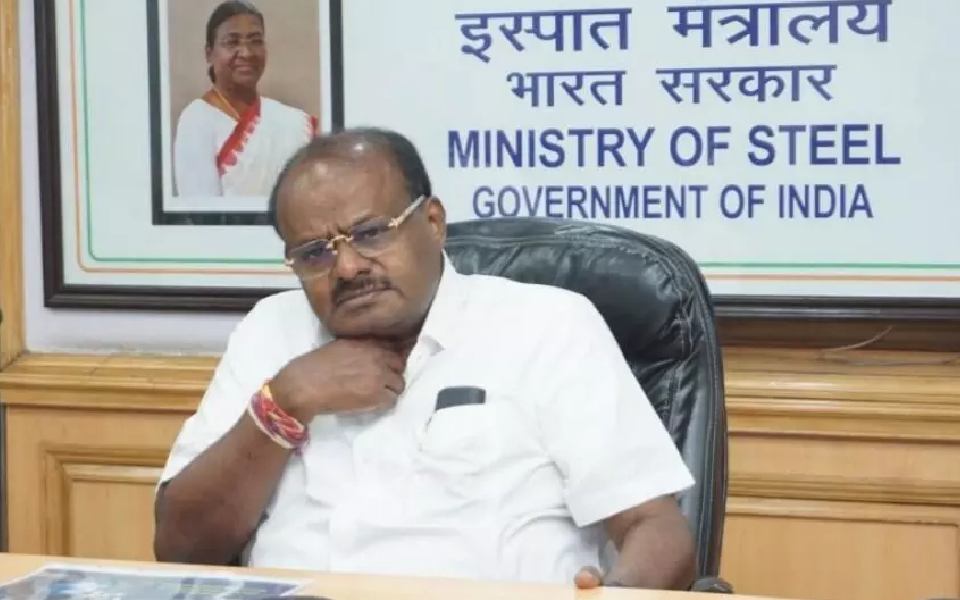
Bengaluru, Aug 13: Union Minister for Steel and Heavy Industries H D Kumaraswamy on Tuesday hit out at Karnataka Minister Eshwar Khandre over his administrative note giving 'clear instructions' to the state forest department to initiate measures to recover 281 acres from Hindustan Machine Tools (HMT) Limited contending that it was a forest land.
Kumaraswamy asked the Forest Minister to "shed his pettiness" and cooperate with him to revive ‘the pride of Bengaluru’, which once ruled the watch market with 90 per cent market share but now was on the verge of closure.
“Doesn’t the pitiable condition of this PSU bring tears to your eyes, which had once captured 90 per cent of the market? Don’t you take pride in Karnataka? Should we come to power to close such plants? Mr Khandre, shed this pettiness,” he told reporters here.
He was referring to Khandre’s August nine administrative note where he cited the June 11, 1896 gazette notification showing that 599 acres in the survey number 1 in Peenya-Jalahalli in Bengaluru city was forest land. He said there are no records to show that the said land was gifted to the HMT as has been said.
Citing the Supreme Court ruling, “Once a forest is always a forest – Environment is more important than civil rights”, the Forest Minister had asked the Additional Chief Secretary (Forest, Wildlife and Ecology department) to initiate steps to recover 281 acres of vacant land out of 599 acres of HMT land.
Khandre’s move came days after Kumaraswamy visited HMT Limited and had a meeting with its officials for its revival.
Rubbishing the Forest Minister’s claim, Kumaraswamy, the JD(S) second-in-command, said the HMT plant that was visited by the first Prime Minister Jawaharlal Nehru, former Prime Ministers Lal Bahadur Shastri and Indira Gandhi was set up by acquiring the land way back in 1958-59 and 1968-70.
According to him, the HMT made a profit of Rs 270 crore in 1970. With these funds, the HMT set up its units in Hyderabad, Uttarakhand, Ajmer and Kerala.
The tractor manufacturing unit in Pinjore town in Haryana was a big success, the Minister said, adding that the Tatas came up with its Titan brand and took away 350 engineers from HMT to their unit, which led to the downfall of the central PSU.
Kumaraswamy wondered why the state Forest Minister was "silent" for so many years.
“Why did the Minister write a note after remaining silent for so many decades? Can land be recovered on the basis of the Minister's ‘clear instruction’? On what basis he gave directions? Does he know the subject?” the Union Minister sought to know.
He said the portfolio he is entrusted with has 40 CPSUs. Out of them 27 are shut down and others are on the verge of closure.
He said he has been struggling hard to give a new lease of life to these PSUs. He added that he firmly believed that he can convince Prime Minister Narendra Modi to revive them.
“When I am putting in so much effort, all of a sudden you issue a note to take back land, which is worth Rs 10,000 crore,” Kumaraswamy said.
Underlining that the HMT paid for the land it owned, the Union Minister, citing documents, pointed out that on November 25, 1960 the Chief Conservator of Forests, Bengaluru was consulted in the matter for the release of land reports that the total area available for disposal was 283.57 acre as against 260 acres requested for HMT limited and the CCF said he has no objection to its grant.
“Nothing was taken for free. Everything was paid for. There is clarity here,” Kumaraswamy said, citing documents.
Questioning Khandre’s "intervention" in the matter, the Union Minister said: “You have given orders to acquire vacant land in a hurry. Whom you want to give this land to?”
He also read out a gazette notification citing the donation of land to HMT during the time of Mysuru Maharaja.
The JD(S) state chief sought to know how the property tax is collected from the HMT Limited if it was forest land.
“Don’t spoil the state for your grudge against HDK (Kumaraswamy). I am also trying to improve the Visvesvaraya Iron and Steel Plant. Cooperate with us. This loot is enough now,” he said.
Let the Truth be known. If you read VB and like VB, please be a VB Supporter and Help us deliver the Truth to one and all.
JD(S) attacks K’taka govt over fuel prices, accuses it of mobilising funds for guarantee schemes
Mysuru (PTI): Union Minister H D Kumaraswamy on Sunday launched a sharp attack on the Congress government in Karnataka over petrol and diesel prices, accusing it of "misleading the public" while repeatedly raising taxes and fuel prices to finance its guarantee schemes.
Addressing a public outreach programme titled 'Janarondige Janata Dal' (Janata Dal with the people) and a membership campaign in the Chamundeshwari Assembly constituency in Mysuru, the JD(S) state president challenged Congress leaders to make public the number of tax hikes and price increases imposed by the state government over the last three years.
"On one hand, the government is deceiving people by claiming to provide guarantees, while on the other, it is repeatedly increasing prices. Let the Congress government release a list of how many times it has imposed taxes and raised prices," Kumaraswamy said.
He alleged that the Congress government had continuously increased taxes and prices on liquor, bus fares, electricity, and several other sectors to mobilise funds for its five guarantee schemes—Gruha Lakshmi, Gruha Jyothi, Anna Bhagya, Shakti, and Yuva Nidhi.
Kumaraswamy also criticised Congress leaders for attacking the Centre over fuel price hikes and asked them to introspect on their own contribution to the state’s development before holding the proposed 'Sadhana Samavesha' (achievement convention) on May 19.
Referring to the global oil situation, he said the ongoing conflict involving the United States, Israel, and Iran had triggered an international oil supply crisis and argued that fuel prices in India remained lower than in many developed countries.
"In Singapore, which is a developed country, petrol costs Rs 245. Congress leaders should open their eyes and see this," he claimed.
He further questioned what the Congress party would have done had it been in power during the present international crisis.
"Did anyone foresee that such a war would take place? If Congress leaders had such foresight, let them say so. If the Congress party itself had been in power during such a difficult situation, what would it have done?" Kumaraswamy asked.
Throughout his address, the former CM mounted a sustained attack on Congress leaders and dismissed claims that guarantee schemes had improved people’s lives.
"Congress leaders think people are living peacefully because of the guarantee schemes. That is wrong," he said.
Recalling the by-election scenario in the Chamundeshwari constituency in 2006, Kumaraswamy said JD(S) had suffered defeat due to internal mistakes within the party.
"If our leaders had been cautious then, the situation would not have reached this stage. JD(S) suffered defeat because of some mistakes on our part," he said.
He added that he shared a deep bond with the constituency.
Calling upon party workers to prepare for the next Assembly elections, Kumaraswamy expressed confidence that JD(S) would win 75 seats in the next polls and asserted that Chamundeshwari constituency would return to the party in 2028.
"There is no confusion in our party," he said, adding that JD(S) would not bow to any pressure and that the convention had been organised to strengthen its presence in Chamundeshwari.
"Our party has lakhs of loyal workers as its backbone. JD(S) remains strong even today because of the hard work of our cadre," he said.
Kumaraswamy also claimed that during his tenure as CM, he had sanctioned more funds for the Chamundeshwari constituency than the present CM (Siddaramaiah).
"We are not holding this convention to oppose anyone. We are organising it to inform the people about the failures of the state government," he said.
Addressing the gathering in a traditional turban, Kumaraswamy said the gesture was intended to send a message to the Hallumatha and Kuruba communities and reassure them of JD(S) support.
"JD(S) is working for Kurubas, Dalits, and minorities. I am not helping distressed people for publicity. I do it out of self-satisfaction and duty," he said.