Hijab case: Karnataka govt submits details of CFI in High Court
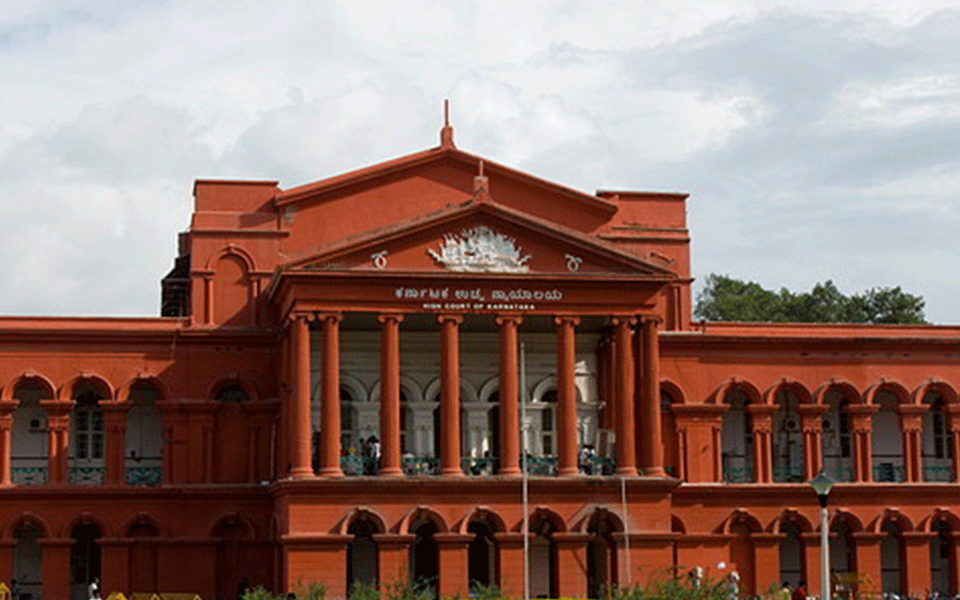
Bengaluru (PTI): The Karnataka government on Thursday informed the High Court that a first information report has been registered against the members of the Campus Front of India (CFI), who had allegedly threatened some teachers in the Government Pre-University Girls College in Udupi district.
As soon as the proceedings began, state Advocate General Prabhuling Navadgi told the full bench of the High Court that an FIR has been registered. He also said he has furnished details relating to the CFI in a sealed cover to the bench.
The full bench comprising Chief Justice Ritu Raj Awasthi, Justice J M Khazi and Justice Krishna S Dixit is hearing the hijab case.
"With regard to the submission made by senior advocate S S Naganand against an organisation, an FIR has been registered," Navadgi told the bench.
On Wednesday, the court had sought to know from the state government the role of the Campus Front of India (CFI).
On January 1, six girl students of a college in Udupi attended a press conference held by the CFI in the coastal town protesting against the college authorities denying them entry into classrooms wearing hijab.
This was four days after they requested the principal permission to wear hijab in classes which was not allowed. Till then, students used to wear the headscarf to the campus, but entered the classroom after removing it, college principal Rudre Gowda had said.
"The institution did not have any rule on hijab-wearing since no one used to wear it to the classroom in the last 35 years. The students who came with the demand had the backing of outside forces," Gowda had said.
Let the Truth be known. If you read VB and like VB, please be a VB Supporter and Help us deliver the Truth to one and all.
NEET student hangs self in Rajasthan's Sikar

Jaipur (PTI): A student preparing for the NEET examination allegedly committed suicide by hanging himself in a rented room in Rajasthan's Sikar on Friday, police said.
According to the police, the student allegedly hanged himself from a ceiling fan using his sister's scarf while one sister was attending coaching classes and the other was in the bathroom.
He had appeared in the NEET UG exam 2026, which was cancelled due to paper leak, they said.
Udyog Nagar SHO Rajesh Kumar said that the deceased, identified as Pradeep Meghwal, was a resident of Kanika ki Dhani village in Jhunjhunu's Gudha Gaudji area.
He had been living in a rented room in Sikar's Jaldhari Nagar area with his two sisters while preparing for NEET over the last three years.
His elder sister later found him hanging and informed the landlord and police after bringing him down, officials said.
The SHO said the body was kept at SK Hospital mortuary, and a postmortem had not been conducted.
The student's father, Rajesh Kumar Meghwal, told police that Pradeep's NEET examination had gone well and the family was expecting him to score around 650 marks.
Former Rajasthan deputy chief minister Sachin Pilot expressed grief over the incident and linked it to anxiety among students after reports of irregularities and paper leaks in NEET 2026.
Pilot said repeated paper leak incidents and cancellation of examinations were affecting students' mental health and demanded a time-bound investigation and strict action against those responsible.