Hutti Gold Mines to triple production in one-and-half years: Mines and Geology Minister Nirani
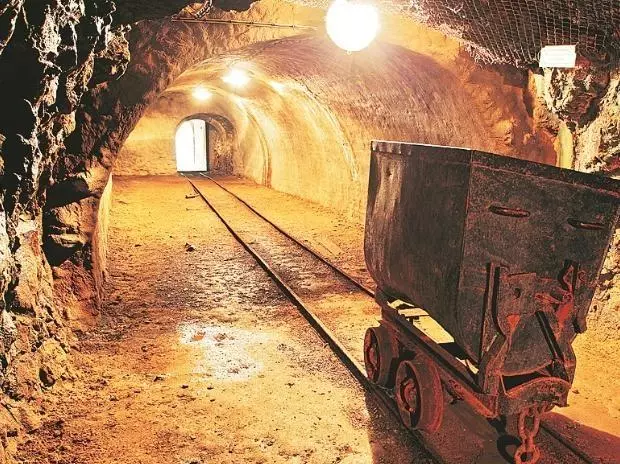
New Delhi, Feb 14: India's only gold producer Hutti Gold Mines plans to triple annual production of the yellow metal to 5,000 kgs in one-and-a-half years, according to Karnataka Mines and Geology Minister Murugesh R Nirani.
Nirani, who completes one month in office as cabinet minister in the BJP-ruled Karnataka government, added that due to COVID-19, the revenue from mines auction so far in the current fiscal could reach only 85 per cent of the Rs 3,700 crore achieved in 2019-20. But in the next fiscal, it is expected to surpass the target of Rs 4,000 crore.
The minister also highlighted the new policy measures the state government is working on to curb illegal mining and attract investment, including introducing a single-window clearance system and holding 'mining adalats' for addressing grievances, besides ramping up gold production in the state.
Speaking to PTI, the minister said Karnataka has the distinction of being the only gold ore producer in India. There are enough reserves, technology and market for gold, the price of which has soared to over Rs 47,000 per 10 grams now.
Hutti Gold Mines Company Limited (HGML), a Karnataka government undertaking, operates one unit each in Raichur and Chitradurga districts.
"Currently, HGML is producing 1,700 kg per annum. Within 18 months, the plan is to increase gold production to 5,000 kg per annum. There are reserves, technology and markets. There is potential," Nirani said.
According to the HGML website, the Chitradurga unit's operations for gold mining and processing ore have been temporarily suspended and the company has diversified into wind farm projects.
The Hutti Gold Unit (HGU) in Raichur district is a fully integrated facility with a capacity to produce 5,50,000 tonnes per annum.
Asked about the number of mining assets to be auctioned in the 2021-22 fiscal, the minister said there are certain issues in mining because of which the proposals are pending at the central government level.
Already, the state government has made a representation to the Union Mines Ministry which has assured clearance of pending proposals and paving the way for auctions in a transparent way, he said.
On revenue earned from mines auction in 2020-21, Nirani said it has reached only 85 per cent of the Rs 3,700 crore achieved in the 2019-20 fiscal.
"The revenue was lower this year because of lack of mining activities in the wake of COVID-19 pandemic. However for next fiscal, our target is to achieve Rs 4,000 crore. We expect to surpass this," he added.
Regarding the District Mineral Foundation (DMF) funds meant to be used in mining-affected areas, the minister said the state government has collected Rs 2,400 crore in the DMF till December 2020. However, only Rs 600 crore has been utilised so far.
"Still we have Rs 1,800 crore. It has not been utilised as in some districts not a single meeting has been convened in the last two years," Nirani said.
However, district collectors in mining areas have been directed to hold monthly meetings and warned of strict action for not utilising the DMF funds which are normally used for construction of roads and health infrastructure, among others, he added.
As regards the policy changes the state government is mulling to make mining activities more transparent, the minister said permissions are required from seven-eight departments, from revenue to environment and transport, for carrying out any mining work.
However, there are certain gaps in the current system due to which in some cases mining activity appears to be illegal.
For example, a company is served with a notice for illegal mining work by the forest department two years after issuing a 'no objection certificate' (NOC) for the same project, he said.
Suppose a company has got permission to excavate from 'x' mine but due to non-recovery has excavated at 'y' place. Even this is termed as illegal but investors have a different view on this, he said, adding these gaps will be addressed.
Nirani, who discussed these issues with Union Mines Minister Pralhad Joshi on Saturday in the national capital, said the central government has assured it of support and cooperation on this issue.
Further, he said the state government is planning to introduce a single window clearance system for mining projects. "Already, a draft is ready and very soon the policy will be announced. The idea is to fast-track the clearance and attract investment," he said.
That apart, the government plans to hold 'mining adalats' in Mysuru, Belgaum, Gulbarga, Bengaluru and Mangalore on a fortnightly basis to address grievances related to mining projects, he added.
Let the Truth be known. If you read VB and like VB, please be a VB Supporter and Help us deliver the Truth to one and all.
Car driver alleges assault by auto drivers after minor road incident in Bengaluru
Bengaluru (PTI): In a suspected case of road rage, a car driver was allegedly chased and assaulted by two autorickshaw drivers following a minor road incident on Sarjapur Road here, police said on Monday.
The incident occurred on March 25 around 8.20 pm when Shriraj Bhardwaj, a native of Ajmer in Rajasthan, and his colleague were driving on Sarjapur Road and allegedly encountered an autorickshaw coming from the wrong side of the road, they said.
The victim later lodged an online complaint regarding the incident on March 26.
A senior police officer said that in this connection, a Non-Cognisable Report (NCR) has already been registered at the Bellandur Police Station and further investigation into the matter is underway.
Registration of NCR means the complaint has been noted in the station diary, but a formal FIR and investigation will require further legal steps or magistrate approval, police said.
Following the incident, Bhardwaj took to 'X', recalling the episode and claiming that it began with a negligible touch between the vehicles that caused no damage.
"What followed was not an argument, it was a chase. The auto driver started aggressively chasing us, trying to block our car multiple times in moving traffic, hitting the vehicle, and attempting to open the doors. We chose not to engage and instead tried to reach a safe place," he alleged.
According to him, the situation escalated when another autorickshaw joined the chase. Together, they allegedly blocked their path near Sarjapur Bridge, and one of them picked up a concrete stone and smashed the windshield of his car while they were still inside.
"We somehow managed to reach RGA Tech Park, thinking a gated office space would mean safety. It didn't. Both drivers followed us inside. Before I could even step out of the car, I was physically assaulted, repeatedly hit in the face, leaving me injured," he alleged.
"Only after things calmed down did the main accused flee. When the police arrived, the second driver apologised in front of them," Bhardwaj further alleged.
He said that following the incident, he has made up his mind to leave Bengaluru and never return.
Bellandur police said they have registered a non-cognisable report and traced the autorickshaw driver.
"The complainant is yet to record his statement for further action. We have been trying to contact him but he informed us that he is out of state. Further inquiry into the matter is underway," the officer said.
The auto driver, however, has alleged that his vehicle was damaged and that he was asking them to stop the car to resolve the issue, but they did not stop, which led to the incident.