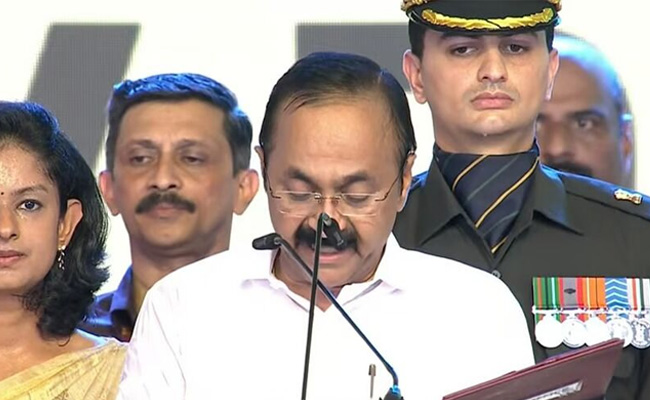
IMD issues orange alert for Bengaluru; Shivakumar says flooding resolved in 70 pc areas in city
_vb_09.jpeg)
Bengaluru (PTI): India Meteorological Department (IMD) has issued an orange alert for Bengaluru and a yellow alert at various places across Karnataka on Tuesday.
An orange alert means very heavy rain of 11 cm to 20 cm, and a yellow alert means heavy rainfall between 6 cm and 11 cm.
IMD Bengaluru Centre Director N Puviarasu said they have issued an orange alert for Bengaluru for the impact 8 cm to 10 cm that will likely affect the big city.
"The amount of rainfall we are receiving is nothing for rural areas. But because cities like Bengaluru are concretised mostly, and thus blocking the outlets for water drainage, we have issued an orange alert so that authorities can prepare accordingly," he said.
According to the IMD statement, areas likely to be affected today are Bagalkot, Bangalore Urban, Bangalore Rural, Belgaum, Chikkaballapura, Dharwad, Gadag, Kolar, Koppal, Vijayanagara districts.
Meanwhile, Deputy Chief Minister D K Shivakumar said flooding issues have been resolved in 70 per cent of the identified areas in Bengaluru.
Shivakumar, who visited the affected areas in Bengaluru, including Sai Layout, Manyata Tech Park and Silk Board Junction, on Monday told reporters that they had identified 210 areas as flood prone in city.
"Ever since I took over as the Bengaluru Development Minister, we have fixed flooding issues in 166 (70 per cent) of those localities. Flood prevention work is currently going on in 24 areas while work would soon be taken up in the remaining 20 areas. We have built 197 km of storm water drains," he said.
Taking to his 'X' account, Shivakumar said rain is controlled by nature and they are trying to "control the controllables".
"We are rectifying flood-prone areas and are trying to help the common people. Quantum of rainfall has been very high in Silk Board junction, Hebbal and Yelahanka area. Underpass works are underway in a couple of places in these areas and they have been flooded. We will work with those departments to resolve these issues," he added.
Let the Truth be known. If you read VB and like VB, please be a VB Supporter and Help us deliver the Truth to one and all.
Rahul Gandhi to go on two-day Raebareli visit from May 19
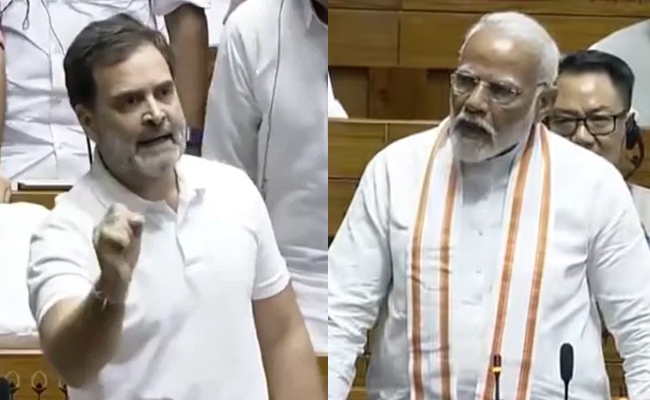
Raebareli (UP) (PTI): Leader of the Opposition in the Lok Sabha and Congress MP from Raebareli Rahul Gandhi will arrive here on May 19 on a two-day visit, a Congress office-bearer said on Monday.
Congress district president of Raebareli Pankaj Tiwari said that on the first day, Gandhi will inaugurate a marriage hall at Thakurain Kheda in Bachhrawan. Subsequently, he will address a public meeting in Khiron. In Lalganj, he will participate in a 'mahila samvaad' programme.
He further said that on May 20, he will meet the public during a 'Janata Darshan' programme at the Bhuyemau Guest House. Following this, he will participate in the unveiling of a statue of Veera Pasi and attend a public meeting in Lodhwari.
He will then depart for Amethi.
In Amethi, Gandhi will hold meetings with party functionaries, workers and senior leaders at the party's district headquarters, Congress district unit chief Pradeep Singhal said on Sunday.
According to political observers, this meeting would form a part of the strategic preparations for the 2027 Uttar Pradesh Assembly elections, alongside an organisational review.
Discussions during the meeting are likely to focus on strengthening the party organisation down to the booth level, increasing participation of youth and women workers, and accelerating public outreach campaigns across villages.
According to sources, a large number of party workers -- from Gram Sabha to the district level -- have been invited to attend the meeting.
Gandhi is expected to interact directly with workers.
During the one-day visit, the Congress leader will also travel to Poore Ramdeen Pandit -- the native village of late Congress district president Yogendra Mishra -- to meet his family members.
Mishra, considered a close associate of the Gandhi family, passed away on March 1 following a prolonged illness.
Political activities in the district have intensified ahead of Gandhi's visit, and party workers have already started making arrangements for his reception.
Kishori Lal Sharma, the Congress MP from Amethi, is also holding regular meetings with local leaders and functionaries to review the preparations.