Increasing wild animals amid decreasing forest cover contributes to human-animal conflicts: Minister
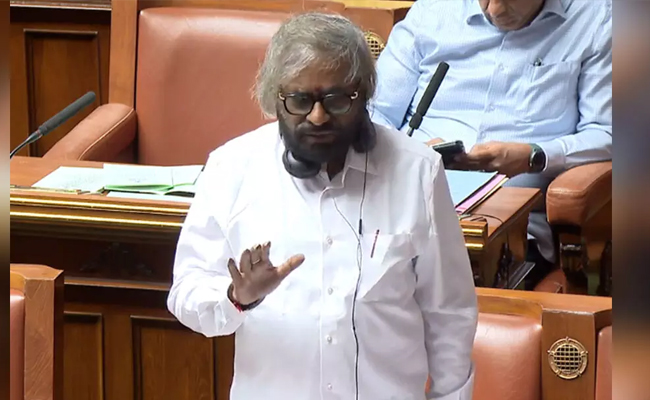
Bengaluru (PTI): Karnataka Forest Minister Eshwar Khandre told the Legislative Assembly on Thursday that the increase in the population of wild animals like tigers and elephants, amid a decrease in forest cover in the state, is contributing to human-animal conflicts.
The minister was responding to questions raised by MLAs, including Leader of the Opposition R Ashoka in the Assembly.
"The number of animals has increased. In 1972, Bandipur had 12 tigers. Now, there are 175 tigers. Regarding the carrying capacity (at Bandipur), we have formed a team of experts and will be getting a report from them," Khandre said.
He said, "Forest cover is not increasing proportionately with the rise in animal population. In fact, forests have decreased. We are trying to save forests."
Ashoka sought to know from the minister if the government's recent decision to halt safaris had decreased human-animal conflict.
In November 2025, the government stopped safaris at Bandipur and Nagarhole tiger reserves following a spate of tiger attacks that resulted in human deaths. However, in February, the government decided to lift the safari ban.
Explaining the decision to stop safari, Khandre said, "Safari was not stopped all of a sudden. In November and December, human-animal conflict increased. In Bandipur and the surrounding areas, three lives were lost in a span of fifteen days due to tiger attack, while one person became permanently disabled".
"When I visited Chamarajanagara district, several people and organisations, including farmers, had submitted memoranda, as two lives were already lost by then."
"They had alleged that the safari vehicles were operating even during the night and they were not being regulated, more than the permitted number of people were coming for safari, and it should be halted, or else it may lead to the loss of more lives," he said, adding that based on the memorandum, he had asked officials to examine things.
As there was one more tiger attack in a week's time, the minister further said, following this, he immediately ordered to stop the safari. "Yes, lots of tourists come for the safaris..... Livelihoods were also lost. There was a loss of Rs 6-8 crore. But we wanted to save lives," he said.
Noting that Bandipur has a periphery of 314 km, of which 100 km is a maximum conflict zone, Khandre said. "In that region, we have 25 anti-poaching camps and round-the-clock patrols, with all required facilities. We have set up an integrated command centre. Drone cameras and other facilities have been provided there," he said.
He said the decision to reopen the Bandipur safari was made after regulating things, based on the recommendations in the interim report from a committee consisting of a central government representative.
The government is conducting an outreach programme in 70 villages around the periphery of Bandipur forest, where the government will use 35 per cent of the income from safaris on education and livelihood improvement, Khandre said.
Responding to another question by Malavalli Congress MLA P M Narendraswamy, the minister said, elephant attacks are also on the rise day by day.
"There are several reasons for this. The elephant population has increased. The elephant corridor has been fragmented due to various developmental works like expressways, among others," he said.
Stating that the government has taken various measures to stop this, Khandre said, "The government is erecting 116 km of railway barricades at a cost of Rs 201 crore. They are at various stages....we are also taking up other measures like tentacle fencing. We also have an elephant task force and a leopard task force (to tackle leopard attacks), command centres, and use of modern technologies to monitor the movement of wild animals."
The minister accepted the request of Sullya BJP MLA Bhagirathi Murulya to allow the trekking at Kumara Parvatha, considered one of the toughest trails in the Western Ghats, from 5.30 am instead of the current 6 am.
"The Subramanya-Kumara Parvatha is 12 km, up and down it is a 24-km, 2-day trek. Earlier, the trek started at 6 am, and people had to camp at one location that had no basic facilities, coupled with wildlife movement," Khandre said.
Considering all these factors, the time was changed by senior officials in June 2024, he said. "Now, the 14-km Beedahalli-Kumara Parvatha trek takes 7 hours. The 19-km Beedahalli-Kumara Parvatha-Subramaya needs 10-12 hours.
The Subramanya-Shesha Parvatha-Subramanya is 20 km. Those who start at 6 am have to return before 6 pm.....The starting time will be changed to 5.30 am," he said.
Noting that beyond the carrying capacity, about 2,000-3,000 people used to gather there for trekking sometimes, which could cause disaster, the minister said.
"It has been decided to regulate it by allowing only 150 people per day. The trek happens for six months; it cannot be done during the monsoon and when there are chances of wildfire during summer."
Let the Truth be known. If you read VB and like VB, please be a VB Supporter and Help us deliver the Truth to one and all.
Late flourish masks CSK’s batting woes on lively Chepauk track, hosts post 158/7
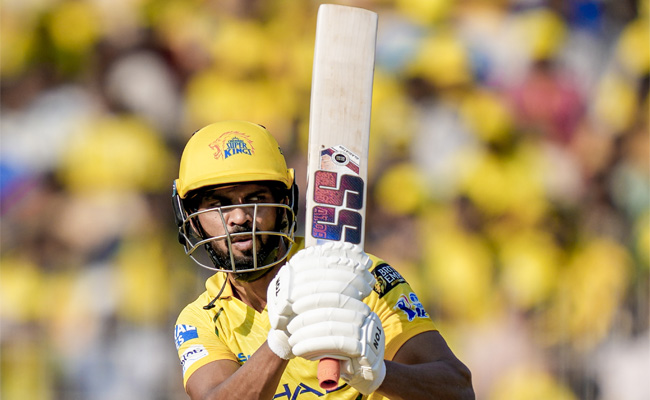
Chennai (PTI): Bowlers calling the shots in a format dominated by big hitters is a rarity, but that script played out at Chepauk on Sunday as Gujarat Titans exploited a lively, bounce-friendly surface to stifle Chennai Super Kings before the hosts managed a late flourish to reach 158 for 7.
On a pitch that offered sharp carry, stroke-making demanded discretion and adaptability. Instead, CSK’s batters often opted for high-risk shots without fully assessing conditions, and paid the price with a flurry of miscued dismissals.
Invited to bat, CSK never quite found rhythm but skipper Ruturaj Gaikwad’s maiden half-century (74 not out) of the current IPL season lent a semblance of respectability to the total in a season where 200-plus scores have become commonplace.
Gaikwad's knock came off 60 balls with six fours and four sixes after a laboured start.
The tone was set early by GT pacer Mohammed Siraj, who extracted steep bounce and forced errors.
Sanju Samson (11) began watchfully, negotiating the first over before opening up against Kagiso Rabada to bring up his 5000 IPL runs milestone. However, Rabada’s bounce soon accounted for him as a hard slash outside off resulted in a faint edge that Jos Buttler pouched safely.
The dismissal triggered a collapse. Urvil Patel (4) fell in the same Rabada over attempting an ambitious pull, while Sarfaraz Khan (0) succumbed to Siraj’s extra lift, mistiming a short ball to offer a simple catch.
At 28 for 3 inside the Powerplay, CSK were already in trouble.
Gaikwad and Dewald Brevis (2) needed to rebuild, but the latter’s impatience against spinner Manav Suthar led to his downfall, holing out after failing to get to the pitch of the ball.
The mounting wickets forced Gaikwad into a shell — an approach that, while understandable, further stalled the momentum. His reluctance to improvise allowed dot balls to pile up, with CSK reaching 50 only in the 12th over.
The skipper eventually broke free, taking on Arshad Khan and Jason Holder with a couple of towering sixes, but the acceleration came too late.
Shivam Dube, dropped thrice on 6, 11 and 22, struggled for fluency before Arshad cleaned him up.
Kartik Sharma (15) and Jamie Overton (18) provided late impetus with a few lusty hits, but the damage had already been done.
On a pitch that rewarded discipline and smart shot selection, Titans' bowlers executed their plans to perfection, while CSK’s batters failed to read the conditions in time, a lapse that ultimately defined the innings.