India has 3,167 tigers, reveals latest tiger census released by PM Modi
Mysuru (Karnataka) (PTI): India's tiger population rose by 200 in the past four years to reach 3,167 in 2022, the latest tiger census data released by Prime Minister Narendra Modi here on Sunday revealed.
According to the data, the tiger population was 1,411 in 2006, 1,706 in 2010, 2,226 in 2014, 2,967 in 2018 and 3,167 in 2022.
At the inaugural session of the commemoration of 50 years of 'Project Tiger', the Prime Minister also launched the 'International Big Cat Alliance' (IBCA) and released a booklet Amrit Kaal Ka Tiger Vision', presenting the vision for tiger conservation in the next 25 years.
The Prime Minister said that protection of wildlife was a universal issue, adding that IBCA was India's endeavour for the protection and conservation of big cats.
"Cheetahs had become extinct in India decades ago. We brought this magnificent big cat to India from Namibia and South Africa. This is the first successful transcontinental translocation of the big cat," Modi said.
For wildlife to thrive, it is important for ecosystems to thrive, Modi said adding that this has been happening in India.
"India is a country where protecting nature is part of culture We do not believe in conflict between ecology and economy, but give importance to coexistence between the two," he noted.
In July 2019, the Prime Minister had called for an 'Alliance of Global Leaders' to "obliterate demand" and firmly curb poaching and illegal wildlife trade in Asia.
India launched the IBCA with to bring focus to protection and conservation of seven major big cats of the world -- Tiger, Lion, Leopard, Snow Leopard, Puma, Jaguar and Cheetah -- with membership of the range countries harbouring these species.
India launched 'Project Tiger' on April 1, 1973 to promote tiger conservation. Initially, it covered nine tiger reserves spread over 18,278 sq km. At present, there are 53 tiger reserves spanning more than 75,000 sq km (approximately 2.4 per cent of the country's geographical area).
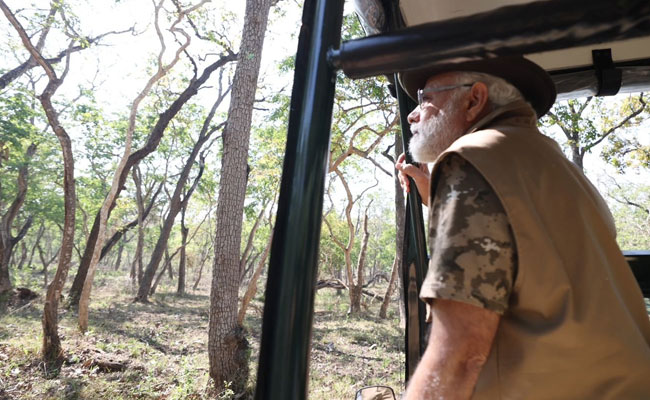
The Prime Minister spent the morning at the scenic Bandipur Tiger Reserve where he went on a jeep safari and got a glimpse of the wildlife, natural beauty and biodiversity.
Let the Truth be known. If you read VB and like VB, please be a VB Supporter and Help us deliver the Truth to one and all.
Pune journalist booked on voyeurism charge for filming woman at lodge

Pune (PTI): Police have registered a case of voyeurism against a television journalist in Pune for allegedly filming a woman in an objectionable position without her consent at a lodge in the city, officials said on Saturday.
The FIR was filed against Rohan Kadam under Bharatiya Nyaya Sanhita (BNS) sections 77 (voyeurism) and 3(5) (common intention) at the Vishrambaug police station here, while the complaint mentions that he was accompanied by three other journalists, they said.
The incident took place on April 8 when the accused had checked into a room at a lodge in Budhwar Peth, which houses a red light area.
In her complaint, the woman said that while she was wearing her saree after establishing "physical relations with a customer", she realised that an unidentified person was filming her through a net above the partition wall between the rooms.
She opened the door of her room and knocked on the adjacent door, asking the person to come out, the FIR said.
"The woman sought clarification from Kadam, who gave vague answers and refused to show his phone. When the lodge operator, the woman and others questioned him, he claimed that they were a group of four journalists conducting a sting operation," it said.
Police said Kadam was assaulted when he allegedly tried to flee from the spot.
The woman later approached the Vishrambaug police station and lodged a complaint.
"We have registered a case in this regard and further probe is on," a police officer said.
Meanwhile, the Pune Union of Working Journalists (PUWJ) has written a letter to city Police Commissioner Amitesh Kumar, seeking action against the journalist for the alleged act.
In the letter, the journalists' body said there were murmurs that some journalists and others were trying to ensure that no offence is registered in the matter.
"We do not agree with this and clarify that PUWJ will not come in the way of the probe," the letter stated.