India is losing pluralism, moving towards Hindutva: Telugu writer Olga
May literature convention in dharwad
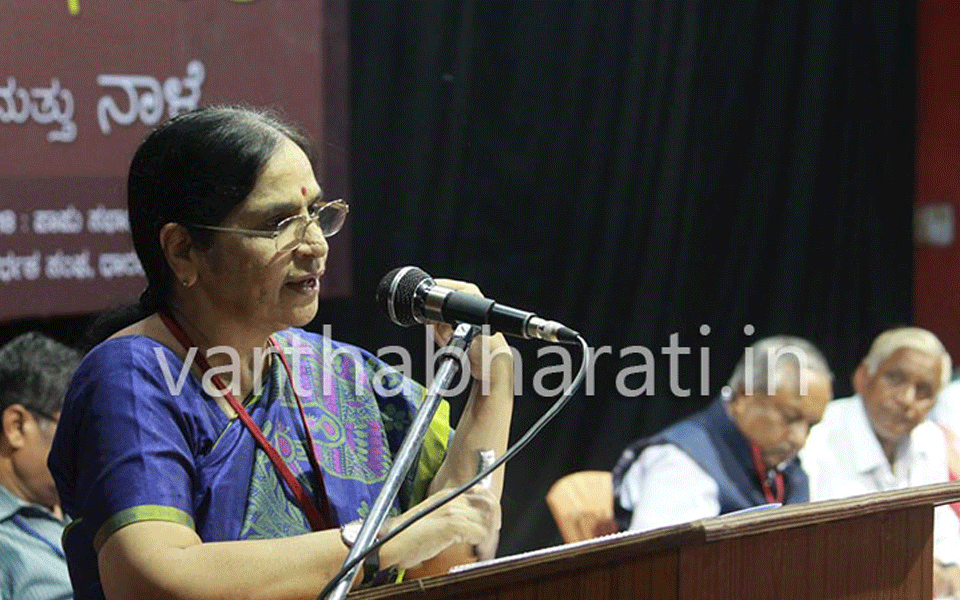
Dharwad, May 26: Today, democracy can only be saved by stimulating constitutional morality among the people of the country and promoting its values. Literature should play a key role in achieving this task, said Olga (P Lalita Kumari), a famous Telugu writer.
She was addressing a gathering after inaugurating May Literary Conference ‘Bahutva Bharata-Indu Nale’ (Plural India - Today Tomorrow), on the premises of Vidyavardhaka Sangh conference hall in Dharwad.
“The true essence of India lies in plurality. But unfortunately, it is a matter of concern that today India is losing its plurality and moving towards Hindutva-Bharat day by day. In this context, India’s pluralism must be protected on the urgent basis,” she said.
The Telugu writer further said that the terms 'Nation' and 'Nationalism' that came into existence during the freedom struggle were associated with the democratic value. But in these seven decades since Independence, these two terms have lost their existence and converted into a concept of attack on pluralism.
“The concept of today's nationalism, which is creating anxiety among the minorities and the majority, has given birth to intolerant people like Narendra Modi and Amit Shah, who do not want to interact with people; rather they infuse their ideologies in people’s minds.”
“We need to understand the relationship between literature and the Constitution. The Constitution guarantees the freedom of expression in its fundamental rights. When this bird is being buried, the relationship between literature and the Constitution have to be strengthened through a struggle. Meantime, it is the duty of the literature-creators for working to protect democratic values,” Olga said.
“Constitutional sculptor Babasaheb Ambedkar emphasized the need to develop the morality of the constitution among people. Ambedkar had precisely said that whoever comes to power must promote Constitutional moralities. But no government in our country has been able to do so in the last few years,” she added.
At the same time, she cautioned that this responsibility is equally there on writers. Only humans can understand human beings. It is enough to have a compassionate heart. Literature can also cause compassion for a thief. Literature can interpret it as poverty leads to theft, and poverty is a social dimension. Values are emotionally inspired by literature, which can then grow into political consciousness. This is possible when literature is made on the suffering lawful people. These sorts of literary festivals must motivate in this regard.
Delivering the keynote address at the program, writer KP Suresh said the May Literary Conference, which is being conducted over the past few years, has contributed in many movements in the state. But ‘the plurality of India,’ which is the theme of the conference, can only be realised when it sets a direction to everyone’s work in next one year.
“Fascist ideas are entering into educational and public stages. Representatives of Vedic culture are discussing to present Brahman’s celebrations such as Brahma Kalasha in Bhootaradhane, the typical cultural celebration of the coastal region. In such a situation, the fading plural legacy among the local livelihood must be recognised and saved besides bringing it to the fore,” he added.
Retired Judge Justice Nagamohan Das, who presided over the inaugural session, said the history of the entire country is associated with diversity. Here in different times, different communities came from different families from different languages. Those who came here stays here. Over the time, the people of these communities have been able to interact with each other in such a way that today the pure race cannot be traced out at first sight. When the Constitution of India was drafted, it was not based on any religion but formed on the secular basis. Secularism means that the ruling government does not act on behalf of any religion and does not discriminate on religion. In our Constitution, significant status has been given to plurality. There is a principle that everyone is equal in the eyes of the law without any discrimination. Article 51-A of the Constitution laid down the duty that every citizen should protect the legacy of plurality and culture of the country.
Such a constitution is an achievement which this country could not have perceived for thousands of years. While the Bhagavad Gita is for Hindus, the Quran for Muslims, and Bible for Christians; the constitution is great for all, he said.
SS Harlapur, Dr Shekhar Ladwa, Dr DB Gawani, Dr Anasuya Kamble and Prakash Udikeri were present. Dr. Sanjeev Kulkarni organized the program.
Report: Harsha Kumar Kugve
Photos: Ivan D'Silva


Let the Truth be known. If you read VB and like VB, please be a VB Supporter and Help us deliver the Truth to one and all.
BJP hatching Op Lotus, alleges Shivakumar as 2 held for trying to bribe Odisha Cong MLAs
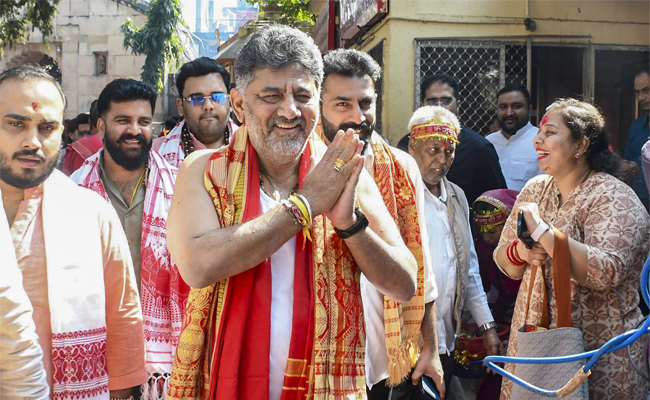
Bengaluru (PTI): Two people were arrested for allegedly attempting to bribe Odisha Congress MLAs, who are staying in a resort near here, as part of BJP's "Operation Lotus," Karnataka Deputy Chief Minister D K Shivakumar claimed on Sunday.
He alleged that the BJP has planned "Operation Lotus'" and was offering Rs five crore to each Odisha MLAs, who were flown here ahead of the March 16 Rajya Sabha polls in that state.
Eight MLAs, along with some other Odisha Congress unit office bearers are camping in the resort.
They have been flown to Bengaluru with apprehensions of horse trading during the Rajya Sabha elections in favour of ruling BJP's Rajya Sabha candidate.
ALSO READ: Environment ministry endorses names of 10-member expert committee set up to define Aravalli hills
Shivakumar, also Congress' Karnataka chief, said two persons were apprehended at the private resort for attempting to buy over Odisha Congress MLAs.
"Four people have come. One local person named Suresh helped them; they contacted him (an MLA) online. In the morning they picked up our MLA. Our MLA told us that they offered Rs five crore for each vote. He (Congress MLA) said he is not for horse-trading," Shivakumar told reporters.
"The cheque and everything should be seized. A complaint will be filed at the police station. After that, whatever legal action is required will be taken," he added.
Shivakumar said those caught have accepted that they came for the "same purpose".
"They have admitted it and the process is on to trace others. This is the great Operation Lotus carried out by BJP friends in Karnataka," the DCM said.
Operation Lotus is a term used by Congress to claim about attempts to topple a non-BJP government by the BJP whose party symbol is lotus. It also involves getting the votes on MLAs from other parties for their Rajya Sabha candidate.
According to a Congress source, one of the persons involved in the horse trading is a defeated Lok Sabha candidate.
A source shared the photograph and blank cheques as well.
"They tried to negotiate with the Congress MLA by offering a blank cheque.
Both have been caught and handed over to the Bidadi police," the source said.
Police sources said that they have been arrested.
According to Congress sources, the Rajya Sabha elections in Odisha will take place on Monday. The BJP has fielded one more candidate, which raised apprehensions of horse-trading.
Congress and the Biju Janata Dal have fielded a candidate.