Infosys founder Narayana Murthy flags fears of GDP growth hitting lowest since 1947
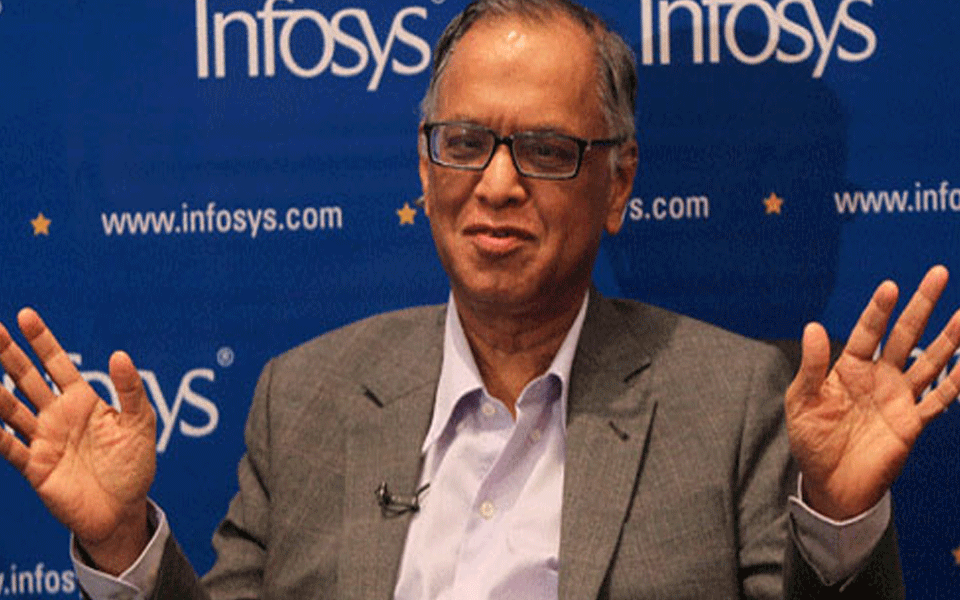
Bengaluru: Flagging fears that the country's GDP growth may even touch its lowest since independence in the backdrop of coronavirus pandemic, Infosys founder N R Narayana Murthy on Tuesday said the economy should be brought back on track and people should be prepared to live with the pathogen.
He also pitched for developing a new system that should allow every player in every sector of the country's economy to operate at full steam with suitable precautions.
"India's GDP is expected to shrink by at least five per cent. There is a fear that we may even reach the lowest GDP (growth) since independence, since 1947," Murthy said.
The software icon was participating in a discussion on 'Leading India's Digital Revolution' during the 16th edition of Institute of Engineering and Technology's India Digital Conversations held virtually.
"The global GDP has gone down. Global trade has shrunk, global travel has almost disappeared. The global GDP is likely to shrink between 5 per cent and 10 per cent," he said.
Murthy said that right from the first day of the national lockdown on March 24 his view had been that people have to be prepared to live with the virus for three reasons -- there is no vaccine, no cure for coronavirus and the economy cannot be brought to a halt.
The earliest possible vaccine was from Oxford University, which may be available in the country anywhere from six to nine months, he said.
"But even if we are able to vaccinate 10 million people a day, it is going to take 140 days to vaccinate all the Indians. That is a long period to prevent the spread of the disease," Murthy said.
"...we cannot make the economy come to a halt. Over all, 140 million workers have been affected by this virus. So the smartness is in defining a new normal. This normal should allow our economy to grow while moving on the earth and fighting the virus," the tech leader said.
Stressing on developing a new system to deal with the current situation, he also laid emphasis on creating a health infrastructure for vaccinating everybody once a vaccine was available and working towards a cure for the new virus.
"India has traditionally not invested sufficiently in public health. We have severe shortage both in talent and in material for a robust public health system. The state of our Institute of Public Health is a good data point," said Murthy.
In the given system, Murthy said, social distancing, and use of masks were the best way to combat the virus. He, however, lauded the country for having done a decent job under the present circumstances.
To bring the economy back on track, the Infosys founder suggested getting back the 140 million migrant workers who have gone back to their villages to their workplaces, mostly in urban India.
His second advice was increasing the number of hospital beds and adding equipment for testing and taking care of the projected number of COVID-19 patients for three months and six months from now.
"Even today there is a severe shortage of COVID-19 care facilities in second tier and third tier towns," said Murthy lamenting the demise of one of his relatives due to coronavirus in Hubballi, a north Karnataka tier-2 city and district headquarters.
The 74-year-old tech leader also favoured amending laws and providing infrastructural facilities for companies which cannot use the work-from-home paradigm and increasing the public transport and public safety facilities for businesses and the public to operate 24 hours.
Let the Truth be known. If you read VB and like VB, please be a VB Supporter and Help us deliver the Truth to one and all.
Iran Foreign Minister Araghchi begins 3-day India visit
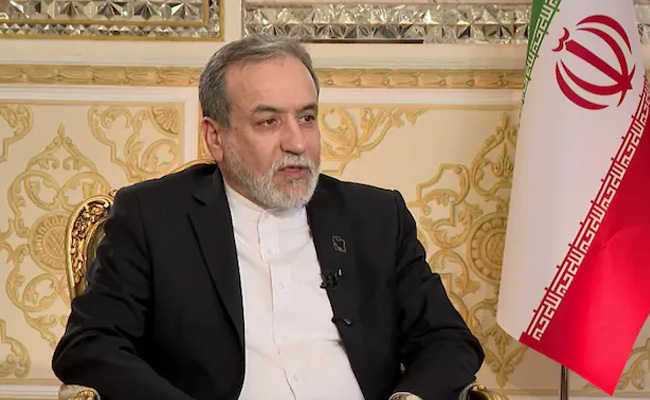
New Delhi (PTI): Iranian Foreign Minister Abbas Araghchi began a three-day official visit to India on Wednesday, marking the first high-level diplomatic engagement from Tehran since the outbreak of the US-Israel war with Iran more than two months ago.
Araghchi is visiting India primarily to attend a two-day meeting of BRICS foreign ministers beginning Thursday.
The Iranian foreign minister is set to hold wide-ranging bilateral talks with his Indian counterpart S Jaishankar, focusing on the escalating crisis in West Asia.
The situation surrounding the Strait of Hormuz is expected to feature prominently. The Indian side is likely to press for the safe passage of remaining merchant vessels through the strategic waterway, according to people familiar with the matter.
Araghchi and other foreign ministers of the BRICS member states are scheduled to call on Prime Minister Narendra Modi on Thursday.
"A very warm welcome to Foreign Minister of Iran, Seyed Abbas Araghchi, on his arrival in New Delhi for the BRICS Foreign Ministers' Meeting," External Affairs Ministry spokesperson Randhir Jaiswal said on 'X'.
The escalating crisis in West Asia and its impact on the global energy supply chain are expected to dominate deliberations at the BRICS foreign ministers' meeting.
India, as the chair of BRICS, is hosting the conclave of the foreign ministers ahead of the annual summit of the grouping in September.
It will be interesting to see if the foreign ministerial conclave manages to produce a consensus statement on the conflict in West Asia.
Sharp differences among the member states over the US-Israel war on Iran stalled India's efforts to build a consensus position on the conflict during a meeting of the grouping's deputy foreign ministers and special envoys on Middle East and North America last month.
No consensus statement on the conflict could be reached largely due to differences between the United Arab Emirates (UAE) and Iran. The two neighbouring countries have sparred in recent weeks over Iran's alleged attacks on energy infrastructure in the UAE.
"The active presence of the Islamic Republic of Iran in mechanisms such as BRICS represents a strategic choice to strengthen genuine multilateralism, expand equitable cooperation, and participate in shaping a more just order in international relations," Iranian Deputy Foreign Minister Kazem Gharibabadi said on 'X'.
"The BRICS foreign ministers' meeting in New Delhi can be an important opportunity for dialogue on the future of Global South cooperation, reforming international economic governance, developing independent trade, strengthening financial and banking ties, and reducing countries' dependence on discriminatory and unilateral mechanisms," he said.
Gharibabadi said Iran, with its geopolitical, energy, transit, scientific, and human capacities, can play an effective role in the BRICS agenda for balanced development, economic security, regional connectivity, and amplifying the voice of independent countries.
The Iranian deputy foreign minister is in New Delhi for the BRICS meeting.
"In this path, opposition to America's unilateral coercive measures and their illegal and anti-development effects is an inseparable part of defending economic justice and the rights of nations to development," he said.
After the West Asia conflict escalated, Iran urged India, as the current BRICS chair, to leverage its "independent role" to halt the US-Israel hostilities against Iran.
Global oil and gas prices have surged after Iran virtually blocked the Strait of Hormuz, a narrow shipping lane between the Persian Gulf and the Gulf of Oman that handles roughly 20 per cent of global oil and LNG (liquefied natural gas).
BRICS, originally comprising Brazil, Russia, India, China, and South Africa, expanded in 2024 to include Egypt, Ethiopia, Iran, and the UAE, with Indonesia joining in 2025.
It has emerged as an influential grouping as it brings together 11 major emerging economies of the world, representing around 49.5 per cent of the global population, around 40 per cent of the global GDP and around 26 per cent of the global trade.
The BRICS foreign ministers held their last meeting on the margins of the 80th session of the United Nations General Assembly (UNGA 80) in September 2025.