Instead of PR events like 'Tika Utsav', ensure free Covid19 vaccination to everyone: Siddaramaiah
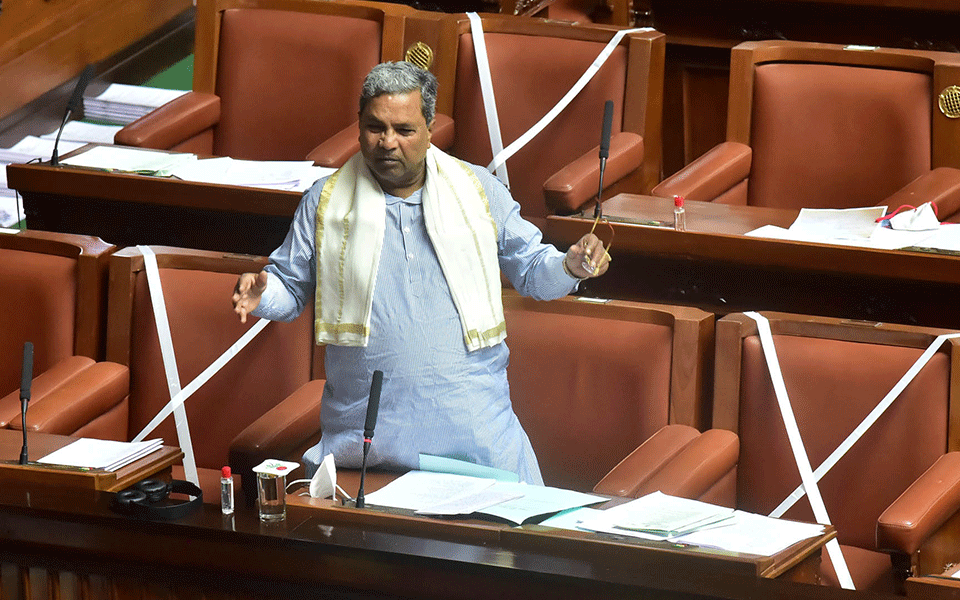
Bengaluru, Apr 25: Accusing the BJP government at the Centre of having created a 'barrier' by increasing the prices of COVID-19 vaccines, the Congress in Karnataka on Sunday demanded that free vaccination be provided to all citizens.
The principal opposition party also questioned the Yediyurappa government for not announcing vaccines free of cost yet for all.
"Instead of encouraging people to get vaccinated, BJP govt at centre has created a barrier by increasing the prices of vaccines.
(PM) Narendra Modi, instead of PR events like 'Tika Utsav', ensure free Covid19 vaccination to everyone," leader of opposition in Karnataka assembly and Congress leader Siddaramaiah tweeted.
State Congress President D K Shivakumar said India is probably the only country which is discussing vaccine prices, when it's being given for free across the world.
"Why has Karnataka govt still not announced FREE VACCINATION for all? I demand that free vaccines be given to all citizens & a roll-out plan be shared asap," he tweeted.
According to sources, the Karnataka government is likely to decide on vaccinating people of state, free of cost.
The state government on Thursday decided to purchase 1 crore doses of Covishield vaccine at a cost of Rs 400crore, in the first phase.
The central government had recently announced that the vaccination for those above 18 years will begin across the country from May 1 as part of the third phase of the inoculation drive.
With government giving manufacturers and importers pricing freedom, Pune-based Serum Institute of India (SII) is the manufacturer of Covishield vaccine said vaccines will be priced at Rs 400 per dose for state governments and Rs 600 for private hospitals.
Hyderabad-based vaccine major Bharat Biotech said it would provide its COVID-19 vaccine, Covaxin, to state governments at Rs 600 per dosage and to private hospitals at Rs 1,200.
In a series of tweets Siddaramaiah also hit out at state BJP leaders for celebrating the 5kg free rice scheme announced by PM Modi, but the same leaders made all attempts to end Anna Bhagya scheme introduced by the Congress government led by him, which provided 7kgs of free rice.
"This is an example for Karnataka BJP's sickness," he said.
The Centre on Friday had decided to resume providing free food grains to 80 crore poor beneficiaries in May and June to help them tide over the economic hardship in the second wave of the coronavirus pandemic, a move that would cost the exchequer around Rs 26,000 crore.
Instead of encouraging people to get vaccinated, @BJP4India govt has created a barrier by increasing the prices of vaccines.
— Siddaramaiah (@siddaramaiah) April 25, 2021
Mr. @narendramodi,
Instead of PR events like 'Tika Utsav', ensure free #Covid19 vaccination to everyone.#Corona2ndWave#vaccine
1/6
.@BJP4Karnataka leaders are celebrating the 5kg free rice scheme announced by @narendramodi but the same leaders made all attempts to end #AnnaBhagya scheme which provided 7kgs of free rice.
— Siddaramaiah (@siddaramaiah) April 25, 2021
This is an example for @BJP4Karnataka's sickness.#AnnaBhagya#Corona2ndWave
2/6
I have always been suggesting the govt to provide 10 kgs of free rice to all distressed people till the pandemic is over @PMOIndia should immediately consider this suggestion & ensure everyone gets 10 kgs of free rice.
— Siddaramaiah (@siddaramaiah) April 25, 2021
3/6#Corona2ndWave#AnnaBhagya
.@BJP4Karnataka govt is giving 2kgs of rice instead of 5kgs in many districts under Anna Bhagya. This is their desperate attempt to end the scheme.
— Siddaramaiah (@siddaramaiah) April 25, 2021
Mr. @CMofKarnataka,
End this injustice immediately so that poor people don't curse you.#AnnaBhagya#Corona2ndWave
4/6
Our govt had launched
— Siddaramaiah (@siddaramaiah) April 25, 2021
Anna Bhagya,
Ksheera Bhagya,
Indira Canteen,
Matrupoorna & other schemes to make Karnataka a hunger free State.
Anti-poor @BJP4Karnataka govt is on a mission to end all these schemes.
5/6#AnnaBhagya
Where are the 25 MPs from @BJP4Karnataka hiding during this time of crisis?
— Siddaramaiah (@siddaramaiah) April 25, 2021
These MPs should sit in front of @PMOIndia @narendramodi's house & demand the necessary facilities required to tackle the pandemic.
6/6#Covid2ndwave
Let the Truth be known. If you read VB and like VB, please be a VB Supporter and Help us deliver the Truth to one and all.
HC seeks mechanism on disclosure of complaints against judges after SC says no data maintained
New Delhi: The Delhi High Court sought suggestions for a framework to balance transparency and judicial independence on April 1, after the Supreme Court submitted that it does not maintain judge-specific data on complaints alleging corruption or misconduct.
The submission was made by Advocate Rukhmini Bobde. He appeared for the Supreme Court’s Central Public Information Officer, before Justice Purushaindra Kumar Kaurav in a petition filed by journalist and RTI activist Saurav Das. The case concerns an RTI application filed by Das in April 2023 seeking information on whether any complaints had been received against Justice T. Raja, former Acting Chief Justice of the Madras High Court, and if so, the number of such complaints and action taken.
According to a detailed report published by The Wire, the CPIO declined the request and stated that the information was “not maintained in the manner as sought for.” The first appellate authority upheld the decision. Although the Central Information Commission remanded the matter, the CPIO reaffirmed the refusal on similar grounds, which led Das to move the high court through Advocate Prashant Bhushan.
At the hearing, Justice Kaurav observed that the issue had wider institutional implications. It directed both sides to propose a mechanism that would protect the reputation of judges while ensuring public access to information regarding the handling of complaints. The case, Saurav Das v. CPIO, Supreme Court of India has been listed for further hearing on May 7.
During the arguments, Bhushan cited numbers released by the Union Law Ministry in Parliament in February 2026, which said that 8,630 complaints had been filed against sitting judges between 2016 and 2025. The Supreme Court provided data showing that complaints increased from 729 in 2016 to 1,102 in 2025. Bhushan questioned how aggregate data could be calculated without identifying the judges against whom complaints were filed.
Bobde responded that the data shared with Parliament reflected only total complaints against all sitting judges and did not involve judge-wise categorisation. She referred to the RTI request as a "fishing and roving inquiry." She also claimed that the Registry could not be forced to spend resources to collect material that was not stored in the format sought. She referenced the 2019 Constitution Bench decision in Supreme Court of India v. Subhash Chandra Agarwal, which allows for rejection if compliance will disproportionately divert resources, as her justification.
The high court questioned how no judge-specific information was maintained and expressed concern that disclosure of large aggregate figures without clarity on how complaints were handled could affect public perception. Justice Kaurav noted that an applicant could not be denied information solely on technical grounds relating to format.
Bhushan argued that the RTI request did not seek details of complaint contents or collegium deliberations but merely whether complaints were received and what action followed, submitting that transparency in the handling of complaints was essential to maintain public confidence.
The Supreme Court’s in-house procedure for examining complaints, adopted in 1999, provides for scrutiny by the Chief Justice of India and, where warranted, inquiry by a committee of judges. There is no statutory requirement for public reporting of outcomes.