Insurer has to compensate kin of driver who died while sleeping inside lorry: K'taka HC
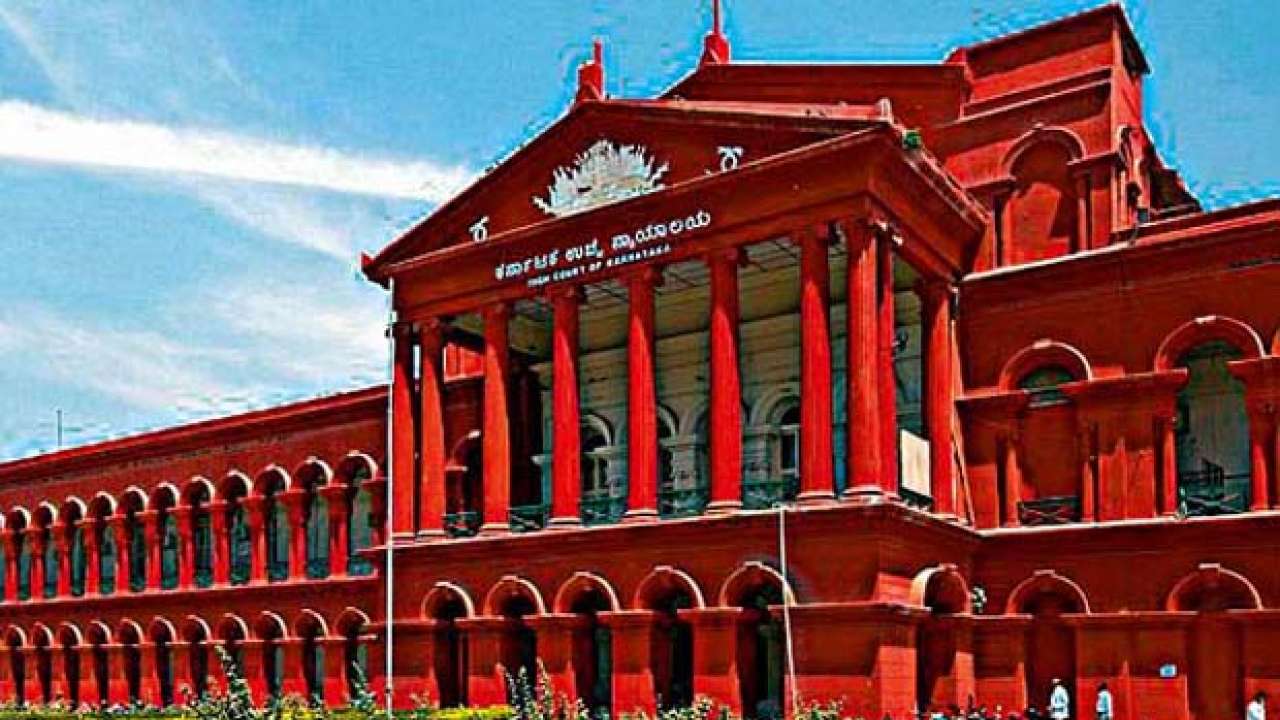
Bengaluru, Sep 21: Disposing an appeal filed in 2010, the High Court of Karnataka has ruled that the driver of a lorry who died while sleeping inside the vehicle due to a heart attack, was still entitled to the compensation payable by insurer of the vehicle.
Eranna, a lorry driver, had died at Idya village near Suratkal where he had halted the vehicle and was sleeping. He died of cardiac arrest which the subsequent post-mortem report proved.
The insurance company claimed that he had "died due to cardiac failure and not due to accidental death and he was taking intoxicated drugs, which is not covered under the policy", and hence it was not liable to pay the compensation.
Dismissing this contention, the HC said: "Usage of the vehicle does not mean that at the time of his death he need not necessarily drive the vehicle, but in casual connection of his employment he was sleeping in the lorry."
"While taking rest he suffered heart attack and hence, very contention of insurance company cannot be accepted that it is not liable to pay the compensation," the court said.
The National Insurance Company had approached the High Court against the order of the Commissioner for Workmen Compensation, Bagalkote. In his order on August 20, 2009, the Commissioner had awarded a compensation of Rs 3,03,620 to the wife and three minor children of the deceased, payable by the insurance company.
The judgement delivered by Justice H P Sandesh recently pointed out that Eranna "was sleeping in the vehicle itself and the fact that he was working the very same day is not in dispute and the owner has also admitted that he died during the course of employment."
Citing an earlier judgement of the HC, the court said that "driving job is undoubtedly a tension filled job, particularly, to cope up with present day traffic and other things. There cannot be any presumption that even when a person dies while actually working in the job that his death may not be due to employment, but may be due to something else. Such presumption is nothing short of a perversity."
Let the Truth be known. If you read VB and like VB, please be a VB Supporter and Help us deliver the Truth to one and all.
Nitish Kumar's son Nishant among 32 to take oath as Bihar ministers
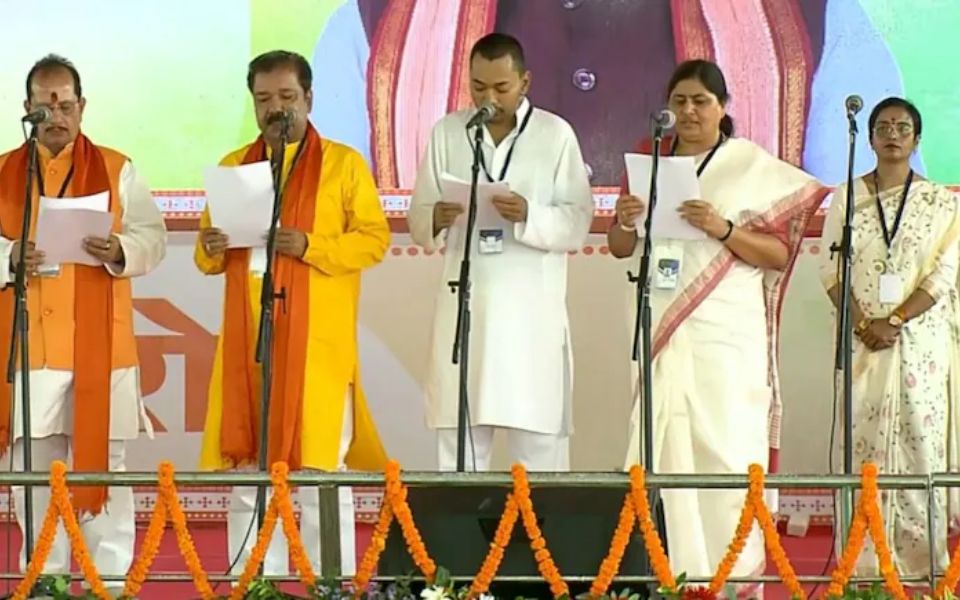
Patna (PTI): In a major expansion of the Cabinet of Bihar's first BJP-led government, JD(U) supremo Nitish Kumar's son Nishant Kumar and 31 others took oath as ministers on Thursday in the presence of Prime Minister Narendra Modi and Union Home Minister Amit Shah.
Altogether 32 leaders, drawn from all constituents of the five-party NDA in the state, were administered the oath of office by Governor Lt Gen (Retd) Syed Ata Hasnain at a grand ceremony that was also attended by Defence Minister Rajnath Singh and Union Health Minister J P Nadda and BJP president Nitin Nabin.
Prominent inductees included Nishant Kumar, the son of JD(U) president Nitish Kumar, who stepped down as chief minister last month to enter the Rajya Sabha.
The BJP, which is the single largest party in the 243-member assembly with 89 MLAs, has 15 ministers, who took oath on Thursday.
Most of the inductees were those who were part of the Nitish Kumar cabinet formed in November last year after the NDA stormed back to power in the assembly polls.
The JD(U) is represented by a total of 15 ministers, 13 of whom took the oath at the Gandhi Maidan on Thursday. Vijay Kumar Chaudhary and Bijendra Prasad Yadav had taken oath in April along with Samrat Choudhary and were designated as deputy chief ministers.
Sanjay Kumar Singh and Sanjay Kumar Paswan, both from the Lok Janshakti Party (Ram Vilas) headed by Union minister Chirag Paswan, are back as ministers, and so are Santosh Kumar Suman and Deepak Prakash, sons of Union minister Jitan Ram Manjhi of the Hindustani Awam Morcha and Upendra Kushwaha of the Rashtriya Lok Morcha, respectively.