It’s Shariat and not politicians to decide on Muslims: Shafi Saadi
Minister Zameer’s statement irks religious leaders
Bengaluru: The statement of Minister Zameer Ahmed Khan that “Muslims will not vote for BJP in the forthcoming Lok Sabha elections. Even if anybody voted, they are not Muslims” has triggered controversy.
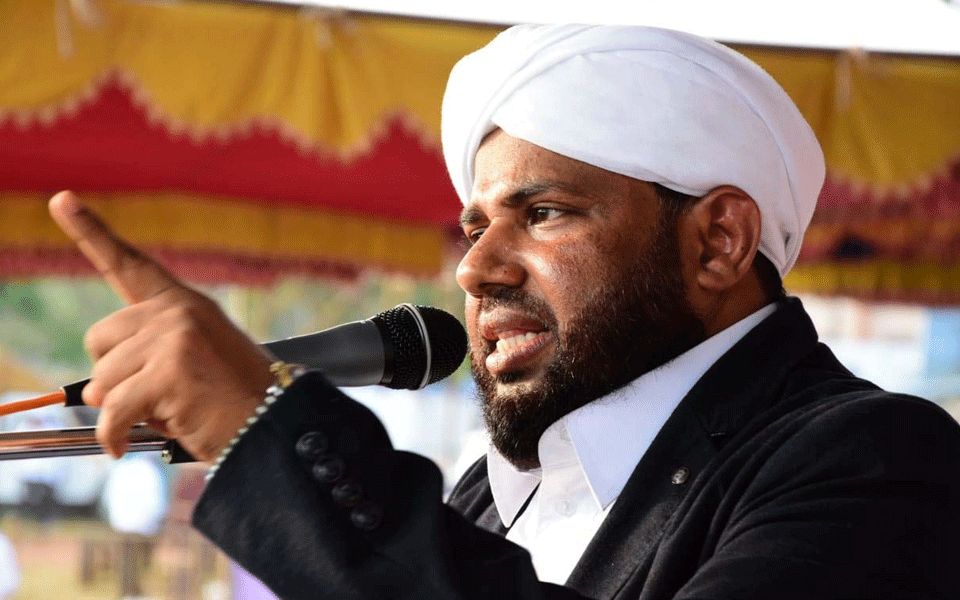
It is Shariat to decide ‘Who is Muslim and how they should be’ and not the politicians, said Karnataka Muslim Jamaat general secretary Moulana NKM Shafi Saadi.
“Those who are in responsible positions should not give such statements. The Minister should give clarification. I will speak to him about the issue. If he gave such statement purposefully, there is no difference between Union Minister Ananth Kumar Hegde and himself. Only Shariat will decide on how the Muslims should be and not the politicians”, he said.
Expresses dissatisfaction
Opposition BJP, social media users and religious leaders expressed their anger about the Minister’s statement saying that “Religion is personal issue. Voting is Constitutional right. Instead of creating awareness on how to use it, no one should try to divide the society and disturb the communal harmony”.
“It shows how the Congress leaders who speak about secularism were afraid of the BJP. After independence, the Congress has cheated the Muslims who are not considering the statements of such leaders. Muslim brothers have understood who will protect their interests”, said BJP state general secretary N Ravi Kumar.
Muslims have been questioning the contributions of Congress leaders for their welfare after the independence. Now all Congress leaders including Minister Zameer Ahmed should introspect themselves, he said in a statement.
“Every citizen in India got voting power due to Constitution and everyone should understand that this right is not given on the basis of any religion. The Minister could have given politically motivated statement. But no one has given the right to the Minister to say that ‘you are not the Muslims if you voted a particular political party”.
-Mufti Bakhar Arshad, state president, All India Milly Council
“It is the decision of the eligible voter to vote to whom. They should create awareness on participating in the voting process and it is not fair to give such statements. It is better to neglect such issues. No one including the community or the society will accept such statements. People should not forget that only Islam will say who is Muslim and how he should be”.
- Atharulla Sharief, state president, Jamaate Islami Hind
“Congress party has not done even a single for the Muslims. Justice Sachar Committee report disclosed that the Muslims had worst situation than dalits in the Congress administration. A few days ago, Congress leader Sonia Gandhi had said that ‘Congress is not a party of Muslims’. People have elected you to work for the community and not the party. The community has many problems. Instead of ensuring free education to the children and releasing the innocents who were arrested, the Minister said that ‘you are not a Muslim if you have not voted the Congress’ and it is like a Fatwa. The religious leaders will guide the Muslims on how to follow Islam and there is nothing to learn from political leaders. The Minister should stop giving such statements. The Minister who has not spoken anything against Ajith Hanumakkanavar who disrespected the Prophet in Suvarna TV channel, has spoken like that which is a shame”.
-AJ Khan, state president, Dalits and Minorities Sene
Let the Truth be known. If you read VB and like VB, please be a VB Supporter and Help us deliver the Truth to one and all.
It has been testing time, not just for us, but entire global community: MEA on West Asia situation
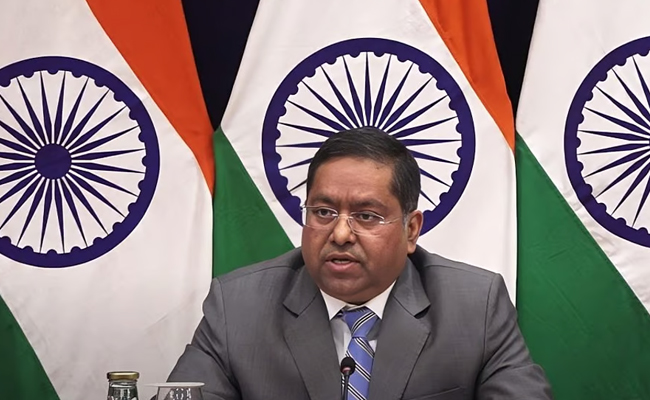
New Delhi (PTI): As the conflict in West Asia widened with global ramifications, India on Thursday said the situation has been a "testing time", not just for the country, but the entire global community.
At an inter-ministerial briefing here on the West Asia situation, MEA Spokesperson Randhir Jaiswal also said, "We continue to remain in touch with concerned countries to ensure our energy security needs are met."
The raging conflict in the region entered its 20th day on Thursday.
The West Asia conflict began on February 28 when the US-Israel combine launched military strikes on Iran. In retaliation, Tehran has targeted Gulf countries hosting US military bases.
"Yes, it has been a testing time, not just for us, but the entire global community. Our leaders have been in touch with their counterparts, as I just spoke about the conversation between our prime minister and the Crown Prince of Kuwait. Similarly, we have been in touch with several other leaders," Jaiswal said.
The two leaders exchanged views on the evolving situation in West Asia and expressed concern over recent developments. The prime minister reiterated India's condemnation of attacks on Kuwait's sovereignty and territorial integrity, he said.
The prime minister also underlined the importance of ensuring safe and free navigation through the Strait of Hormuz. Both leaders agreed that sustained diplomatic engagement remains essential for ensuring regional peace and stability.
He was asked if the West Asia conflict situation has proven to be a test of New Delhi's diplomatic approach in challenging global scenarios.
"Couple of days back you saw that because of our engagement, we were able to... and with talks and diplomacy with several of the stakeholders, we were able to get two of our LPG ships through the Strait of Hormuz," he added.
The MEA spokesperson said India "continues to remain in touch with several stakeholders in this matter, so that we can ensure our energy security needs, as also at the same time, ensure well-being and safety of our Indian nationals, diaspora, present in large number in this region".
"So, our diplomatic efforts continue, and we are committed to taking care of our interests," he asserted.
Later, at his weekly media briefing, Jaiswal said India has been saying that there has to be an "early end to this conflict" through the path of dialogue and diplomacy.
The West Asia conflict has stretched into three weeks, with an Israeli attack on Iran's strategic gas fields of South Pars resulting in an intense Iranian retaliation on key energy infrastructure in several Gulf nations, including Qatar's LNG (liquefied natural gas) hub of Ras Laffan, triggering global concerns.
Qatar accounts for nearly 40 per cent of India's LNG requirement.
The MEA in a statement said the strikes are "unacceptable and need to cease" even as Prime Minister Narendra Modi reached out to top leaders of Oman, France and Malaysia, emphasising the urgency to restore peace in the volatile region.
New Delhi described the attacks on the gas infrastructure as "deeply disturbing" and said that assaults will only serve to further destabilise an already uncertain energy market globally.
Additional Secretary (Gulf), Ministry of External Affairs, Aseem R Mahajan, said the MEA continues to "closely monitor" the developments in the Gulf and wider West Asia region, with the safety, security and welfare of the Indian community remaining the highest priority.
Since February 28, around 2.8 lakh passengers have returned from the region to India.
In the UAE, limited non-scheduled flights continue to operate, with around 75 flights on March 18, and about 90 flights expected later on Thursday from various airports to India, Mahajan said.
Flights continue to operate from Oman and Saudi Arabia to India. Qatar airspace remains partially open, with Qatar Airways operating non-scheduled flights, including nine flights to India on Thursday, he added.
Kuwait airspace has remained closed since February 28; special non-scheduled flights by Jazeera Airways are being operated from Al-Qaisumah Airport in Saudi Arabia, with the first flight to Cochin scheduled on Friday.
Bahrain airspace remains closed, with Gulf Air operating special flights from Dammam in Saudi Arabia and additional services expected.
For Indian nationals in Kuwait, Bahrain and Iraq, where airspace remains restricted, transit through Saudi Arabia continues to be facilitated, particularly for emergency cases, the MEA official said.
On the 15 Indian crew members of MT Safesea Vishnu who were rescued, he said they have departed from Iraq and are "expected to return to India shortly".
The Mission remains in contact with the crew and Iraqi authorities to facilitate their return and to expedite repatriation of the mortal remains of the deceased Indian national, he said.
The government told reporters that all Indian seafarers in the region are safe and no shipping incident involving Indian-flagged vessels has been reported in the past 24 hours.
At present, 22 Indian-flagged vessels with 611 Indian seafarers remain in the western Persian Gulf region, with DG Shipping continuing close monitoring in coordination with ship owners and Indian Missions.
Jaiswal, on a query regarding fertilisers supply, said, "Our fertiliser situation at this point in time, especially for kharif 2026, we have adequate stock, so we are comfortable. The Department of Fertilisers has also put out global tenders well in advance in anticipation of the current situation, and these have received a very good response. We expect the bulk of the quantities ordered from a variety of sources to arrive by the end of March."