Judges should use a sense of robust common sense in bail petitions: CJI D Y Chandrachud
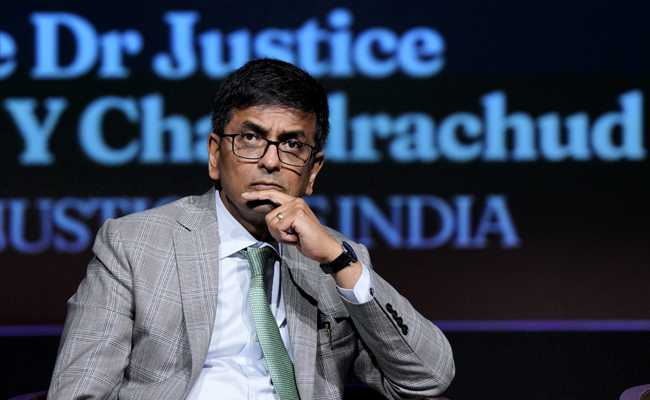
Bengaluru (PTI): Chief Justice of India D Y Chandrachud on Sunday said the trial judges prefer playing safe by not granting bail on important issues of crime when it is looked at with a degree of suspicion.
The Chief Justice underlined the need for a ‘sense of robust common sense’ to look at the nitty-gritty of each case.
"People who should be getting bail in the trial courts and not getting it there, as a result of which, they have to invariably move the high courts. People who should be getting bail in the high courts will not necessarily get it, as a result of which, they have to move to the Supreme Court. This delay compounds the problem of those who are facing arbitrary arrests," Justice Chandrachud said.
He was replying to a question at the end of a keynote address during the ‘11th Annual Conference of the Berkeley Centre on Comparative Equality and Anti-Discrimination'. The question was on the arbitrary arrests.
The questioner said we seem to live in a society where one acts first and seeks forgiveness later. This has become particularly true for public authorities acting in a politically motivated manner by detaining activists, academics, journalists and even politicians, including the chief ministers of opposition parties, he said.
According to him, all of these actions are taken with deep trust in the face of justice coming very slowly.
In reply, Justice Chandrachud said the Supreme Court has been constantly trying to convey that part of the reason for it is that there is an inherent distrust in the institutions within the country.
"I think it's important that we learn to trust people who may be in a hierarchical legal system, like much below, which are the trial courts. We have to encourage trial courts to be more receptive to the need for accommodating concerns of people who are seeking liberty," the CJI said.
"Unfortunately, the problem today is this, that we look at any grant of relief by trial judges with a degree of suspicion. That means that the trial judges increasingly are playing it safe, not granting bail on important issues of serious crimes," he explained.
According to the CJI, judges have to look at the nitty gritties and see the fine prints of each case.
"You (judges) have to have a sense of robust common sense. Now, unless we, therefore, separate the grains from the chaff in criminal jurisprudence, it's very unlikely that we will have just solutions and to allow for decision makers to separate the grain from the chaff, it's important that we also place a great deal of trust," Justice Chandrachud noted.
"I think that's my concern that you can’t render courts as in the hierarchy as you go up dysfunctional, just by the number of very small cases that are placed before us".
According to him, most of the cases should not have come to the Supreme Court at all.
"The reason why we are prioritising bail is to send this message across the nation that those at the most incipient levels of the decision-making process have to do their duties without this feeling that. I've been disgusted that my career will be on the line," the CJI underlined.
Let the Truth be known. If you read VB and like VB, please be a VB Supporter and Help us deliver the Truth to one and all.
JD(S) wants changes in certain provisions in One Nation-One Election proposal
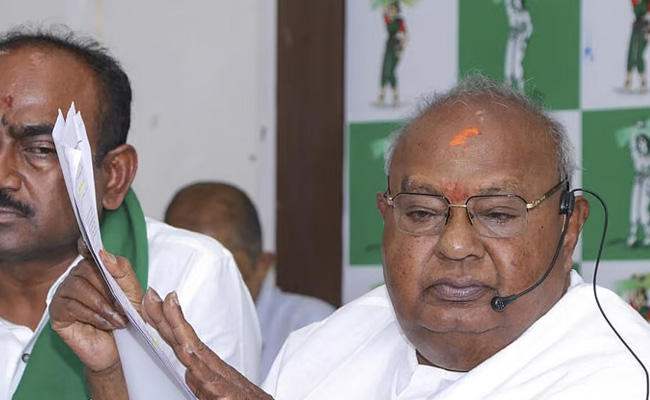
Bengaluru (PTI): The JD(S) has requested its ally BJP to make changes in certain provisions of the proposed 129th Constitutional Amendment Bill linked to the ONOE proposal, particularly the special powers proposed to be given to the ECI to recommend postponement of elections in any state.
The Parliamentary Joint Committee held discussions with political parties in Bengaluru on Saturday regarding the Constitution Amendment Bill connected to 'One Nation-One Election' and sought their suggestions and opinions.
The JD(S) said suitable amendments had been proposed to the provisions empowering the Election Commission of India to recommend to the President the deferment of state elections, while also seeking legal safeguards for the stability of coalition governments and protection for regional parties during simultaneous elections.
"With regard to the Bill, the JD(S) extended support to the Constitutional amendment with certain conditions and amendments, while suggesting safeguards to ensure that regional parties are not adversely affected by the aggressive election campaigns of national parties during simultaneous elections," the statement said.
The party stated that coalition governments have been formed and functioning at both the state and national levels for several decades in recent years, and "there is a need for legal protection to ensure their stability".
"Therefore, it also suggested incorporating legal safeguards for the stability of coalition governments in the proposed Constitutional amendment," the party, headed by former Prime Minister H D Deve Gowda, said.
The proposed Constitutional amendment grants special powers to the ECI to recommend to the President the postponement of elections in any state. Suitable amendments to these special powers have been proposed, the party said.
"On the above stated subjects, suitable submissions were made to the JPC," the party said in a statement, which has been posted on its 'X' handle.
According to the statement, the JD(S) delegation was led by M Mallesh Babu and included former MP D Kupendra Reddy, former Assembly Deputy Speaker M Krishna Reddy, former minister Venkatrao Nadagouda, MLA T N Javarayi Gowda, former MLA K A Tippeswamy and party legal cell president A P Ranganath.