Judicial independence must include freedom from AI influence: Justice Nagarathna
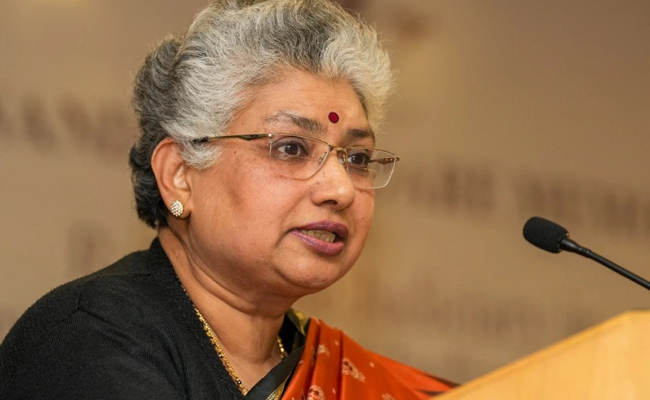
Bengaluru (PTI): Supreme Court judge Justice B V Nagarathna on Saturday said that judicial independence in the modern era is not just freedom from external power, but also freedom from algorithmic influence.
She said the future of justice cannot be shaped by Artificial Intelligence (AI) alone, but must be determined by judges—supported by tools, yet always guided by constitutional values, the rule of law, and a commitment to equity and fairness.
Justice Nagarathna was speaking at the 22nd Biennial State-Level Conference of Judicial Officers, themed 'Reimagining the Judiciary in the Era of Artificial Intelligence', organised by the Karnataka State Judicial Officers Association.
"The principle that must remain absolutely unchanged amid all this change is the rule of law. No matter how advanced technology becomes, the foundation of our judiciary cannot and must not shift," she said.
"The rule of law is not a technical concept; it is a moral and constitutional commitment that ensures fairness, equality, and accountability," she added.
Justice Nagarathna emphasised that, in this context, artificial intelligence must always remain on the periphery—as a tool, an aid, and a support system, but never the core of decision-making.
"The core must always be human judgment, guided by legal reasoning, constitutional values, and a deep sense of justice. If at any point technology begins to replace human judgment, we risk weakening the very institution of the judiciary that we are trying to strengthen," she said.
Chief Justice of India Surya Kant, Supreme Court Judge Aravind Kumar, and Chief Justice of the Karnataka High Court Vibhu Bakhru were among those present at the event.
Stating that AI must respect the experience, discretion, and role of judges as guardians of justice, she said that excessive reliance on AI could create a form of cognitive influence.
"AI poses a threat to human cognition by subtly shaping how we process information and make decisions. It can affect the cognitive autonomy of individuals," she said.
"Therefore, the classical idea of judicial independence must evolve to include independence from undue AI influence. This means ensuring that judges retain final control over reasoning and that the use of AI remains at the periphery at all times and at all stages," she added.
Judicial independence in the modern era is not just freedom from external power, but also freedom from algorithmic influence," she said.
At a broader level, Justice Nagarathna noted, AI can support the functioning of legal aid systems.
"In a system where delays and costs are major concerns, even small efficiency improvements can make a significant difference for litigants who often wait years—sometimes across generations—for resolution," she said.
"Justice involves empathy, compassion, context, and a deep understanding of human life. No machine can replicate that. Therefore, the principle must remain clear and non-negotiable: artificial intelligence can assist, but the judge must always decide," she said.
"Unlike other sectors, errors in the judicial system do not merely cause inconvenience; they can affect life, liberty, and dignity. Therefore, the introduction of AI into judicial processes must be approached with a deep sense of responsibility," she added.
Let the Truth be known. If you read VB and like VB, please be a VB Supporter and Help us deliver the Truth to one and all.
Case registered against associate film director for sexual assault of model in Kochi

Kochi (PTI): Police on Saturday said they had registered a case against an associate director in the film industry for "sexually assaulting" a model here.
The case was registered against Jojo Kurishinkal of Chengannur in Alappuzha district at the Maradu police station on May 6.
Kurishinkal has worked in several films as an assistant and associate director.
According to the FIR, the complainant, a model based in Kochi, met Kurishinkal through a dating app in July 2023.
The FIR stated that the accused told the complainant he was a film director and had separated from his wife before proposing marriage to her.
He later allegedly assured the complainant and her mother that he would go ahead with the marriage once the legal procedures related to his divorce were completed, the FIR said.
According to the FIR, the accused later invited the complainant to his apartment in Vyttila on April 18, 2024, where he "sexually assaulted" her.
The FIR further alleged that he continued to sexually harass the woman thereafter. It also stated that the accused had "physically assaulted" the complainant on multiple occasions before later refusing to marry her.
Based on the complaint, police registered a case under Section 376(2)(n) of the Indian Penal Code for repeatedly raping the same woman.
Police said the woman’s confidential statement would be recorded, following which the accused would be summoned for questioning.