Kalaburagi to be developed into smart city with Rs 1,685 cr investment: CM Siddaramaiah
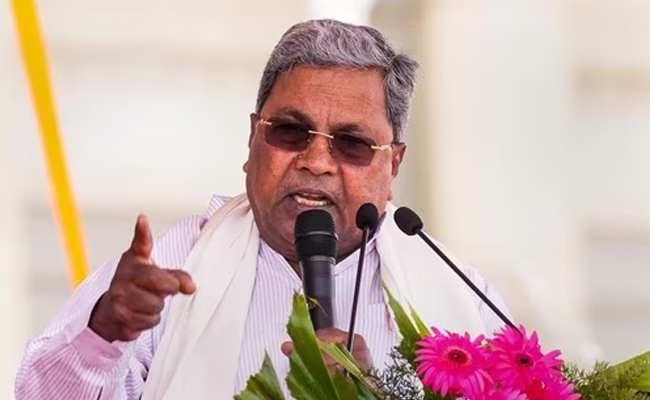
Kalaburagi (PTI): Karnataka Chief Minister Siddaramaiah on Tuesday said the state government is planning to develop Kalaburagi into a smart city with an estimated investment of Rs 1,685 crore, which will improve the quality of life for its residents and attract investment in backward districts.
Under the Mahatma Gandhi Nagar Vikas Yojana 2.0, Rs 200 crore each is being provided for basic infrastructure development in Kalaburagi and Ballari municipal corporations, he said.
The chief minister delivered his address on the occasion of 'Kalyana Karnataka Amrut Mahotsav' and the 10th anniversary of giving special status to Kalyana Karnataka under Article 371(J) of the Constitution after hoisting the national flag on the Police Parade Ground here.
He noted that though India gained independence in 1947, the districts of Bidar, Kalaburagi, and Raichur, under the rule of the Nizam of Hyderabad, secured freedom only a year later, adding, Kalyana Karnataka region joined the country due to the sacrifices of many freedom fighters, the "vision" of Jawaharlal Nehru, and the "strength" of Sardar Vallabhbhai Patel.
"I pay respect to all the great people who fought for the liberation of Kalyana Karnataka," the chief minister said.
A scheme called "Kalyana Patha" has been developed to improve road connectivity and rural development in the Kalyana Karnataka region, he said.
Under this, the state government will build 1,150 km of roads in rural Assembly constituencies at a cost of Rs 1,000 crore.
The government is ready to provide all necessary support to establish an AIIMS institute in Raichur. "We urge the Central government to take immediate steps to start AIIMS here," Siddaramaiah said.
For 2024-25, the State government aims to generate 4.85 crore person-days of work under the Mahatma Gandhi National Rural Employment Guarantee Scheme (MGNREGS) in the seven districts of this region. So far, 3.43 crore person-days have been generated, providing employment to 13.69 lakh people.
To develop tourism in the famous Anjanadri Hill and surrounding areas of Koppal district, Rs 100 crore will be provided, the chief minister said.
"In Ballari, we will organise unorganised jeans industries and develop a Jeans Apparel Park and Common Facility Centre to upgrade them to world-class standards," Siddaramaiah said.
In the 2024-25 budget, the government has allocated Rs 5,000 crore to the Kalyana Karnataka Development Board.
"This amount has been approved for development projects in the region, and we expect a new phase of progress," the chief minister said.
A committee led by Professor Govind Rao has been formed to study the economic and social changes in the region and suggest ways to reduce inequalities, he added.
Let the Truth be known. If you read VB and like VB, please be a VB Supporter and Help us deliver the Truth to one and all.
Judiciary needs to function like 24x7 hospitals to address common man's pain, aspirations: CJI

Jabalpur (PTI): Chief Justice of India (CJI) Surya Kant on Saturday said it was time for the judiciary to address the pain and aspirations of the common man through an immediate relief-giving mechanism, and stressed the need for the judicial system to function like hospitals that work round-the-clock.
He said technology was the only effective answer to wastage of judiciary's time, and called for deepening technology and artificial intelligence (AI)-based judicial architecture to expedite justice delivery.
The CJI was speaking at a programme organised by the Madhya Pradesh High Court on "Fragmentation to fusion, Empowering justice via united digital platform integration". He also launched the high court's newly-developed digital platforms.
"Indian judiciary is committed to ensuring optimum utilisation of not only technological advancements that have been going on and which are integral part of our system since 1990, but also of latest AI designs and how we can use them for the benefit of the common man," he said.
"We should think of deepening technology and AI-based judicial architecture. Technology is the only effective answer to wasting judicial time," CJI Kant said.
The time has come when the judiciary needs to address the aspirations, requirements, demands, pain and agony of the common man through an immediate relief-giving system, he said.
"For that, the judiciary needs to work like hospitals that function 24x7," he added.
Recalling the COVID-19 pandemic, the CJI said the Indian judiciary was praised globally for discharging its constitutional duties during difficult times.
"We did not close our courts," he said, elaborating on how technology enabled courts to conduct urgent hearings during the pandemic.
He stressed the need to make use of technological advancements in judiciary for expediting the justice delivery system.
Praising Madhya Pradesh HC for developing digital platforms, the CJI said that as stated by the Union Minister of State for Law and Justice Arjun Ram Meghwal, there was a need to roll out these technological advancements at the pan-India level.
A committee has been constituted by the Supreme Court on how to use AI for the benefit of the judicial system, especially in speedy disposal of cases, according to him.
Minister Meghwal, Madhya Pradesh Chief Minister Mohan Yadav and MP High Court Chief Justice Sanjeev Sabharwal also spoke on the occasion.